

Singapore is the most humid country in the world by dew point if you want the clearest single answer. It combines very high moisture levels with very little seasonal relief, which is why the air often feels sticky the moment you step outside. If you want a broader comparison, our ranked table of the most humid countries in the world covers the wider field too.
There is a bit of nuance. Qatar can hit even more extreme peaks during late summer, and Saudi Arabia holds the all-time dew point record at Dhahran. But for persistent, year-round mugginess, Singapore is the name that comes up again and again.
If you are trying to work out where humidity is worst, the key is to look past the percentage on a weather app. Dew point is the metric that best matches how oppressive the air feels, especially in tropical cities such as Singapore, Kuala Lumpur, Jakarta, Palembang, and Manaus.
Quick answer (checked October 2026):
- Most humid country: Singapore, with an average dew point of 75.0°F (23.9°C), level with Palau, Micronesia and Tuvalu in our ranking of 197 countries.
- Most humid country with a big population: the Philippines (73.2°F), just ahead of Malaysia (73.0°F).
- Highest average relative humidity: Equatorial Guinea, at 87.5%.
- Most humid month in any country: August in Bahrain, when the average dew point reaches about 80.9°F (27.2°C).
- Most humid cities: Singapore and Bandar Seri Begawan in Brunei, both averaging a dew point of about 76°F (24.7°C) between 2016 and 2025.
- Highest dew point on record: 95°F (35°C) at Dhahran, Saudi Arabia, on 8 July 2003.
What Counts As “Most Humid”?
Humidity gets measured in a few different ways, and that is where a lot of list articles go sideways. Relative humidity is temperature-dependent, so it can show 100% on a cool morning without feeling especially miserable. Dew point is much more useful for comparing one place with another.
Dew point measures how much moisture is actually in the air. The higher it gets, the harder it is for sweat to evaporate, which is why a hot day with a high dew point feels far more draining than a dry one. As a rough comfort guide, a dew point above 70°F feels uncomfortable to many people. Above 80°F feels oppressive.
For background on how surface water vapour and climatological normals are tracked, the World Meteorological Organization’s surface water vapour overview and WMO climatological normals guidance are useful references. For city-level climate patterns, many readers also compare station summaries from WeatherSpark.
Quick Answer: The World’s Most Humid Countries

This list blends high dew point patterns with the countries that repeatedly show up in humid-climate rankings and city records. It is best read as a practical guide to places where the air often feels heavy, not as a perfect one-to-twenty scientific league table.
| Country | Representative City Or Area | What Stands Out |
|---|---|---|
| Singapore | Singapore | Most consistent year-round humidity, with dew points averaging about 76°F (24.7°C) at Changi and average relative humidity around 84% |
| Qatar | Doha, Pearl-Qatar | Extreme seasonal peaks, touching about 89°F (32°C) in August when Gulf moisture piles in |
| Indonesia | Palembang, Jakarta | Palembang averages around 76°F year-round; Jakarta is regularly very muggy, especially in the wet season |
| Malaysia | Kuala Lumpur | High dew points through the year, with around 78°F in May and frequent thunderstorm build-up |
| Brazil | Manaus | Amazon Basin humidity with about 74°F on average and little real drying-out |
| Saudi Arabia | Dhahran | All-time dew point record of 95°F in 2003 |
| Papua New Guinea | Coastal lowlands | Often listed near the top on average relative humidity, commonly near or above 80% |
| Brunei | Bandar Seri Begawan | Equatorial climate with consistently high moisture and very little seasonal change |
| Liberia | Monrovia | West African coast with very humid tropical conditions and a long wet season |
| Myanmar | Sittwe | Bay of Bengal influence and persistently sticky wet-season air |
| Thailand | Bangkok | High heat plus humidity, especially in the monsoon months and pre-rainy-season buildup |
| Vietnam | Ho Chi Minh City | Tropical wet-dry pattern with long humid stretches and little cool-season relief |
| Philippines | Manila | Monsoon and typhoon climate keeps the air damp for much of the year |
| Maldives | Malé | Warm Indian Ocean setting with year-round maritime humidity |
| Colombia | Caribbean and lowland tropical zones | Very humid low-elevation areas near coast and rainforest |
| Nigeria | Lagos, Niger Delta | Coastal tropical humidity and moisture-heavy rainy season |
| Costa Rica | Caribbean coast and lowlands | Humid tropical air, especially outside the higher elevations |
| Trinidad and Tobago | Port of Spain | Warm Caribbean climate with persistent moisture |
| Eritrea | Red Sea coast | One of the world’s more extreme humidity zones in season, especially when sea temperatures climb |
| India | Eastern and coastal cities | Several cities post very high humidity during monsoon periods, especially Kolkata, Chennai, and Mumbai |
Most Humid Countries in the World Ranked by Dew Point
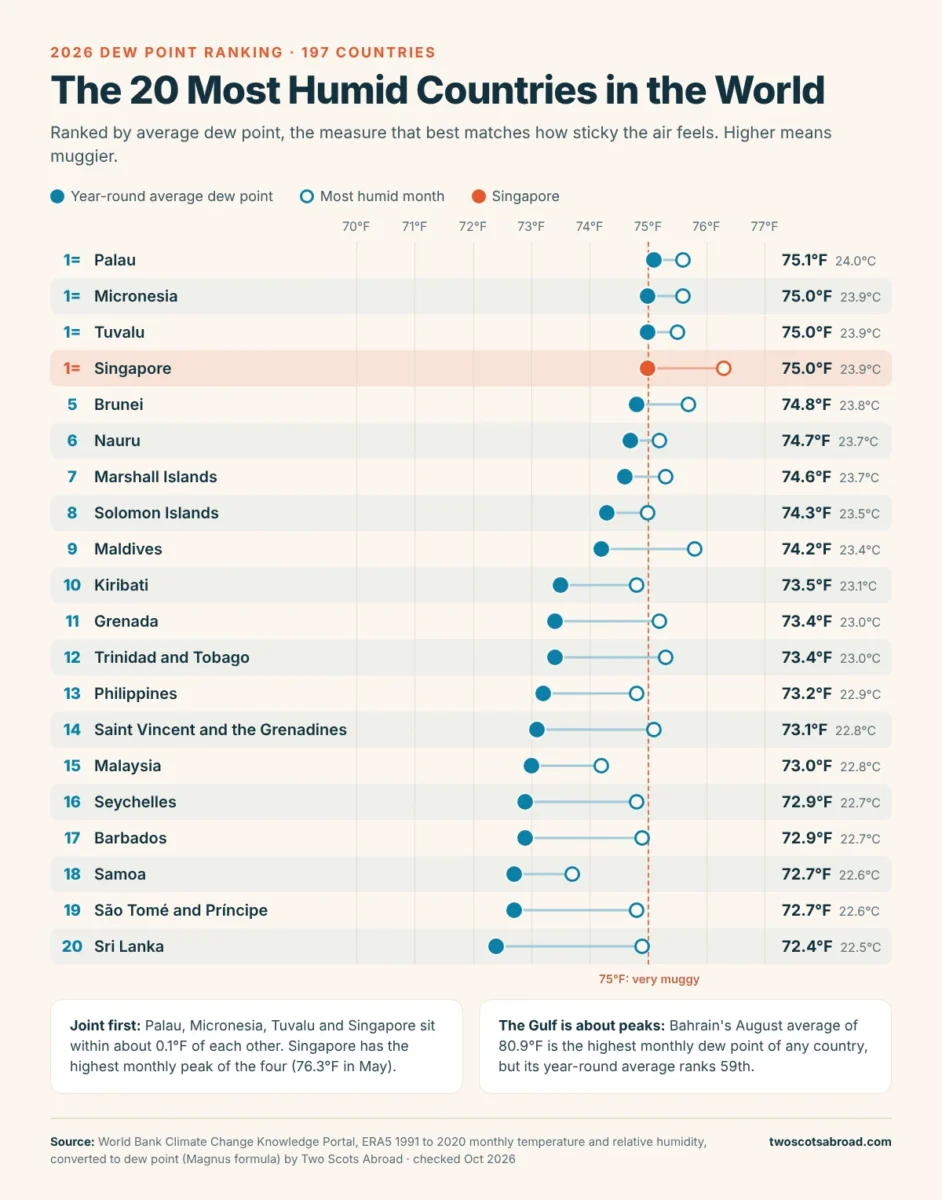
Want the actual league table? Here it is. We ranked 197 countries by average dew point, using the same climate data for every one of them, so the comparison is like for like.
How we ranked them: we took each country’s average monthly temperature and relative humidity for the 1991 to 2020 climate normal period from the World Bank’s Climate Change Knowledge Portal, which is built on the ERA5 reanalysis from Copernicus and ECMWF. We converted every month to a dew point with the Magnus formula, then averaged the twelve months. Dependent territories such as Hong Kong, Puerto Rico and Guam are left out, and differences of a few tenths of a degree are best read as a tie.
| Rank | Country | Average dew point | Most humid month | Average relative humidity |
|---|---|---|---|---|
| 1= | Palau | 75.1°F (24.0°C) | November (75.6°F) | 82.9% |
| 1= | Micronesia (Federated States of) | 75.0°F (23.9°C) | May (75.6°F) | 82.7% |
| 1= | Tuvalu | 75.0°F (23.9°C) | May (75.5°F) | 81.2% |
| 1= | Singapore | 75.0°F (23.9°C) | May (76.3°F) | 83.0% |
| 5 | Brunei | 74.8°F (23.8°C) | May (75.7°F) | 85.8% |
| 6 | Nauru | 74.7°F (23.7°C) | April (75.2°F) | 80.6% |
| 7 | Marshall Islands | 74.6°F (23.7°C) | June (75.3°F) | 82.0% |
| 8 | Solomon Islands | 74.3°F (23.5°C) | February (75.0°F) | 85.5% |
| 9 | Maldives | 74.2°F (23.4°C) | May (75.8°F) | 79.7% |
| 10 | Kiribati | 73.5°F (23.1°C) | April (74.8°F) | 79.9% |
| 11 | Grenada | 73.4°F (23.0°C) | September (75.2°F) | 81.1% |
| 12 | Trinidad and Tobago | 73.4°F (23.0°C) | September (75.3°F) | 82.1% |
| 13 | Philippines | 73.2°F (22.9°C) | June (74.8°F) | 83.6% |
| 14 | Saint Vincent and the Grenadines | 73.1°F (22.8°C) | September (75.1°F) | 80.7% |
| 15 | Malaysia | 73.0°F (22.8°C) | May (74.2°F) | 84.8% |
| 16 | Seychelles | 72.9°F (22.7°C) | April (74.8°F) | 80.8% |
| 17 | Barbados | 72.9°F (22.7°C) | September (74.9°F) | 80.0% |
| 18 | Samoa | 72.7°F (22.6°C) | April (73.7°F) | 84.2% |
| 19 | São Tomé and Príncipe | 72.7°F (22.6°C) | March (74.8°F) | 83.0% |
| 20 | Sri Lanka | 72.4°F (22.5°C) | May (74.9°F) | 78.2% |
| 21 | Indonesia | 72.4°F (22.4°C) | April (73.4°F) | 84.8% |
| 22 | Cambodia | 72.3°F (22.4°C) | May (76.1°F) | 74.6% |
| 23 | Saint Kitts and Nevis | 72.3°F (22.4°C) | August (75.0°F) | 79.7% |
| 24 | Panama | 72.2°F (22.3°C) | June (73.7°F) | 85.3% |
| 25 | Liberia | 72.2°F (22.3°C) | April (74.0°F) | 84.9% |
A few things jump out:
- The top four are a dead heat. Palau, Micronesia, Tuvalu and Singapore are separated by about 0.1°F, which is well inside the margin of the data. Singapore gets our nod because it has the highest monthly peak of the four (76.3°F in May) and the highest relative humidity (83.0%).
- Small, ocean-wrapped countries dominate. 20 of the top 25 are island nations, because warm seas on every side keep feeding moisture into the air.
- Big countries get diluted. Country averages include mountains, plateaus and dry interiors, which is why Brazil (68.8°F), Colombia (69.8°F) and India (61.8°F) sit lower than their stickiest cities would suggest.
- The Gulf is about peaks, not averages. Qatar averages 62.0°F and ranks 84th, but Bahrain’s August average of 80.9°F is the highest monthly dew point of any country in the dataset, ahead of Bangladesh in August (78.5°F).
If you are reading this in the US, the national average is dragged down to 37.4°F by mountains and deserts, but the Gulf Coast is a different story. Our guide to the most humid places in the USA covers the stickiest cities and states.
Which Country Is the Most Humid in the World?
Singapore is the strongest all-around answer. It sits almost on the equator, has a tropical rainforest climate, and does not get a real dry season that would give you a proper break. In practice, that means the city-state stays muggy month after month.
The numbers behind that reputation are pretty blunt. Singapore’s dew point averages about 76°F (24.7°C) at Changi, peaks at around 78°F in May, and stayed at 70°F or above on virtually every day between 2016 and 2025. Daily temperatures in Singapore also tend to run around 30 to 32°C most afternoons, so the air rarely gets much help from a cooler spell.
If your personal definition of worst humidity is the highest spike ever felt by humans in a built-up place, then Qatar enters the chat. Dew points around Doha and Pearl-Qatar have touched about 89°F (32°C) on the worst August days, and the wider Persian Gulf is famous for short periods of brutal, sauna-like air.
For the single highest dew point ever recorded, Dhahran in Saudi Arabia reached 95°F in 2003. That is an atmospheric outlier, not a year-round norm, but it belongs in the conversation whenever people ask about the most humid place on Earth.
The Muggiest Countries and Cities in Real Life
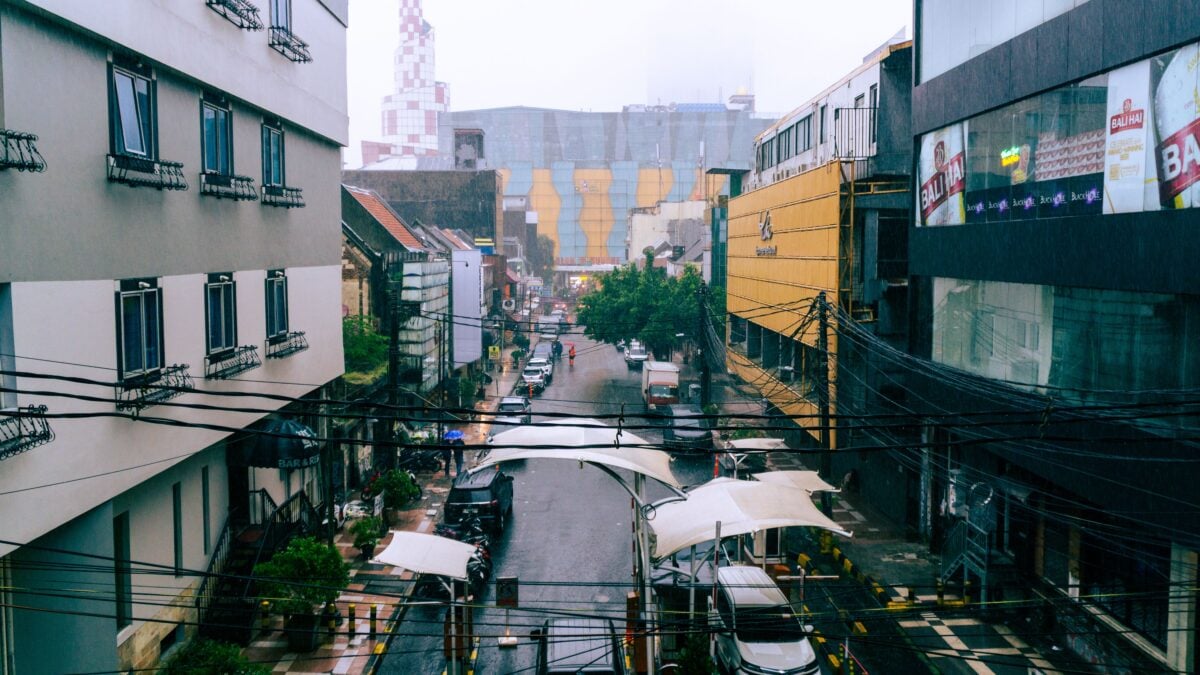
Country averages only tell part of the story, because you do not experience a country, you experience a city. Here is how the big humid cities compare on the same measure, using a decade of hourly data.
| City | Country | Average dew point | Days a year averaging 70°F or more | Highest hourly dew point |
|---|---|---|---|---|
| Bandar Seri Begawan | Brunei | 76.4°F (24.7°C) | 365 | 84.6°F (29.2°C) |
| Singapore (Changi) | Singapore | 76.4°F (24.7°C) | 365 | 84.0°F (28.9°C) |
| Kuala Lumpur | Malaysia | 76.3°F (24.6°C) | 364 | 85.3°F (29.6°C) |
| Lagos | Nigeria | 75.9°F (24.4°C) | 358 | 82.6°F (28.1°C) |
| Monrovia | Liberia | 75.7°F (24.3°C) | 365 | 83.3°F (28.5°C) |
| Palembang | Indonesia | 75.6°F (24.2°C) | 360 | 82.8°F (28.2°C) |
| Koror | Palau | 75.5°F (24.1°C) | 365 | 79.2°F (26.2°C) |
| Colombo | Sri Lanka | 75.3°F (24.1°C) | 344 | 84.2°F (29.0°C) |
| Ho Chi Minh City | Vietnam | 75.2°F (24.0°C) | 335 | 83.3°F (28.5°C) |
| Chennai | India | 75.0°F (23.9°C) | 330 | 84.7°F (29.3°C) |
| Belém | Brazil | 74.8°F (23.8°C) | 365 | 81.3°F (27.4°C) |
| Manila | Philippines | 74.7°F (23.7°C) | 341 | 82.0°F (27.8°C) |
| Bangkok | Thailand | 74.7°F (23.7°C) | 313 | 83.3°F (28.5°C) |
| Malé | Maldives | 74.6°F (23.7°C) | 362 | 79.5°F (26.4°C) |
| Jakarta | Indonesia | 74.5°F (23.6°C) | 355 | 80.4°F (26.9°C) |
| Manaus | Brazil | 74.4°F (23.5°C) | 360 | 81.7°F (27.6°C) |
| Port of Spain | Trinidad and Tobago | 73.3°F (23.0°C) | 346 | 79.2°F (26.2°C) |
| Kolkata | India | 72.2°F (22.3°C) | 238 | 86.2°F (30.1°C) |
| Mumbai | India | 71.9°F (22.1°C) | 236 | 82.8°F (28.2°C) |
| Dhaka | Bangladesh | 71.6°F (22.0°C) | 230 | 85.8°F (29.9°C) |
| Manama | Bahrain | 68.9°F (20.5°C) | 182 | 89.2°F (31.8°C) |
| Doha | Qatar | 64.0°F (17.8°C) | 106 | 89.4°F (31.9°C) |
| Dhahran | Saudi Arabia | 57.1°F (13.9°C) | 48 | 90.7°F (32.6°C) |
Singapore and Bandar Seri Begawan finish level at the top, and both averaged a dew point of 70°F or more on virtually every day of the year. The Gulf cities are the opposite: drier on average, but they own the highest single readings in the table.
Singapore
Singapore is the benchmark for nonstop humidity. You can plan around rain showers, but not around the moisture in the air. If you are walking in Marina Bay, Chinatown, or around Orchard Road, the feeling is usually the same: a few minutes outdoors and your shirt starts negotiating terms.
That consistency is what puts Singapore ahead of many rivals. Plenty of places get very humid for part of the year. Singapore stays humid almost all the time. Afternoon temperatures were sitting around the low 30s°C in recent live readings (as of July 2026), which is exactly the sort of weather that makes short, air-conditioned breaks feel less like luxury and more like planning.
If you are planning a trip, our Singapore humidity guide picks the least sticky months, with February to April usually the most comfortable.
Qatar
Qatar is a different kind of humid. For much of the year, it is known more for heat and dryness, but along the coast and around Pearl-Qatar, late summer can produce some of the highest dew points on the planet.
July to October is the rough window, with August standing out for peak discomfort. Overnight lows in Doha can stay around 30°C or higher in late summer, so even evening walks may feel like somebody left the steam room door open.
Heat and humidity are not the same contest, mind you. If raw temperature is your bigger worry, our ranking of the hottest countries in the world covers that side of the Gulf summer.
Indonesia
Palembang is one of the strongest city-level cases anywhere, with dew points averaging about 76°F (24.2°C) through the year. That is elite-level stickiness. Jakarta is also repeatedly cited as a very humid city, with many days pushing relative humidity well above 80%.
Indonesia’s geography does a lot of the work here. Thousands of islands, warm seas, tropical rainfall, and equatorial heat all keep moisture hanging in the air. If you are comparing equatorial climates, it belongs in the same conversation as countries shaped by very different coastlines, because here the surrounding water is a major part of the problem.
Malaysia
Kuala Lumpur is another city that never really lets you forget where you are. May dew points averaging around 78°F (25.5°C) put it firmly in the same oppressive club as Singapore and parts of Indonesia.
The difference is not that Kuala Lumpur is comfortable. It is that Singapore is even more relentlessly consistent. This is a game of unpleasantly small margins. In Kuala Lumpur, frequent late-day storms can break the heat a little, but they usually leave the air feeling even thicker afterwards.
Brazil
Manaus, deep in the Amazon, is humid in a way that feels almost biological. Dew points averaging about 74°F (23.5°C) year-round show just how moisture-heavy the central Amazon atmosphere can get.
If you have ever stepped off a plane into Manaus, you know the sensation. The air does not just feel warm. It feels occupied. Daytime temperatures commonly climb above 31°C, and the combination of rainforest moisture and urban heat means even short walks can feel longer than they are.
Other Very Humid Countries That Belong On the List
After the headline names, there is a larger group of countries that regularly appear in humid-climate comparisons or have major cities known for sticky conditions.
- Papua New Guinea is often cited with average relative humidity around 80%, especially in its coastal lowlands.
- Brunei has a classic equatorial climate with heavy moisture and little relief.
- Liberia sits on the humid West African coast and stays muggy for long stretches.
- Myanmar, especially around Sittwe, gets persistent moisture from the Bay of Bengal.
- Thailand and Vietnam combine tropical heat with long monsoon seasons, so cities such as Bangkok and Ho Chi Minh City can feel extremely sticky. Our guide to the best time to visit Southeast Asia to avoid humidity breaks down the least sticky months by country.
- The Philippines, especially Manila, deals with both monsoon humidity and typhoon-season moisture.
- The Maldives has warm, ocean-driven humidity all year.
- Colombia has very humid tropical lowlands, especially outside the cooler Andean zones.
- Nigeria, particularly Lagos and the Niger Delta, gets heavy coastal humidity.
- Costa Rica and Trinidad and Tobago are both strong examples of humid tropical air outside higher elevations.
These places are not interchangeable. Some are humid because of equatorial rainforest, some because of warm enclosed seas, and some because monsoon systems keep moisture levels high for months at a time. That is part of why two countries can feel equally sticky for totally different reasons. Plenty of them also appear in our list of the rainiest countries in the world, which is no coincidence.
Dew Point Vs. Relative Humidity
If you only remember one thing, make it this: a high relative humidity percentage does not always mean the air will feel worst. Dew point is usually the better guide to actual discomfort.
Cold air cannot hold much moisture, so 100% relative humidity on a cool morning can feel fine. Hot tropical air can feel awful even at a lower percentage because it is carrying far more water vapour. That is why weather apps can mislead people who are trying to compare countries.
Here is the best example we found. Ireland averages 83.1% relative humidity, a touch higher than Singapore’s 83.0%, and ranks 15th in the world on that measure. Its average dew point, though, is just 44.8°F (7.1°C), against Singapore’s 75.0°F. Anyone who has spent a drizzly week in Galway or Glasgow knows damp and muggy are not the same thing.
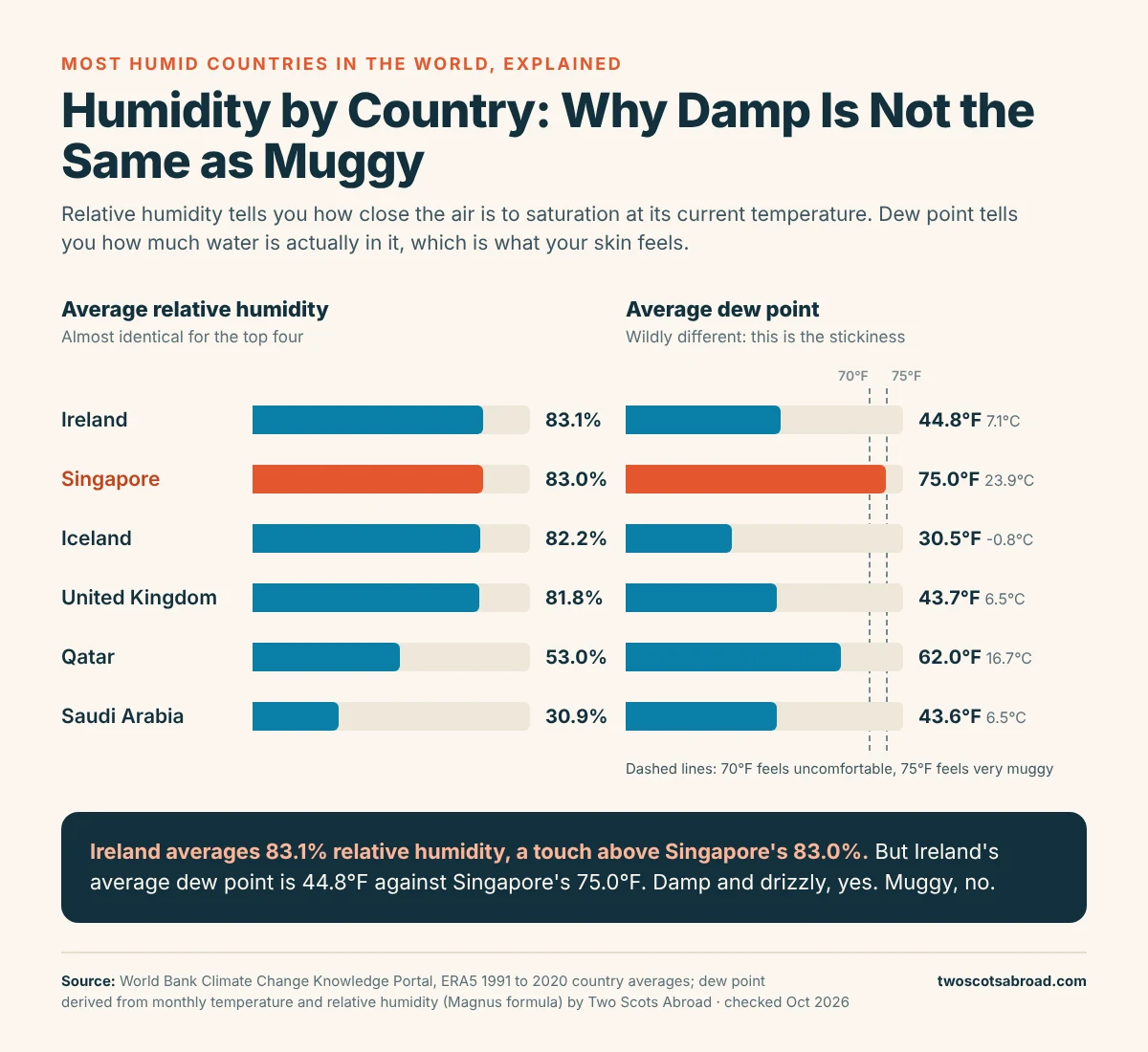
For practical trip planning, watch the dew point if the data is available. Above 70°F gets uncomfortable. Above 75°F feels very muggy. Above 80°F is oppressive. If your weather app only shows humidity percentage, check the “feels like” temperature as a rough backup, though it is still less precise.
Countries With the Highest Relative Humidity
If you do want the relative humidity ranking, here are the top 10 by annual average, with dew point alongside so you can see which ones actually feel sticky.
| Rank | Country | Average relative humidity | Average dew point |
|---|---|---|---|
| 1 | Equatorial Guinea | 87.5% | 70.9°F (21.6°C) |
| 2 | Papua New Guinea | 86.6% | 70.0°F (21.1°C) |
| 3 | Brunei | 85.8% | 74.8°F (23.8°C) |
| 4 | Ecuador | 85.7% | 64.6°F (18.1°C) |
| 5 | Solomon Islands | 85.5% | 74.3°F (23.5°C) |
| 6 | Panama | 85.3% | 72.2°F (22.3°C) |
| 7 | Liberia | 84.9% | 72.2°F (22.3°C) |
| 8 | Indonesia | 84.8% | 72.4°F (22.4°C) |
| 9 | Malaysia | 84.8% | 73.0°F (22.8°C) |
| 10 | Costa Rica | 84.5% | 68.5°F (20.3°C) |
What Is the Most Humid Place on Earth?
That depends on whether you mean the most consistently humid place or the highest humidity ever recorded.
- Most consistently humid country: Singapore
- Most extreme seasonal urban humidity: the Persian Gulf coast, including Bahrain and parts of Qatar around Pearl-Qatar
- Most humid month in any country: August in Bahrain, with an average dew point of about 80.9°F (27.2°C)
- Highest recorded dew point: Dhahran, Saudi Arabia, at 95°F in 2003
- Other extreme humidity zones: the Persian Gulf coast and parts of the Red Sea coast, including Eritrea
- Most dangerous humid heat: climate researchers have found that some coastal subtropical weather stations have already reported a 35°C wet-bulb temperature, the theoretical limit of human tolerance, for one to two hours at a time
That is why different answers float around online. They are often talking about different definitions of humid. Some lists also lean on annual relative humidity averages, which can elevate cloudy or rainy places that do not necessarily feel as punishing as a tropical city with a brutal dew point.
The record may already have been beaten. On 16 July 2023, Persian Gulf International Airport in southern Iran logged a dew point of 90°F (32°C) and a heat index of 152°F (66.7°C). In late August 2024, a station near Dayrestan Airport on Iran’s Qeshm Island reported a dew point of 97°F (36.1°C), which would beat Dhahran, but the reading has not been verified and meteorologists were quick to urge caution.
Meteorologist Jeff Berardelli summed up the reaction on X at the time:
So for now, Dhahran’s 2003 reading is still the number most sources quote, although climate researchers treat even that as an unofficial reference value rather than a fully validated record.
How To Travel in Extremely Humid Countries Without Melting
If you are headed to one of these places, the good news is that people live, work, and go about daily life in them just fine. The less good news is that your usual cool-weather dignity may leave first.
- Plan outdoor walks early or late. Midday heat plus high dew point is the roughest combination.
- Use indoor breaks strategically. In cities like Singapore, Kuala Lumpur, and Manila, malls, metro stations, and museums can be part climate shelter, part sightseeing stop.
- Choose lighter fabrics. Cotton is comfortable for short wear, but many people prefer quick-dry clothing in tropical cities.
- Hydrate more than you think you need. Humid heat can feel less dramatic than desert heat, but it still drains you. If you are sweating through a long day outdoors, an electrolyte drink helps replace the salts that water alone does not.
- Accept that laundry dries slower. In very humid climates, this is not user error. It is physics being annoying.
A quick-dry shirt is worth packing for tropical cities.

We earn a commission if you buy through this link, at no extra cost to you.

Ultima Replenisher
We earn a commission if you buy through this link, at no extra cost to you.
If you do head out at midday, a cooling towel or small handheld fan takes the edge off.

We earn a commission if you buy through this link, at no extra cost to you.
If you already plan trips around weather windows, you might also like comparing this with destination-specific guides such as St Lucia weather in April or more hiking-focused reads like Ben Ledi weather in August. Same planning habit, very different kind of sweating.
If all of this has you craving drier air, our picks of the countries with the best weather year-round are a good place to start. For a near guarantee of blue skies, the sunniest places in the world are the other way to go.
FAQ: The World’s Most Humid Countries
Which country has the highest humidity in the world?
Singapore is the best single answer when humidity is measured by dew point and judged across the whole year. It stays oppressively humid with very little seasonal relief.
Is Singapore the most humid country in the world?
Effectively, yes. Singapore averages a dew point of about 75.0°F (23.9°C), tied with Palau, Micronesia and Tuvalu to within 0.1°F, and it has the highest monthly peak and the highest relative humidity of that group.
What is the most humid place on Earth?
Dhahran in Saudi Arabia holds the highest recorded dew point at 95°F in 2003. For places that are humid most of the time, Singapore and parts of Indonesia are stronger examples.
Is Qatar more humid than Singapore?
Qatar can reach higher short-term peaks, especially around the Persian Gulf in late summer. Singapore is more consistently humid across the entire year.
Why use dew point instead of relative humidity?
Dew point is more comparable from place to place because it measures the actual moisture in the air. Relative humidity changes with temperature and can be misleading on its own.
Which cities feel the most humid?
Singapore, Kuala Lumpur, Palembang, Jakarta, and Manaus are among the standout examples based on the climate patterns and figures discussed here.
What is the most humid city in the world?
Singapore and Bandar Seri Begawan in Brunei share the top spot in our 2016 to 2025 data, both averaging a dew point of about 76°F (24.7°C), with Kuala Lumpur a whisker behind.
Which country has the highest relative humidity?
Equatorial Guinea, at 87.5% on average, followed by Papua New Guinea (86.6%) and Brunei (85.8%). On its own, though, relative humidity is a poor guide to stickiness: Ireland averages 83.1%.
Final Word
If your question is simple, the answer can be simple too: Singapore is the world’s most humid country if you care about the place that feels sticky most consistently. If you care about brief but monstrous peaks, look to Qatar and the Persian Gulf. If you care about the all-time atmospheric record, that goes to Dhahran in Saudi Arabia.
And if you are planning a trip to any of them, pack light, walk slower, and make peace with the fact that some climates do not do crisp and refreshing. They do glossy.