
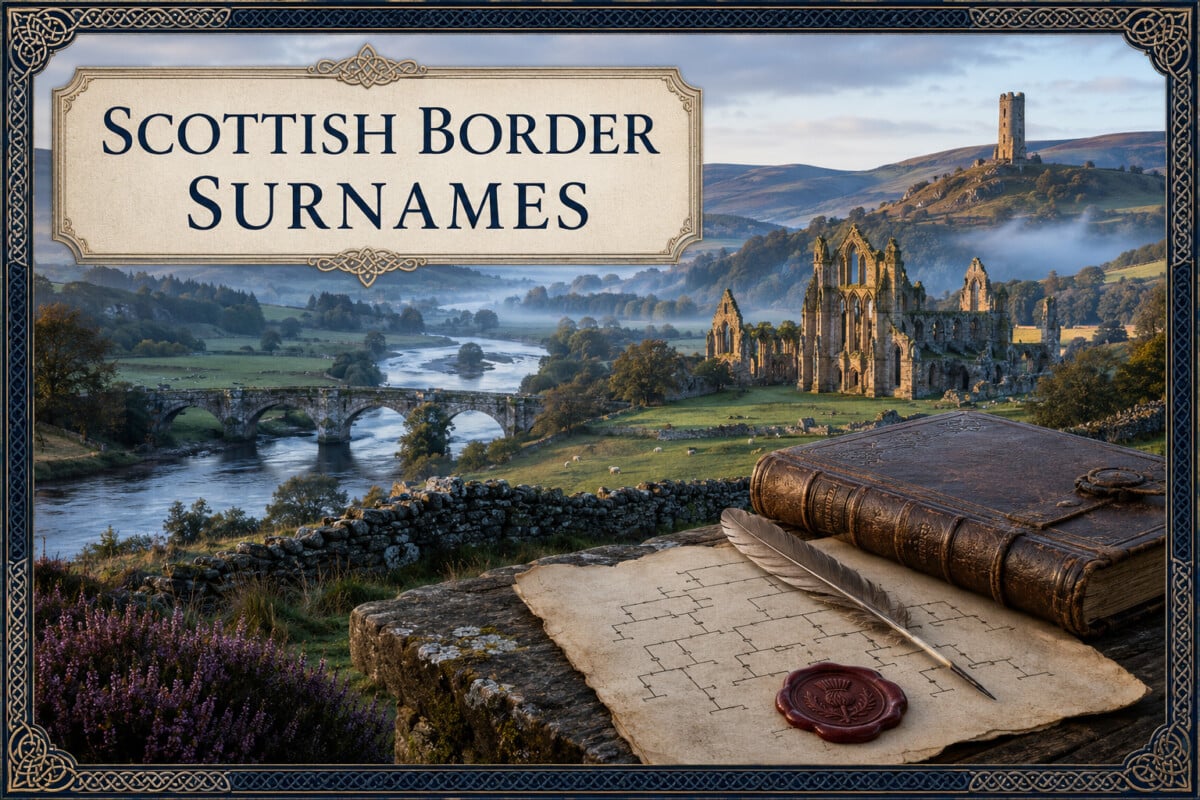
Scottish Border surnames such as Armstrong, Elliot, Graham, Scott, Kerr, Maxwell and Johnstone are closely associated with the Anglo-Scottish frontier and the kin-based riding families known as the Border Reivers. A surname alone cannot prove descent, but it can point a family historian towards particular valleys, parishes and cross-border records.
These names carry a history that is more complicated than Scotland versus England. For centuries, people on both sides of the line made alliances through kinship, marriage, protection and rivalry, often putting the interests of their own surname ahead of national loyalty.
The Scottish Borders remain a useful starting point for this story, especially around Hawick, Teviotdale and the valleys running towards England. The past can be dramatic, but the paperwork is usually less so. That is part of the charm.
What Makes a Surname a Scottish Border Name?
A Border surname is a family name historically found in the contested country along the Anglo-Scottish border, particularly in what became the Scottish Borders and Northumberland. Many became prominent between the 12th century and the end of the 16th century, when the frontier was divided administratively into East, Middle and West Marches.
The Marches were supervised by wardens, but daily security depended heavily on extended families and local alliances. Raids for livestock and goods, retaliatory attacks, feuds and protection arrangements all flourished in a region repeatedly disrupted by war between the two crowns.
The term “Border Reiver” is generally used for the raiding families active in this frontier world. It should not be treated as a hereditary certificate of criminality. Plenty of people bearing the same surnames were farmers, tenants, officials, clergy and neighbours trying to get through a difficult political landscape.
How Border Reiver Families Worked
Border families were often called riding clans because mounted men could move quickly through rough country. They were not Highland clans of Gaelic origin, even though both systems placed enormous importance on kin and leadership. A Border group commonly shared a surname, a local territory and loyalty to a leading branch or chief.
Family networks crossed the border with little regard for neat modern categories. Armstrong, Graham and Hall are among the surnames found on both the Scottish and English sides. A feud could therefore unite an English branch with a Scottish branch against another neighbour, which makes any simple national reading of the period unreliable.
Names also shift in surviving records. Elliot may appear as Elliott, while Crozier can occur as Crosar or Croser. Spelling was not fixed in the way it is on a modern passport, so researchers should search variants before deciding a line has disappeared.
Famous Scottish Border Surnames and Their Associations
Several names appear repeatedly in accounts of the frontier. Their prominence reflects local influence and surviving tradition, not a guarantee that every person with the name belonged to a single unified family.
| Surname | Border Association | Useful Research Note |
|---|---|---|
| Armstrong | Strongly associated with the western frontier and with branches active in the Scottish East March and English West March. | Search both Scottish and Northumberland records, especially when a line seems to cross the border abruptly. |
| Elliot or Elliott | A major Scottish riding family, often linked in Border tradition with Armstrong and other Teviotdale groups. | Use both Elliot and Elliott in catalogues and indexes. |
| Graham | Found on both sides of the frontier, making it a good example of a surname that cannot be assigned to one nation alone. | Pin down a parish and occupation before connecting distant Graham lines. |
| Scott | One of the best-known Border surnames, with the Scotts of Buccleuch especially embedded in Borders history. | Separate local Scott families by place, dates and witnesses in records. |
| Kerr | Particularly associated with the Scottish Borders and prominent in Border political and family networks. | Look for spelling variants including Ker in older documents. |
| Maxwell | A leading Border name with major influence in the western March country. | Do not assume every Maxwell line descends from one elite branch. |
Armstrong
The Armstrongs are perhaps the surname most readily associated with the Border Reivers. Border tradition places them across the English West March and Scottish East March, a reminder that their sphere did not stop at the political boundary. Accounts of the family include figures remembered by colourful bynames, including Johnnie Armstrong and Kinmont Willie Armstrong.
For genealogy, the important point is geographic: a possible Armstrong connection may lead into records on both sides of the frontier. A Scottish baptism in one generation and an English marriage in the next is not automatically a mistake.
Elliot or Elliott
The Elliots were a Scottish Border family, often associated with the Teviotdale area and frequently allied with Armstrong interests in traditional accounts. Their surname is still familiar throughout the Borders, while Elliott is a widespread spelling elsewhere in Britain and beyond.
Do not let an extra “t” derail a search. Parish clerks, census enumerators and later indexers did not always use one consistent form, and a family could appear under both spellings in a relatively short run of records.
Graham, Scott and Kerr
The Grahams demonstrate the cross-border nature of reiving society. Graham families appear in Scottish and English Border history, and their alliances could change according to local circumstance. Broad family labels were useful in a feud, but they do not replace the details of a particular household.
The Scotts are closely identified with the Scottish Borders, including the powerful Scotts of Buccleuch. Scott is also an extremely common surname, so a claimed connection needs documentary proof. A coat of arms, a family story or a tartan shop certificate is not enough to bridge generations.
Kerr is another established Borders name. The name is sometimes linked with the Gaelic word cearr, meaning left-handed, though surname origins can be layered and disputed. In practical research, Kerr and Ker should be treated as essential search companions.
Other Prominent Border Family Names
A fuller roll of Border-associated names includes Bell, Burn, Carruthers, Charlton, Crozier, Davison, Dixon, Douglas, Dodd, Fenwick, Forster, Hall, Home, Irvine, Johnstone, Laidlaw, Maxwell, Moffat, Nixon, Noble, Pringle, Robson, Routledge, Rutherford, Tait, Trotter and Turnbull.
Douglas is widely explained through the Gaelic dubh ghlas, often rendered as “dark water” or “dark grey.” Its Border presence does not mean every Douglas family began there. The same caution applies to names such as Bell or Scott, which became common well beyond the frontier.
Some surnames identify a place, while others may reflect an occupation, a personal characteristic or descent from an ancestor. A modern surname map can offer clues, but a real family line is built from named people in dated records, not from a broad distribution pattern. The wider lists of Scottish last names beginning with M, Scottish last names beginning with P and Scottish last names beginning with R can help when a Border branch turns up under a less familiar name.
How to Research a Border Surname Properly
Start with the people you can document and work backwards. The National Records of Scotland advises family historians to build a tree from known information rather than leaping directly to a famous clan. That approach is less romantic, but it prevents a great deal of accidental ancestry.
- Collect family certificates first. Note full names, occupations, addresses and the names of witnesses. These details help distinguish unrelated people who share a surname.
- Use civil registration and census material. Scottish civil registration began in 1855, while earlier searches may depend on Old Parish Registers and other local sources.
- Search surname variants. Try Elliot and Elliott, Kerr and Ker, Crozier and Crosar, plus likely transcription errors.
- Map each confirmed place. A run of entries in Hawick, Jedburgh, Langholm, Dumfries, Newcastleton or Northumberland is more useful than a dramatic but undocumented clan claim.
- Read local history after building the line. Once a parish or valley is established, Border history can give the names on the page much more texture.
A genealogy research notebook is useful for keeping record references, spelling variants and unresolved possibilities separate from confirmed facts. Family history gets messy quickly, especially when three men called William Scott appear in the same district.

Genealogy Research Logbook: Genealogy Research Organizer, family Research Log to Build And Organize Your Family History, Timeline Genealogy Research, 100 Pages, Large Print 8.5 x 11 in
Where to Explore Border Family History
Hawick is a natural place to begin for anyone interested in the riding families. The town remains strongly associated with Border traditions, and the annual Hawick Reivers Festival is held in March. It offers a local setting for understanding why surnames such as Elliot, Turnbull, Pringle, Scott and Armstrong still have such resonance in the region.
For document-based research, the National Records of Scotland is the key public institution for Scottish genealogy. Its guidance on Old Parish Registers is particularly useful for the period before civil registration began in 1855. Records can be incomplete, and some entries are spare, so patience is part of the equipment.
On the English side, Northumberland and the old Border valleys are equally relevant for names including Charlton, Fenwick, Forster, Robson and Graham. Treat the frontier as a connected historical zone, not as a barrier that families never crossed.
Scottish Border Surnames FAQ
Does an Armstrong, Elliot or Kerr surname mean I am descended from a Border Reiver?
No. These surnames are associated with Border Reiver history, but a surname alone cannot establish descent from a particular riding family or individual. Build the connection through certificates, parish records, census entries and carefully matched places.
Were Border Reivers Scottish or English?
Border Reivers lived on both sides of the Anglo-Scottish border. Their loyalties often followed family and local alliances, so English and Scottish branches could cooperate or feud with one another.
When did Scottish Border surnames become established?
Many Border kin groups emerged around the 12th century and became deeply rooted during the long period of Anglo-Scottish conflict. Individual surnames, branches and spellings have their own histories, so no single founding date fits them all.
What are the most famous Border Reiver surnames?
Armstrong, Elliot, Graham, Scott, Kerr, Maxwell, Johnstone, Bell, Crozier, Rutherford, Turnbull and Robson are among the best-known names associated with the Border Reivers. The wider list is much longer and includes families from both Scotland and northern England.
A Surname Is the Start of the Story
Border family names endure because they connect people to a frontier history of movement, allegiance and survival. Armstrong, Elliot, Graham, Scott and Kerr may open a door into that history, but the rewarding work lies in identifying the particular people behind the name.
Keep the legend and the evidence in separate columns. If they eventually meet, you may have found something special. If they do not, you still have a more accurate family story, which is a better inheritance than a borrowed one.