
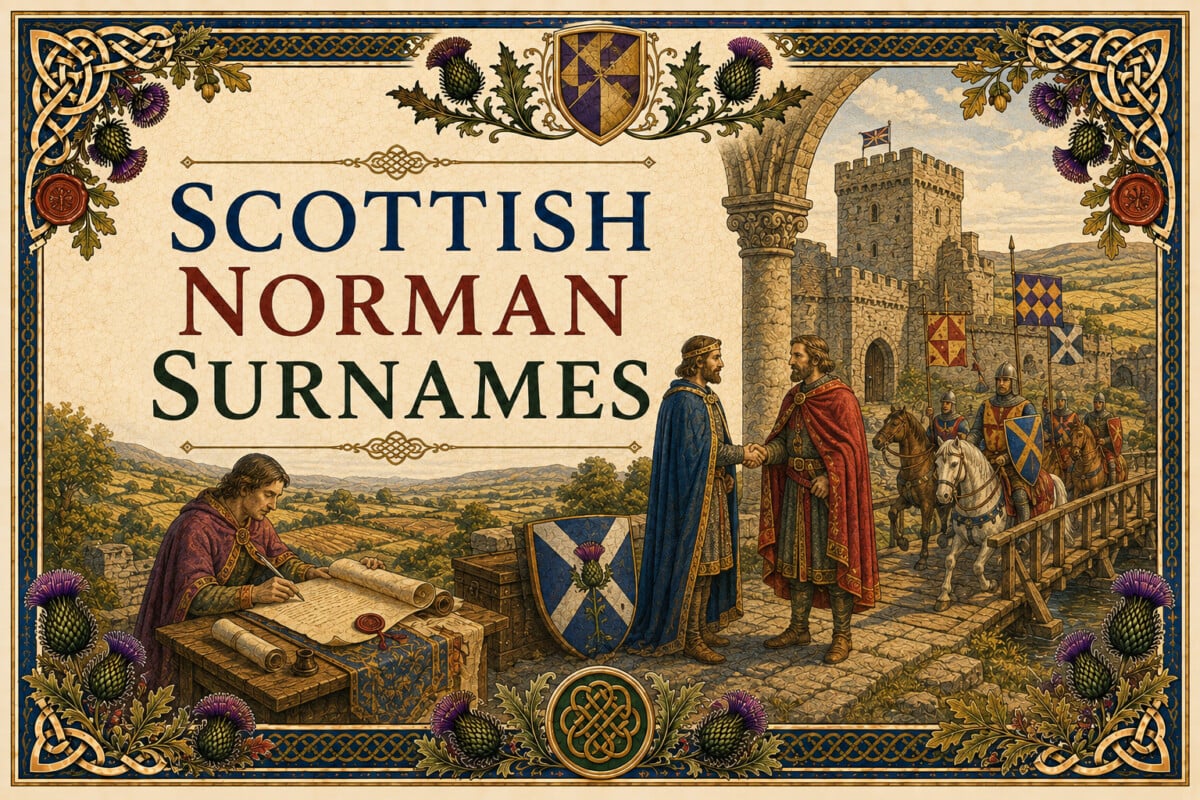
Scottish Norman surnames are family names brought into medieval Scotland by Anglo-Norman and continental families, especially in the 12th century, then made distinctly Scottish through generations of landholding, service and intermarriage. Bruce, Fraser, Sinclair, Hay, Graham and Balliol are among the best-known examples.
These names do not mean that every modern bearer has a documented Norman ancestor. A surname can spread through many branches, spelling changes and unrelated lines. Still, the names offer a useful route into the era when Scottish kings drew settlers, knights, clergy and merchants into burghs and lordships across the kingdom.
For family historians, the useful distinction is simple: “Norman” describes a surname’s early medieval background, while “Scottish” describes the long history that followed. After eight or nine centuries, those identities are hardly strangers. They also sit alongside the Gaelic traditions behind many rare Scottish boy names and unusual Scottish girl names.
If you are interested in specific last or first names of the Scottish origin, try our interactive tool below:
Scottish Names Beginning With
Choose which type of Scottish name you would like to explore.
How Norman Surnames Reached Scotland
The earliest hereditary surnames recorded in Scotland are associated with the reign of David I of Scots, who ruled from 1124 to 1153. David’s government and church reforms were closely connected to the Anglo-Norman world. Families with roots in Normandy, England, Flanders and northern France received land, offices and opportunities in Scotland.
Many of these early names were territorial. A man might be called “de” followed by the place he came from or the estate he held. In that context, “de Brus,” “de Balliol” and “de Morville” did not work like modern fixed surnames at first. They identified a person through a place, status or inheritance.
Over time, the “de” often disappeared and the name settled into a hereditary form. The process was uneven. Gaelic patronymics based on mac, Norse-influenced names, Scots occupational names and local place names continued alongside Norman-style surnames. Scotland’s surname history is a busy crossroads, not a tidy single-file queue.
What “Norman Origin” Actually Means
Norman origin does not always mean a family sailed directly from Normandy to Scotland. Some arrived through England after the Norman Conquest of 1066, where hereditary surnames and feudal naming customs had already taken firmer hold. Others had French or Flemish connections within the wider Anglo-Norman network.
Names of this type commonly fall into two groups:
- Territorial names, drawn from a place in Normandy, France, England or Scotland.
- Names shaped by Norman French, including forms that later changed in Scots, English, Latin and Gaelic records.
A surname’s literal translation is often less useful than its place connection. For example, a name may point to Brix, Bailleul, Saint-Clair or another locality, but centuries of spelling variation can obscure the original form. Genealogy is not improved by forcing every name into a neat one-line definition.
Common Scottish Norman Surnames and Their Background
| Surname | Early Form or Association | How to Read Its Origin |
|---|---|---|
| Bruce | de Brus | A territorial name associated with Brus or Brix in Normandy. |
| Fraser | Fraser, Frisel or related medieval forms | A surname generally treated as Norman in Scottish historical tradition, though its earliest exact derivation has been debated. |
| Sinclair | de Saint-Clair | A place-based Norman French name connected with Saint-Clair localities. |
| Hay | de la Haye | A Norman French territorial surname, later prominent in Scottish public life and landholding. |
| Graham | de Graham | A name associated with a family established in Scotland during the medieval Anglo-Norman period. |
| Balliol | de Balliol | A territorial name linked with Bailleul-en-Vimeu in Picardy. |
Bruce
Bruce is the most famous Scottish Norman surname. The medieval form was de Brus, associated with a place in Normandy. Scotland’s People identifies Robert the Bruce as a descendant of Robert de Brus, a figure connected in tradition with William the Conqueror’s circle. The family’s later Scottish story became inseparable from the Wars of Independence and King Robert I.
The key point is that Bruce began as a territorial name and became a Scottish royal name. It is a strong example of why origin and identity should not be treated as competing labels.
Fraser
Fraser appears in Scotland among the Norman-origin surnames that became established after the 12th-century influx. Its early forms vary in medieval records, which is normal for a period when clerks wrote in Latin, French and evolving Scots forms. The surname later became associated with major Scottish branches, including Frasers of Lovat and the Fraser lands around Aberdeenshire.
Be cautious with confident claims that Fraser has one settled literal translation. The surname’s Norman association is clearer than any simple modern-English meaning.
Sinclair
Sinclair developed from de Saint-Clair, a Norman French territorial form. The surname became deeply rooted in Scotland, particularly through the powerful Sinclairs linked with Caithness, Orkney and Rosslyn. Its original place-name component refers to Saint Clair, so it belongs to the broad family of names built around a locality or religious dedication.
Modern spellings can include St Clair, Saint Clair and Sinclair. In archival work, checking these variants is essential, especially before assuming two entries represent separate families.
Hay, Graham and Balliol
Hay is commonly traced to the Norman French de la Haye form, while Graham is associated with a medieval family that gained a foothold in Scotland during the Anglo-Norman period. Both names later became fully woven into Scottish regional history, with branches, estates and alliances that cannot be reduced to their earliest continental connection.
Balliol is less common as a modern Scottish surname but carries enormous medieval weight. The de Balliol family was linked to Bailleul-en-Vimeu in Picardy, and John Balliol became King of Scots in 1292. The name’s political importance far outstrips its modern frequency.
Why These Names Became Hereditary
Land, lordship and written administration helped turn changing bynames into inherited family names. A lord identified by an estate could pass both land and name to descendants. Royal charters, church records and legal documents reinforced the habit because officials needed a reliable way to identify people with property and obligations.
This pattern began among nobles and major landholders, then extended more widely. By the time the Ragman Roll recorded acts of homage to Edward I in 1296, many recorded surnames resembled the local, patronymic, occupational and nickname-based names found elsewhere in Britain.
That does not mean every Scottish family used a fixed surname at the same moment. Gaelic naming traditions remained especially resilient in parts of the Highlands and Islands, and the spelling of all surnames could remain fluid for generations.
How To Research a Possible Norman Scottish Line
Start with the most recent proven generation, not a medieval coat of arms or an attractive online tree. A surname alone cannot establish descent from a named Norman family, and the same name may have multiple unrelated lines.
- Record every spelling used by parents, grandparents and great-grandparents, including forms with or without “de,” “St” or “Mac.”
- Use parish registers, censuses, wills, valuation rolls and statutory records to establish places and dates before moving further back.
- Track locations as carefully as names. A Bruce family in Fife and a Bruce family in Dumfriesshire may have very different documentary paths.
- Read medieval surname claims as leads, not proof. A line needs records connecting each generation.
A bound family history research notebook is still useful for keeping variants, archive references and unresolved questions together. Digital trees are convenient, but a handwritten list of spellings can stop a promising lead from vanishing into a dozen browser tabs.

Family History Record Book: An 8-generation family tree workbook to record your research
Scottish Identity Came After the Arrival
The Norman label describes an early chapter, not the whole book. Families such as Bruce, Fraser, Sinclair, Hay and Graham built their Scottish identities through service to Scottish kings, marriages with Scottish families, regional power and, in some cases, conflict with one another. The Balliol and Bruce rivalry is an obvious reminder that medieval Scotland was politically complicated enough without modern ancestry labels simplifying it.
That layered history is what makes Scottish Norman surnames so interesting. A name may have begun in a French-speaking world of castles and charters, passed through English or continental connections, and then acquired a thoroughly Scottish life in places such as Fife, Aberdeenshire, Caithness, Galloway and the Borders. The surviving castles associated with that long history still shape many stays at Scottish Highlands castle hotels.
Frequently Asked Questions About Scottish Norman Surnames
Are Bruce and Fraser Norman surnames?
Yes. Bruce and Fraser are widely recognized as surnames with Norman-era roots in Scotland. Their long subsequent histories are Scottish, so a Norman origin does not make them less Scottish.
Is Sinclair a Scottish or Norman name?
Sinclair is both in different senses. It developed from the Norman French de Saint-Clair form and became an important Scottish surname through medieval settlement, landholding and family branches in northern Scotland.
Does a Norman surname prove Norman ancestry?
No. A surname can be inherited through many lines and shared by unrelated families. Documentary research connecting one generation to the next is needed to establish a particular descent.
What does “de” mean in medieval Scottish names?
In medieval Latin and French usage, “de” generally meant “of” or “from.” In surnames such as de Brus or de Balliol, it usually marked an association with a place or estate.
When did Norman surnames become common in Scotland?
Norman-style hereditary surnames began appearing in Scotland during the 12th century, particularly under David I. Their adoption expanded gradually and did not replace Gaelic, Norse, Scots or occupational naming traditions overnight.