
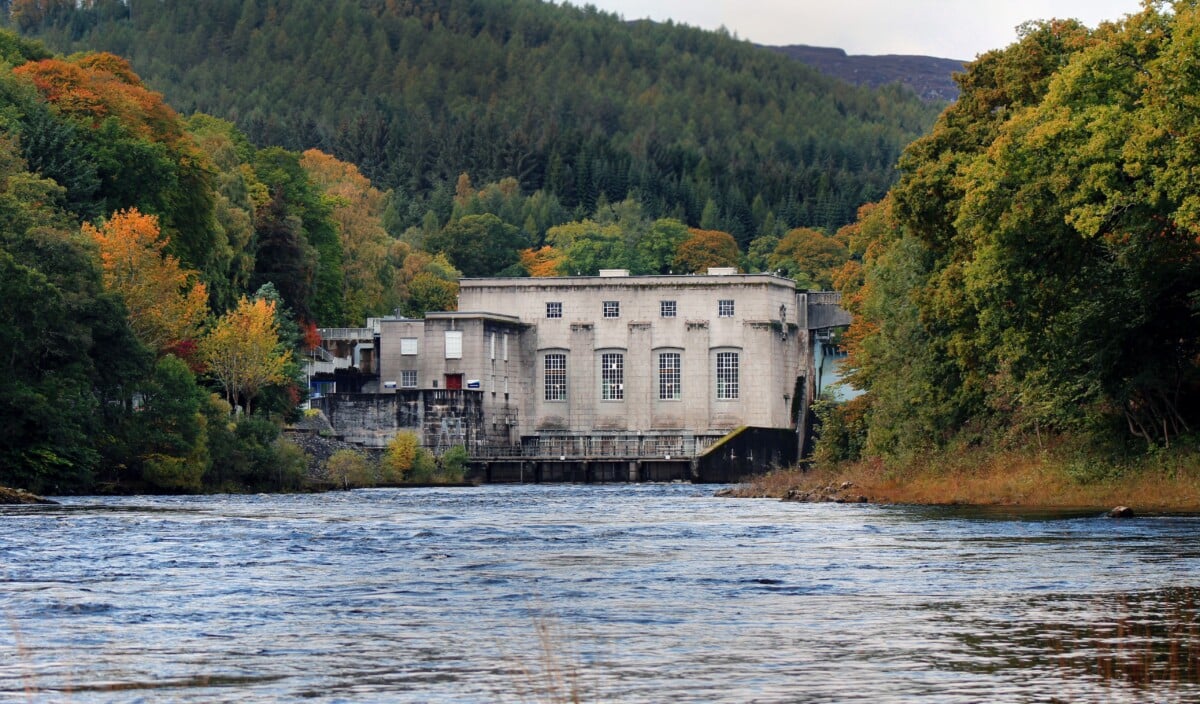
If Pitlochry Dam is on your Highland Perthshire list, the short version is good news: it is free, it is a short walk from the town centre, and the salmon still climb the famous fish ladder beside it every year. The dam holds back Loch Faskally on the River Tummel, and its 34-pool fish ladder lets salmon and sea trout get past the concrete wall on their way upriver to spawn.
What has changed is how you watch them. The old underwater viewing chamber is closed, so the salmon-spotting now happens at an outdoor observation point with live underwater footage, plus the SSE visitor centre and café on the bank. This guide covers what you can see, when the centre is open, how to get there, the walks that start at the dam, and whether it is worth building a stop around.
Pitlochry Dam Key Facts
Here are the numbers that answer most first questions.
| What | Detail |
|---|---|
| Where | River Tummel, Pitlochry, Highland Perthshire (visitor centre: Armoury Road, PH16 5AP) |
| Built | 1947 to 1951; the station started generating in 1950 |
| Dam size | About 145m long and 16m high |
| Power | 15MW from two turbines, enough for about 15,000 homes a year |
| Fish ladder | 34 pools over about 310m, including three resting pools |
| Salmon per year | About 4,500 on average; counts have ranged between 2,000 and 12,000 |
| Entry | Free (visitor centre, dam walkway and observation point) |
| Visitor centre hours | Wednesday to Sunday, 10.00am to 4.30pm, closed Monday and Tuesday from 2 November (checked November 2026) |
| Parking | Car park with disabled spaces, 2-hour limit |
| Heritage status | Category A listed (power station and dam) |
Both structures are protected, with a Category A listing for the power station and dam, and the station was designed for two Kaplan turbines of 7.5MW each.
Can You Still See Salmon at Pitlochry Dam?
Yes, though not through glass any more. The underwater viewing chamber inside the ladder closed at the start of 2019 for health and safety reasons, and it was still closed in November 2025 with no reopening date. In the meantime, SSE has built a replacement on the bank.
The Salmon Observation Point
The replacement is an outdoor observation point east of the dam, on the path towards Pitlochry Festival Theatre. SSE Renewables broke ground on the new attraction in May 2023: four stainless steel totems explain how the ladder works and the salmon life cycle, and a circular concrete seating area looks back at the dam. The useful part for salmon spotters is the live underwater camera footage and fish counter statistics, which show what is moving through the ladder even when the surface gives nothing away.
The original plans for the viewing point placed it on the main access route to the theatre, with views back to the dam and the visitor centre, so you will walk past it if you cross the dam on foot.
When Is the Best Time To See Salmon?
Salmon use the ladder through spring, summer and autumn. Spring fish are already on the move by May: by the end of May 2026, 922 salmon had reached the top of the ladder that year. Autumn is often the most productive time to catch one leaping in the river below the dam, but sightings are never guaranteed, whatever your itinerary says.
A few things improve your odds:
- Check the counter and camera at the observation point first. If fish are passing through the ladder, the river below is worth watching for a while.
- Give the river below the dam some time. A leaping fish is over in a second, so pick a spot and stay put for a few minutes.
- Use the café balcony on a dreich day (grey and drizzly). It overlooks the river beside the power station and you can look out for a leaping salmon with a hot drink in hand.
A small pair of binoculars helps with the far bank and the lower river, and doubles up for birdwatching on Loch Faskally.
compact binoculars: Check price on Amazon
How Many Salmon Use the Pitlochry Fish Ladder?
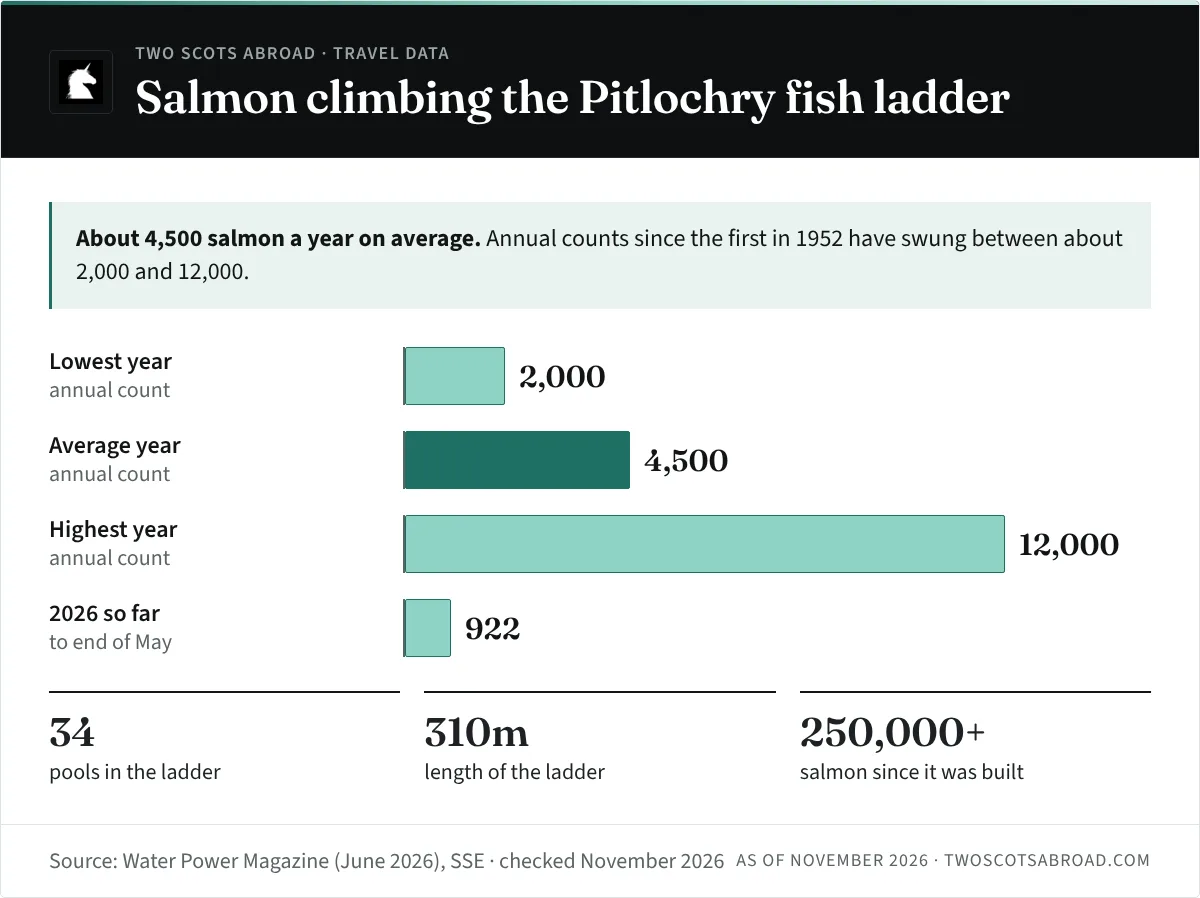
On average about 4,500 fish a year climb the ladder, and annual counts since the first one in 1952 have ranged between about 2,000 and 12,000 fish. The running total is over 250,000 salmon since the ladder was built.
The ladder works by giving each pool a water level slightly higher than the one below. Salmon swim pool to pool through small circular openings, and three of the 34 chambers are resting pools where fish can recover before the next stretch. Screens keep large fish away from the turbines, and the turbine blades are designed so young fish heading back to sea can pass through safely.
Parliament required the Highland hydro schemes to protect fish stocks, which is why the ladder was part of the design from the start. Without it, the dam would be a wall across the river for every salmon heading for the spawning grounds above Loch Faskally.
Pitlochry Dam Visitor Centre: Opening Hours, Entry and Café
The visitor centre’s current opening hours are Wednesday to Sunday, 10.00am to 4.30pm, closed on Mondays and Tuesdays from 2 November (checked November 2026). The centre warns that hours can change at short notice, so if you are driving any distance, call 01796 484111 or check its social channels before you set off. Entry is free.
Pick the day you plan to go and see what will be open when you get there.
The centre opened on 30 January 2017 and welcomed its one millionth visitor on 16 October 2025, averaging about 110,000 visitors a year. Inside you will find:
- Exhibitions on the history of hydro power in the north of Scotland, the Hydro Boys and Tunnel Tigers who built the schemes, the salmon life cycle and habitat management.
- The Salmon Leap café, with coffee, cakes, scones and a deli menu, free wifi and a viewing balcony over the River Tummel.
- A gift shop beside the café.
- Dog-friendly rules: dogs are welcome on a collar and lead or harness, in the dog-friendly areas.
The café looks over the River Tummel and Loch Faskally, so even on a wet day you get the view of the dam and the river without standing in the rain. If you only have an hour, that is the best use of it.
How To Get to Pitlochry Dam
Pitlochry Dam is easy to reach on foot or by car from Pitlochry town centre, and the town has bus and train links to Glasgow, Edinburgh and Inverness.
- On foot: Pitlochry train station is a 14-minute walk from the visitor centre, and the town centre is closer still.
- By train: Pitlochry is on the Highland Main Line, with trains from Edinburgh, Glasgow, Perth and Inverness. Check ScotRail or National Rail for current times.
- By car: use the postcode PH16 5AP (Armoury Road). The car park has disabled spaces and a 2-hour limit. For a longer stay, such as the loch circuit below, use the long stay car park at Pitlochry Business Centre.
- By coach or minibus: watch out for the height restriction at the bridge on Armoury Road, which makes the access road unsuitable for large buses.
- By bike: the visitor centre sits directly on National Cycle Route 7.
Most areas at the visitor centre are accessible. The fish ladder itself has steps between its top and bottom sections, so step-free visitors should plan on the bank and the centre.
Walks From Pitlochry Dam
The dam is the start of some of the best low-level walking around Pitlochry, and you do not need to commit to a long one.
Across the Dam and Back
The walkway over the dam’s drum gates is a public bridge, so the shortest walk is simply to cross it, stop at the observation point on the east side, look down the length of the fish ladder and come back. It is a wee loop, ideal with kids or when the weather is turning.
The Loch Faskally Circuit
For a full day, a 19km circuit with about 410m of ascent starts at the car park below the visitor centre and links Loch Faskally, the Clunie footbridge, the Coronation Bridge, the Linn of Tummel waterfall, the Garry Bridge and the Pass of Killiecrankie before returning along the east side of the loch past the boating station. Expect narrow, muddy lochside paths, quiet single-track roads and one steep, rough woodland section. Shorter loops around the loch are possible too, so pick the length that fits your day and take a map.
With a 2-hour limit at the dam car park, park in the long stay car park for anything beyond the short loop.
How the Dam Works and Why It Was Built
Pitlochry Dam is one of nine power stations in the Tummel Valley hydro scheme. It is a run-of-the-river station: water flows through two turbines under a head of about 15m, with Loch Faskally, created by the dam, acting as the reservoir behind it. The scheme collects water from a catchment of about 1,800 square kilometres in the Grampian Mountains.
The North of Scotland Hydro-Electric Board built it between 1947 and 1951, with architect Harold Ogle Tarbolton on the board’s design panel. The building’s classical modern style, with drum gates and the balustraded walkway above them, is a big part of why it is Category A listed. It was controversial at the time: critics feared the scheme could bring the “ruination of tourism”. A million visitors through the centre since 2017 suggests tourism coped.
Is Pitlochry Dam Worth Visiting?
For most people passing through Pitlochry, yes. It is free, it is close to the town centre, and between the observation point, the exhibitions and the café you can fill an hour without spending anything but the price of a scone. It suits:
- Road-trippers on the A9 who want a leg stretch that is more interesting than a lay-by. Keep the 2-hour parking limit in mind.
- Families, thanks to the salmon story, the hands-on exhibits and the short loop over the dam.
- Walkers using the dam as the start of the Loch Faskally paths.
- Anyone interested in engineering or Highland history, since the hydro schemes reshaped life in the north of Scotland.
Skip it, or keep it short, if seeing salmon through the old glass window was the main draw: that view is gone, and the observation point’s camera is the closest replacement. From 2 November the centre and café close on Mondays and Tuesdays, so on those days you get the dam and the walk only.
Pitlochry Dam FAQ
Is Pitlochry Dam Free To Visit?
Yes. The Pitlochry Dam Visitor Centre, the walkway across the dam and the salmon observation point are all free to visit, and the centre’s car park has a 2-hour limit.
Are Dogs Allowed at Pitlochry Dam?
Dogs are welcome at the Pitlochry Dam Visitor Centre on a collar and lead or harness, in the dog-friendly areas, and owners are asked to clean up after them.
Who Runs Pitlochry Dam?
Pitlochry Dam and its power station are operated by SSE, which also runs the visitor centre, café and the salmon observation point beside the fish ladder.