
Is Belfast safe? Yes. Belfast is safe for tourists: crime aimed at visitors is rare, the US government rates the whole of the UK at Level 2 of 4 (“exercise increased caution”), and the main risks are ordinary big-city ones like pickpocketing, plus a handful of neighbourhoods best avoided late at night.
I’ll be honest: before our first trip to Belfast, I had done the kind of obsessive pre-trip research that would embarrass a PhD student. Conflict murals, the Peace Walls, the Troubles, Orange parades. I had basically talked myself into thinking we were heading somewhere genuinely tense. We arrived, walked around the city centre for about twenty minutes, and I felt like an idiot.
Belfast is fine. More than fine, actually.
Quick Answer: Is Belfast Safe for Tourists?
Yes, Belfast is safe to visit. But there are places to avoid (we talk about this later in this article). Northern Ireland recorded 94,334 crimes in the 12 months to August 2026, one of its lowest totals since 1998, and Belfast City’s figure rose only 1.3% to 31,921 (PSNI). The city has changed enormously since the conflict years, and the vast majority of visitors have no issues at all.
That said, it is still a real city with real neighbourhoods, and a handful of areas are worth avoiding at night. More on those below.
What Belfast Is Actually Like as a Destination

The Titanic Quarter, the Cathedral Quarter, the food scene, the nightlife (which has been voted among the best in the UK and Ireland), festivals, outdoor activities. There is a lot going on here, and the locals are genuinely warm. Rick Steves, who has been writing about Northern Ireland for decades, put it plainly: every traveller he met in the North was at ease, and statistically it is as safe as anywhere else.
The city’s troubled past is real and worth understanding before you go. The conflict between communities was political at its core, centred on whether Northern Ireland should be governed from London or Dublin, and it was prolonged and brutal. But that history is now largely what people come to learn about, not something they encounter on the streets. If you’re planning to explore the nightlife side of things, the bars in the Cathedral Quarter are a brilliant place to start.
Small crimes like pickpocketing can happen, as they can anywhere. Taxi scams are occasionally mentioned. But violent crime targeting tourists is not a feature of modern Belfast.
Areas of Belfast to Avoid (Especially at Night)

Most of these are fine during the day, particularly if you are visiting to see the murals or understand the city’s history through a Black Cab tour. Night is a different calculation.
- Tiger’s Bay (North Belfast) – best avoided after dark
- New Lodge (North Belfast) – same advice
- Ardoyne (North Belfast) – historically tense, avoid at night
- Falls Road (West Belfast) – worth seeing in daylight for the murals, but not a place to wander at night
- Shankill Road (West Belfast) – same applies, great history during the day, skip it after dark
- The Holylands (South Belfast) – student area that can get rowdy at night, more petty nuisance than danger
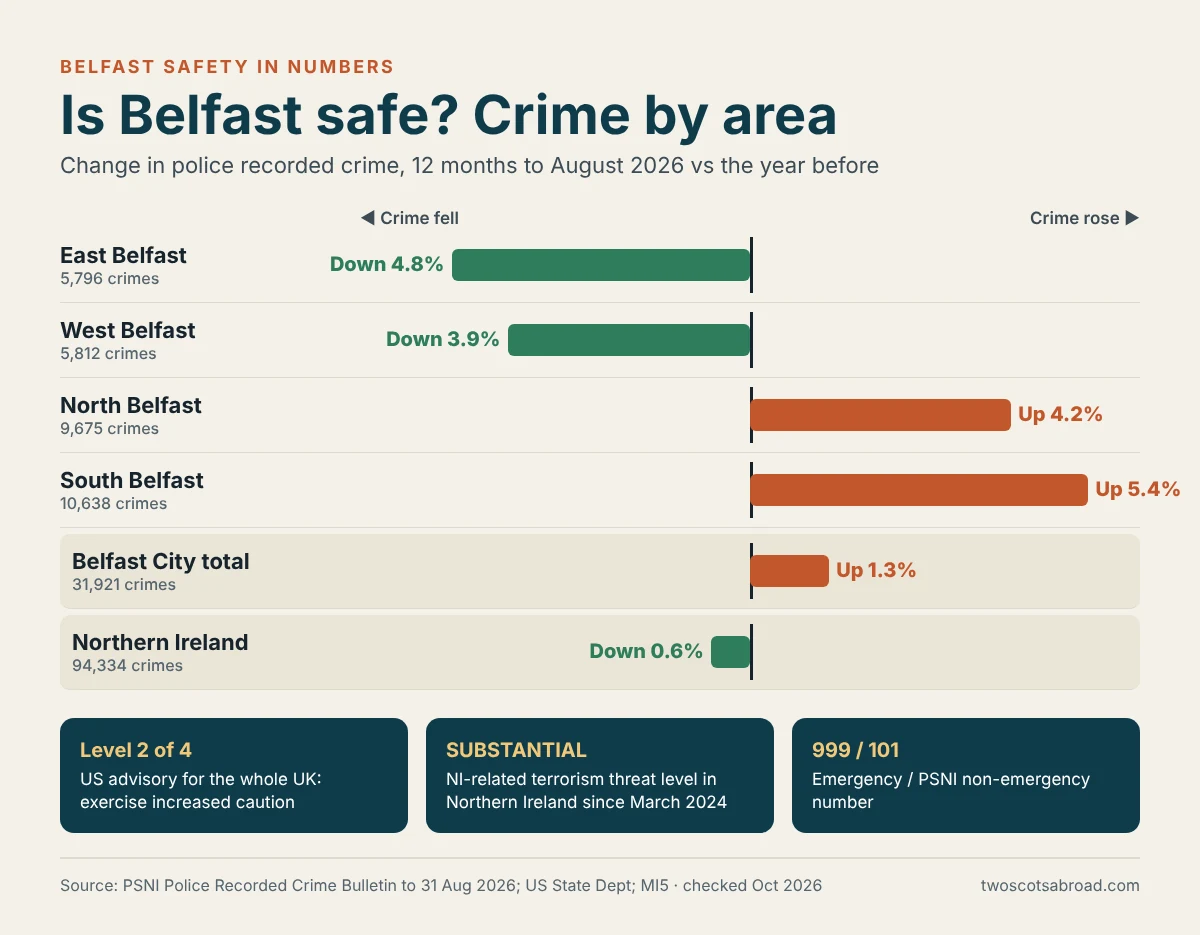
Recorded crime in West Belfast actually fell by 3.9% in the 12 months to August 2026, which is encouraging, and East Belfast fell by 4.8%. North and South Belfast both rose (by 4.2% and 5.4%), so the usual night-time common sense applies there.
South Belfast generally, and areas like Stranmillis and Balmoral, are considered among the most relaxed parts of the city. The city centre and Titanic Quarter are well-patrolled and popular with tourists around the clock.
Belfast Crime Statistics (Latest PSNI Figures)
The Police Service of Northern Ireland publishes recorded crime every month. In the 12 months to the end of August 2026, it recorded 31,921 crimes in Belfast City, 1.3% more than the year before. Northern Ireland as a whole recorded 94,334 crimes, down 0.6% and one of the lowest totals since the series began in 1998. Belfast, the largest city, accounts for about a third of Northern Ireland’s recorded crime (31,921 of 94,334).
| Area | Sep 2024 to Aug 2025 | Sep 2025 to Aug 2026 | Change |
|---|---|---|---|
| East Belfast | 6,087 | 5,796 | Down 4.8% |
| West Belfast | 6,046 | 5,812 | Down 3.9% |
| North Belfast | 9,287 | 9,675 | Up 4.2% |
| South Belfast | 10,092 | 10,638 | Up 5.4% |
| Belfast City (total) | 31,512 | 31,921 | Up 1.3% |
| Northern Ireland | 94,944 | 94,334 | Down 0.6% |
Here is the same picture as a chart, so you can see which parts of the city moved which way.
The Safest Areas for Tourists
- City Centre – the obvious base, busy, well-lit, police presence
- Titanic Quarter – tourist-heavy, no real concerns
- South Belfast / Stranmillis / Balmoral – calm, residential, low crime
- Cathedral Quarter – nightlife hub, lively but generally fine
If you are still choosing a base, our guide to where to stay in Belfast breaks these neighbourhoods down by budget and vibe.
Belfast Safety Tips Worth Actually Following

These are not dramatic warnings. They are the kind of common-sense things that apply in any city, with a couple of Belfast-specific ones layered on.
- Skip the political chat. Do not ask locals which side they are on, do not bring up the Troubles as a conversation opener, and do not wade into discussions about Britain, the UK, or Irish reunification. You will not win and you might genuinely offend someone.
- Leave the jerseys at home. Celtic, Rangers, any Irish or Northern Irish sports kit. Belfast is far from unique in having areas where the wrong shirt causes problems, but it is genuinely not worth the risk. Just wear something else.
- Use taxis or public transport at night. Especially if you are moving between areas or heading home late from a night out.
- Stick to well-lit, well-used routes after dark. Obvious advice that people ignore until something minor happens.
- Watch for pickpockets in busy spots. Not rampant, but it happens around tourist areas and pub strips, particularly on weekends.
- Pack layers and a rain jacket. Belfast weather is changeable, and rain is possible in any month. Honestly, even in summer you’ll want something waterproof within reach. If you’re visiting during the colder months, our winter travel tips cover packing and planning for exactly this kind of weather.
- Know the currency. Northern Ireland uses the British pound sterling (£). You’ll also see Northern Irish banknotes issued by local banks. They’re perfectly legal but can occasionally cause confusion if you try to spend them back on the mainland. Worth having a heads-up.
- Emergency services in Northern Ireland: call 999. For non-emergencies, the PSNI number is 101.
Is Belfast Safe at Night?
Yes, broadly. The nightlife is genuinely good and the city centre stays lively. Police patrol the busy areas. The main risk at night is less about targeted crime and more about wandering into the wrong neighbourhood without realising it, or getting caught up in weekend pub-area chaos, which is more loud than dangerous.
Do yourself a favour and sort your taxi home before you need it rather than standing on a street corner at 2am trying to figure it out.
Is Belfast Safe for Solo Travellers?
Yes. The locals are approachable and helpful, and the city is well set up for independent travel. Solo travellers are specifically called out as having an easy time here, partly because Belfast residents are genuinely friendly and partly because the tourist infrastructure is solid. Hostels are available if you want to meet other travellers, and there are plenty of organised Belfast tours including hop-on hop-off buses, Black Cab tours of the murals, and Game of Thrones filming location tours.
Understanding the Context: The Troubles and Modern Belfast
The conflict that defined Belfast for decades was political, not simply religious, though the two communities broadly mapped onto Catholic (nationalist, pro-Dublin) and Protestant (unionist, pro-London) identities. Orange parades still take place from Easter through September, mostly peaceful when they pass through Protestant areas. The murals on both the Falls and Shankill Roads are now a major tourist draw, and having a look at what to expect on the Peace Walls and mural routes before you go adds a lot of context.
Rick Steves noted that even on a visit to Belfast, a bomb scare was announced on the radio, taken seriously by police because an authenticating code word was used. The point is that the city has come an enormous distance since those years, and the gap between what visitors expect and what they actually find tends to be significant.
Violence can still flare occasionally, perhaps once a year, usually tied to specific political events. But it is rare, and it is not aimed at tourists.
Current Travel Advice and Threat Level for Belfast
The UK government’s own travel advice only covers trips abroad, so for Belfast the useful official signals are the US State Department advisory, MI5’s terrorism threat levels and the police. Here is where they stood when we checked in October 2026.
- US State Department: the United Kingdom is at Level 2, “exercise increased caution” (updated 9 September 2026), with terrorism the only risk indicator listed. It notes a risk of isolated violence by dissident groups in Northern Ireland, mainly aimed at police and the military, and that tensions can rise during the marching season (April to August) and around the 12 July holiday.
- MI5 threat levels: the threat from Northern Ireland-related terrorism in Northern Ireland has been SUBSTANTIAL (an attack is likely) since it was lowered from SEVERE in March 2024. The UK-wide national threat level is also SUBSTANTIAL.
- Police: the Police Service of Northern Ireland (PSNI) polices Belfast. Call 999 in an emergency and 101 for non-emergencies.
None of that is aimed at visitors. It is just worth knowing, especially if your trip lands in July.
Belfast Travel Tips: Quick Recap
| Topic | What to Know |
|---|---|
| Overall safety | Safe for visitors; Belfast City crime up 1.3% in the 12 months to August 2026 while Northern Ireland overall fell 0.6% (PSNI) |
| Travel advisory | US: Level 2, exercise increased caution (whole UK). NI-related terrorism threat: SUBSTANTIAL |
| Areas to avoid at night | Tiger’s Bay, New Lodge, Ardoyne, Falls Road, Shankill Road, The Holylands |
| Safest areas | City Centre, Titanic Quarter, South Belfast, Stranmillis |
| Political conversations | Avoid entirely |
| Clothing | No Celtic, Rangers, Irish, or Northern Irish sports symbols |
| Currency | British pound sterling (£). Northern Irish banknotes are legal but sometimes queried elsewhere |
| Nightlife | One of the best in the UK and Ireland, generally safe |
| Solo travel | Absolutely fine |
| Emergency number | 999 |
Is Belfast Safe? FAQs
Is Belfast safe for tourists in 2026?
Yes. Crime targeting tourists is uncommon, and the main things to watch are pickpockets in busy areas and wandering into the wrong estate late at night. The US advisory for the UK sits at Level 2, mainly because of the general terrorism risk across the country.
What is the crime rate in Belfast?
The PSNI recorded 31,921 crimes in Belfast City in the 12 months to August 2026, up 1.3% on the year before, while Northern Ireland as a whole fell 0.6% to 94,334, one of its lowest totals since 1998. East and West Belfast both saw falls.
Is it safe to see the Peace Walls and murals?
Yes, in daylight. The Falls Road and Shankill Road murals are one of the city’s biggest draws, and a Black Cab tour is the easiest way to see both sides with a local guide. Avoid them late at night and steer clear of any protest or parade.
What is the emergency number in Belfast?
Dial 999 for police, ambulance, fire or coastguard emergencies, or 101 to contact the PSNI about something that is not an emergency.
Once you have ticked off the practicalities, our honest list of the top attractions in Belfast will help you plan the fun bit.
Packing for the weather? Our Belfast packing list covers the layers and waterproofs. Crossing from Dublin? Read up on travelling between Ireland and Northern Ireland first, as the currency changes at the border.
Belfast rewards visitors who show up without preconceptions. I spent the first hour waiting for something to feel tense and the rest of the trip just enjoying a city that turned out to be far more relaxed, friendly, and interesting than my pre-trip anxiety spiral had suggested. Past-me was being ridiculous. Go.
