
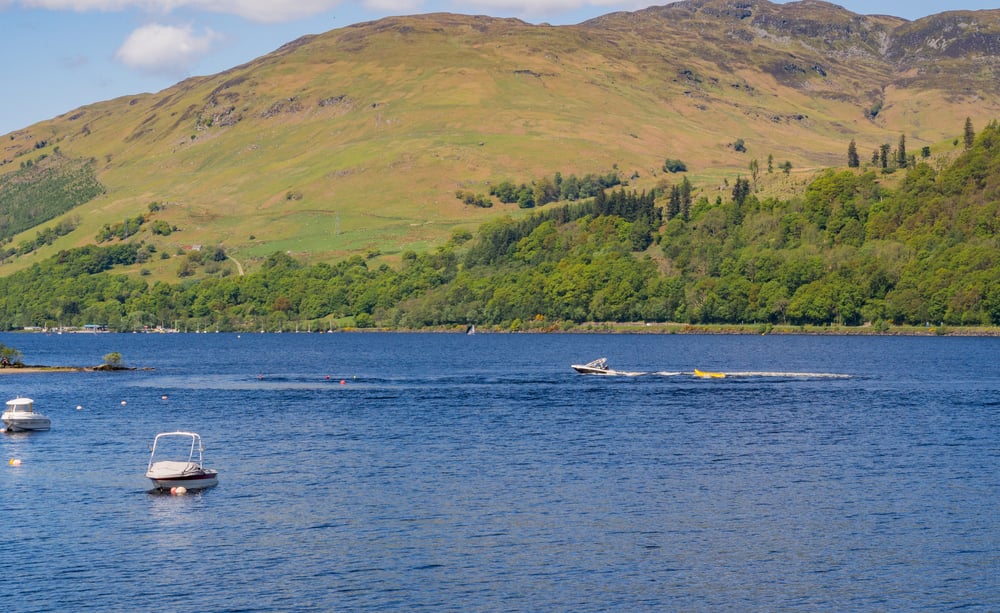
If you are planning a day or a long weekend around Loch Tay, the good news is that the best things to do here sit on one loop road, so you can mix a mountain walk, a boat trip and a bit of Iron Age history without much driving. The loch runs for about 14.5 miles between Killin in the south-west and Kenmore in the north-east, with Ben Lawers, at 1,214 metres, rising straight off the north shore.
This guide covers 12 things to do at Loch Tay, what each one costs where a price is published, how long to allow, and which end of the loch to base yourself at. There is a quick comparison table first, then the detail, then a realistic one-day route for road-trippers.
Things to Do at Loch Tay at a Glance
Use this table to match a stop to the time you have. Published prices are in each section below; times are our planning estimates unless an official allowance is given in the section below.
Pick the end of the loch you are staying at to see which stops are on your doorstep.
| Stop | Area | Time to allow | Best for |
|---|---|---|---|
| Scottish Crannog Centre | Dalerb, north shore near Kenmore | 2 to 3 hours | Families, history fans, wet days |
| Ben Lawers National Nature Reserve | North shore, Lawers | 1.5 hours to a full day | Walkers of every level |
| Falls of Dochart | Killin | 30 to 60 minutes | A quick, free stop |
| Loch Tay Safaris | Kenmore | 50 minutes to 2 hours | Seeing the loch from the water |
| Kayak, paddleboard and boat hire | Kenmore and the north shore | 1 hour to half a day | Active couples and families |
| Falls of Acharn and the Hermit’s Cave | South shore, Acharn | 1 to 2 hours | A short woodland walk |
| Kenmore village and beach | Kenmore | 1 hour | Picnics, a pint, a wander |
| Fortingall Yew and Glen Lyon | North of the loch | 1 hour to half a day | Scenic driving |
| Moirlanich Longhouse | Glen Lochay, near Killin | 1 hour | Social history |
| Cycling the Loch Tay loop | Whole loch | Half to full day | Fit road cyclists |
| Golf at Mains of Taymouth | Kenmore | 1.5 to 4 hours | Holiday golfers |
| Salmon season opening | Kenmore | A morning in January | Anglers and tradition |
If you only have half a day, pair Kenmore with the Crannog Centre and the Falls of Acharn: all three sit within a few miles of each other at the east end of the loch.
1. Scottish Crannog Centre, Dalerb: Iron Age Life on the Loch
The Scottish Crannog Centre is the one attraction most people come to Loch Tay for, and it has had a busy few years. A fire destroyed the original reconstructed crannog in 2021, and the museum moved across the loch to a new site at Dalerb, PH15 2NX, on the north shore just west of Kenmore, in 2024. Its new crannog, a round timber house on stilts over the water, was opened by First Minister John Swinney on 22 May 2026. The move cost £5m and the crannog another £700,000, and the new site is 12 times bigger than the old one.
A visit combines a museum of artefacts recovered from the loch, an Iron Age village with traditional crafts and hands-on activities, and guided tours out onto the crannog itself. There is also a café. The centre lists its hours as daily, 10am to 5pm (checked November 2026), and tickets are booked online, so check the price and any closure days when you book.
Good to know: the tour is outdoors and the loch catches the wind, so bring a proper jacket even if the car park feels mild. Allow two to three hours if you want the tour, the village and a coffee without rushing.
2. Ben Lawers National Nature Reserve: Walks for Every Ability
Ben Lawers National Nature Reserve, run by the National Trust for Scotland, covers the high ground on the north side of the loch. The main access is the NTS car park on the single-track road that climbs from the A827 near Lawers towards Lochan na Lairige. There is no entry fee for walking, and parking is free for NTS members; non-members pay a small charge at the machine.
Pick the walk to match your legs and the weather:
- Edramucky Trail: the NTS rates this one-mile loop as moderate and allows about 1½ hours. It climbs through the reserve’s montane plant area above the car park and is the right choice for families or a short leg-stretch on a drive.
- Ben Lawers and Beinn Ghlas: the classic Munro day bags two summits, Beinn Ghlas first and then Ben Lawers at 1,214 metres. The loop is roughly 11 km with around 940 metres of climbing, and most walkers take 4 to 6 hours. The path is clear in summer, but this is full mountain terrain with real weather.
- Meall Corranaich and Meall nan Tarmachan: the quieter Munros either side of the mountain road. The NTS grades Meall Corranaich as difficult and allows about 4 hours.
Those are official and published allowances for fit, prepared walkers. For planning a holiday day, add an hour for lunch, photos and the drive up the narrow road, which has passing places and the occasional sheep that refuses to move.
The walk to the summit is exposed, and the cloud can sit on the ridge on a clear day at loch level. Take a map and compass, waterproofs and more food than you think you need.
OS Explorer map Loch Tay Ben Lawers: Check price on Amazon
3. Falls of Dochart, Killin: The Easiest Big View
The Falls of Dochart are the reason most road-trippers stop in Killin. The River Dochart pours over a wide shelf of rocks right in the village, and you see the whole thing from the Bridge of Dochart, first built in 1760. It is free, it is beside the road and after heavy rain it is loud enough to drown out conversation.
Halfway across the bridge, a gate leads down onto Inchbuie, the wooded island in the river. At its far end is the old burial ground of the Clan MacNab, an enclosure where the chiefs were buried with clan graves outside it to the east; at least one grave slab is medieval. It takes ten minutes and very few people bother, which is a shame.
Watch out for the rocks themselves. They are popular for photos, but they are slippery and the river is powerful when it is high. Killin also has cafés, a pub or two and the start of several walks, so it makes a good lunch stop at the west end of the loch. Killin sits inside Loch Lomond and the Trossachs National Park; the rest of Loch Tay does not.
4. Loch Tay Safaris and Boat Trips From Kenmore
Loch Tay Safaris runs cruises from Taymouth Marina on Pier Road in Kenmore, covering the loch’s wildlife, crannogs and folklore. The VisitScotland listing shows trips from £40 per adult and £25 per child (checked November 2026), with prices varying by season and a season running roughly March to November. The operator advertises shorter 50-minute and longer 1.5-hour sailings, and the VisitScotland listing quotes 2 hours, so confirm the length when you book.
A cruise suits you if you want to see the loch without the effort of paddling, or if the cloud is too low for the hills. Book ahead in July and August, when sailings fill with families staying at the holiday parks around Kenmore.
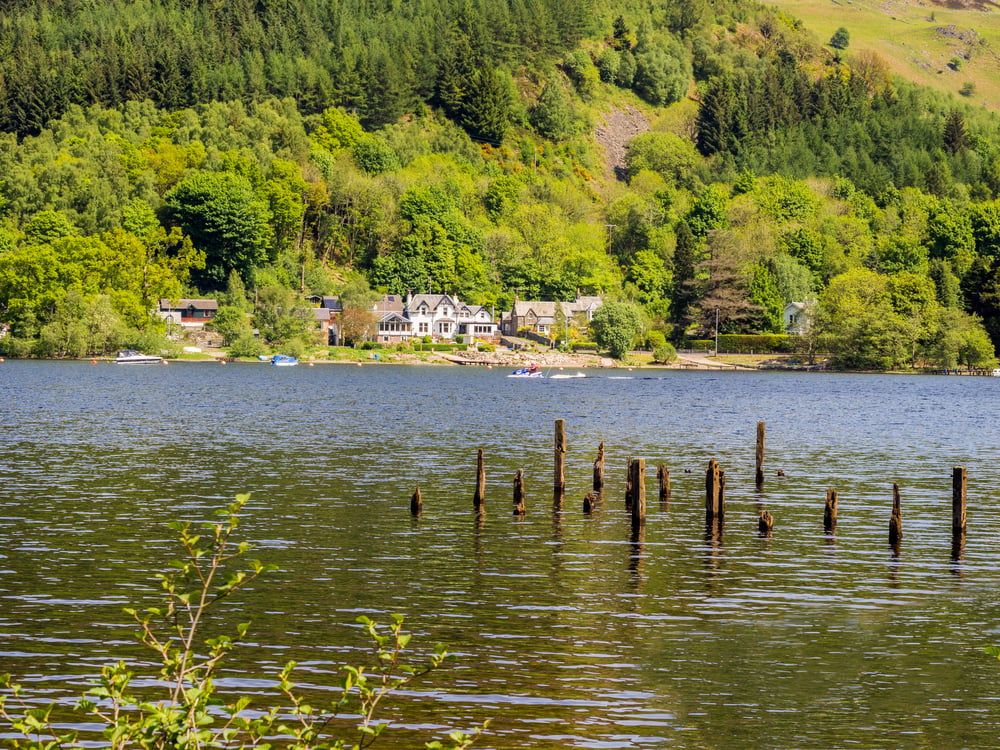
5. Kayaking, Paddleboarding and Sailing on Loch Tay
Kenmore is the hub for getting out on the water yourself. Taymouth Marina’s watersports base hires canoes, kayaks, sailing dinghies, paddleboards, pedalos and motorboats, and runs lessons in each. Further west, Loch Tay Highland Lodges near Killin hires sit-on-top kayaks, canoes and paddleboards, with paddleboards handed out first come, first served.
The east end around Kenmore is the more sheltered spot for beginners. Loch Tay is deep, roughly 150 metres at its deepest point, and cold all year, so wear the buoyancy aid you are given, stay near the shore and keep an eye on the wind, which funnels down the loch and can build a chop quickly in the afternoon.
6. Falls of Acharn and the Hermit’s Cave, South Shore
Acharn is a small village on the south shore road about 1.5 miles west of Kenmore, and the walk up the Acharn Burn is the best short walk on that side of the loch. A track climbs from the village through woodland to the Hermit’s Cave, a dark stone passage built as a folly on the old Breadalbane estate, which opens out onto a viewing platform facing the falls.
The out-and-back route is about 2 km with around 120 metres of climbing. Allow one to two hours, and wear shoes with grip, because the track is steep in places and the cave floor is uneven and dark. Park considerately in the village; spaces are limited and the road is narrow.
7. Kenmore Village: Bridge, Beach and Burns
Kenmore sits where the River Tay leaves the loch, and it is a neat estate village of whitewashed cottages, a church and a small loch-side beach that fills with picnickers on warm days. The bridge over the Tay gives the classic view back up the loch towards Ben Lawers.
The Kenmore Hotel claims to be Scotland’s oldest inn, dated to 1572, and Robert Burns pencilled a poem praising the view onto the chimney breast of what became the Poet’s Bar during his Highland tour in 1787. The hotel has been closed for redevelopment as part of the Taymouth estate project, so check it is open before planning a meal there.
Next to the village, Taymouth Castle has been turned into a private members’ club by its owners, Discovery Land Company, after more than £100 million of work. It is not open to the public, so do not plan a visit around it.
8. Fortingall Yew and Glen Lyon
A short drive north of Kenmore, the churchyard at Fortingall holds one of the oldest living trees in Europe. Estimates for the Fortingall Yew’s age vary wildly: local signage says 3,000 to 5,000 years, while the more cautious view among yew researchers is that the yew is probably over 2,000 years old. The original trunk has split and decayed, so what you see today looks like several trees growing in a walled enclosure. Entry to the churchyard is free.
Fortingall sits at the mouth of Glen Lyon, which runs west for miles into the hills. The single-track road up the glen is a slow, rewarding drive past old bridges and estate houses, and it links back to Loch Tay over the mountain road past Lochan na Lairige and the Ben Lawers car park. That road is narrow and climbs steeply, so it is not one for big motorhomes or nervous drivers.
9. Moirlanich Longhouse, Glen Lochay
Moirlanich Longhouse, a short drive up Glen Lochay from Killin, is a 19th-century cruck-framed farmhouse where a family lived alongside its cattle under one roof. The National Trust for Scotland looks after it, and inside you can see its hingin’ lum (a hanging chimney canopy) and the layers of wallpaper the family added over the years.
Opening is limited to a handful of afternoons a week, and the days change between seasons, so check the NTS Moirlanich page before you drive up the glen. Entry is free for NTS members.
10. Cycling the Loch Tay Loop
The full loop around Loch Tay, starting and finishing in Killin and using the A827 on the north shore and the minor road on the south shore, comes in at about 54 km (34 miles) with roughly 560 metres of climbing. The south road is quieter and a favourite with cyclists, but it is narrow and constantly up and down, with a stiff climb near Kenmore if you ride clockwise. The north shore A827 is faster and carries more traffic.
Fit cyclists ride the loop in half a day. Add the Glen Lyon and Ben Lawers mountain road and you have a full day of around 75 km with a big climb in the middle.
11. Golf at Mains of Taymouth
Mains of Taymouth Golf Course, the former Kenmore Golf Course, is a relaxed 9-hole course beside the River Tay with 18-hole tickets available and 5,458 yards off the medal tees. Between April and October, the green fees are £20 for 9 holes on weekdays (£22 at weekends) and £27 for 18 holes on weekdays (£30 at weekends); in winter a pay-to-play day ticket is £14 for adults (checked November 2026). It opens from 9am on weekdays and 10am at weekends, weather permitting.
The championship course in the grounds of Taymouth Castle belongs to the private club, so the Mains of Taymouth course is the one holidaymakers can book.
12. Salmon Fishing and the January Opening Ceremony
Loch Tay and the River Tay that flows out of it at Kenmore are famous salmon waters. The Tay salmon season opens in mid-January with a ceremony in Kenmore that has been held there since 1947: anglers follow a pipe band down to the river, the water is blessed with a dram of whisky, and an invited guest makes the first cast. If you are in Perthshire that week, it is free to watch and very well attended.
Fishing itself needs a permit from the relevant beat or ghillie service, and catch-and-release rules apply to salmon, particularly early in the season. Book through a local fishing operator, who will sort the permit and the rules for you.
A One-Day Loch Tay Itinerary for Road-Trippers
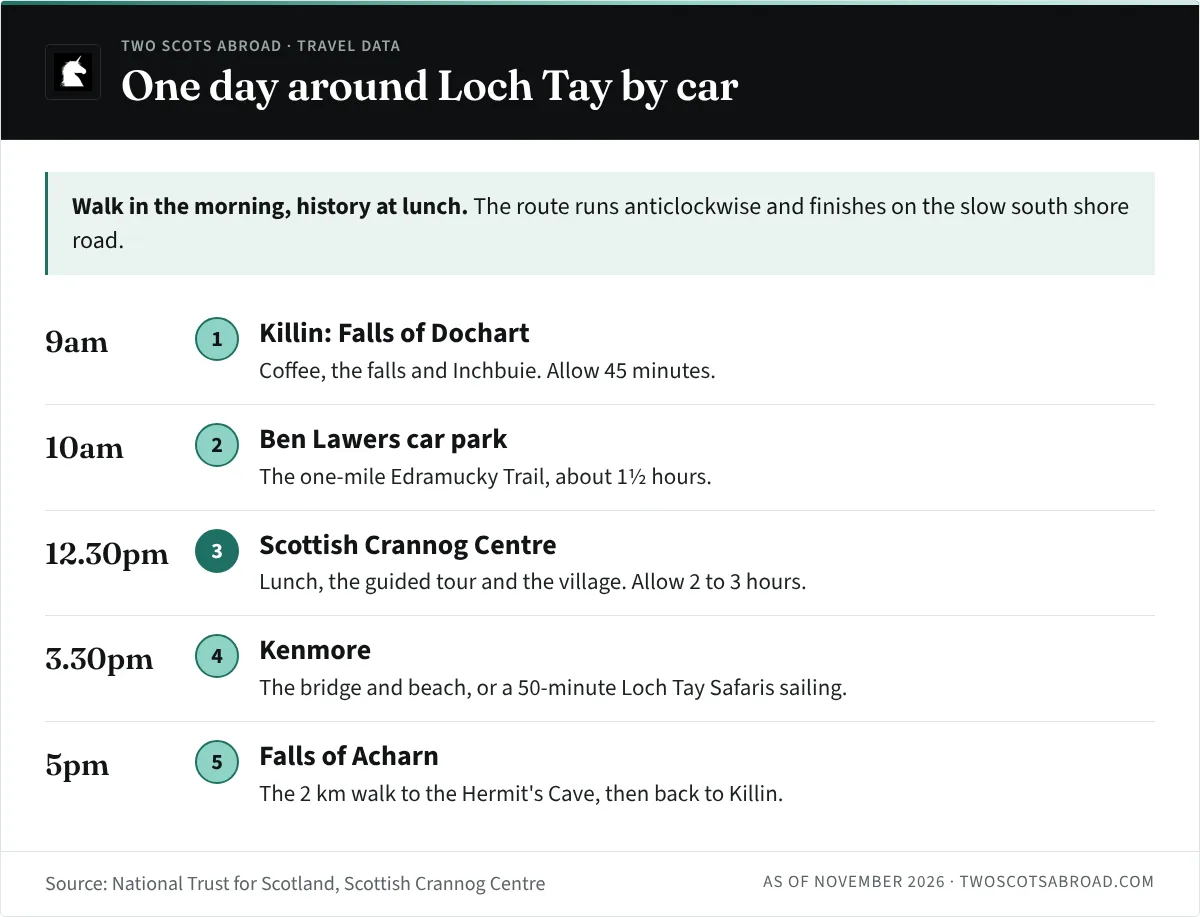
This route covers the highlights in one day by car without turning it into a race. It runs clockwise, with the mountain walk in the morning before the cloud tends to build.
- Killin, 9am: coffee and the Falls of Dochart, then the short detour onto Inchbuie. Allow 45 minutes.
- Ben Lawers car park, 10am: walk the one-mile Edramucky Trail, with the NTS allowance of about 1½ hours. Strong walkers can swap this for the summit, but at 4 to 6 hours it leaves too little time for the Crannog Centre before its 5pm close, so save the crannog for a second day.
- Scottish Crannog Centre, 12.30pm: lunch at the café, then the guided tour and the village. Allow 2 to 3 hours.
- Kenmore, 3.30pm: a stroll over the bridge and onto the beach, or a 50-minute Loch Tay Safaris sailing if one fits.
- Falls of Acharn, 5pm: the 2 km walk up to the Hermit’s Cave, then the slow south shore road back to Killin.
Allow around an hour and a half to drive the loop without stops, as the south road is slow going; with the stops above you will use the whole day. If you have two days, give the second to Glen Lyon and Fortingall, or a proper Munro walk on Ben Lawers.
Where to Stay Around Loch Tay
Kenmore is the best base for most holidaymakers: seven of the 12 stops in this guide, including the Crannog Centre, boat trips, golf and the Falls of Acharn, are within a few minutes’ drive, and there are holiday parks, lodges and self-catering cottages around the village and along the south shore. Killin suits walkers heading for the Ben Lawers hills and anyone arriving from Stirling or Glasgow on the A827 via Lochearnhead. Aberfeldy, about six miles east of Kenmore, has the most shops and places to eat if you want a town base.
Summer weekends book out early at the loch-side lodges, so book ahead for July and August. In spring and autumn, the shoulder season, you get quieter roads and the best chance of a room at short notice, but pack for midges in the summer months and for rain at any time.
Smidge midge repellent: Check price on Amazon
Loch Tay FAQs
Is Taymouth Castle Open to the Public?
No. Taymouth Castle at Kenmore is now a private members’ club run by Discovery Land Company, and the castle and its championship golf course are not open to day visitors.
Can You Swim in Loch Tay?
You can, but Loch Tay is cold all year and drops to around 150 metres deep. Swim with a friend, wear a tow float and stay close to the shore.
Is Loch Tay Worth Visiting Without a Car?
It is harder. The main attractions are spread around a 34-mile loop with long gaps between villages, so a car or a bike makes the trip far more practical.
What Is the Best Month for Things to Do at Loch Tay?
May, June and September give the best balance of long days, open attractions and fewer midges and crowds. Boat trips mostly run between spring and November, and the Crannog Centre opens daily.
