

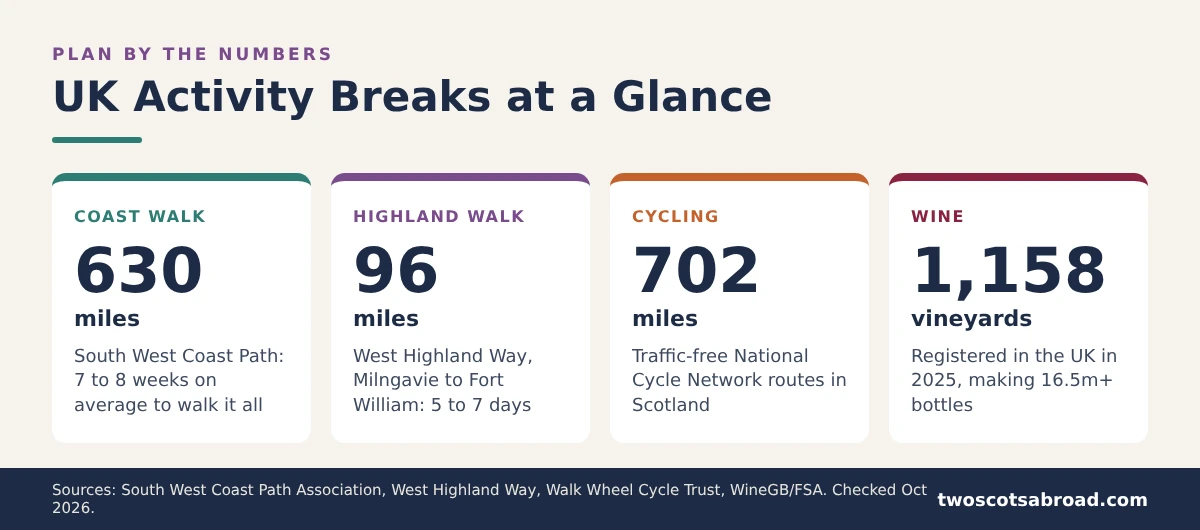
If you are planning a weekend or a week built around walking, golf, cycling or wine, let the activity choose your base before the hotel does. UK activity breaks work best when the route, the room and the timing fit together, and the scale catches people out: the South West Coast Path runs for 630 miles, and most walkers take seven to eight weeks to finish it.
This guide matches each type of break to where to stay, compares the big walking trails, then covers the coast, golf, cycling, vineyards and spa recovery, and ends with a planning order you can follow.
Quick Answer: Which UK Activity Break Suits You?
Pick the activity first, then look for a base within easy reach of it, and quiz the accommodation about the practical bits that make or break the trip: storage, drying space and breakfast times.
| Break type | Where to start looking | Good for | Ask your accommodation about |
|---|---|---|---|
| Walking | Towns along a National Trail or the West Highland Way | Walkers who want a set distance each day and a proper bed at the end | Drying room, early breakfast, packed lunches, bag transfer |
| Coastal water sports | Coastal towns near lifeguarded beaches and licensed outdoor providers | Kayaking, coasteering and surfing with a guide | Wetsuit storage, outdoor tap or shower, breakfast around tide times |
| Golf | Hotels on or near a course, such as St Andrews or East Lothian | Golfers playing two or more rounds | Tee time booking, club storage, golf and hotel package rates |
| Cycling and mountain biking | Near the 7stanes, Coed y Brenin or a National Cycle Network route | Mountain bikers, road riders and leisure cyclists | Locked bike storage, a wash-down hose, drying space |
| Vineyards and food | Kent, Sussex and Hampshire | Couples and food lovers | Taxi numbers and train links to the estates |
| Spa and recovery | Spa hotels close to walking or cycling routes | Mixed groups and rest days | Whether spa access is included and how slots are booked |

Here are the headline numbers for the main break types covered below.
Walking Breaks: Which Long-Distance Trail Fits Your Time?
The trail you pick decides how many nights you need, so start with the distance and work back to the dates. On a short break, pick one section, book two to four nights and use a single base or a bag transfer service.
| Trail | Distance | Start and finish | How long to allow |
|---|---|---|---|
| South West Coast Path | 630 miles | Minehead to South Haven Point, Poole Harbour | Seven to eight weeks on average for the full path |
| Pennine Way | 268 miles (431 km) | Edale to Kirk Yetholm | No set figure; build in rest days |
| West Highland Way | 96 miles | Milngavie to Fort William | Five to seven days |
| Hadrian’s Wall Path | 84 miles (135 km) | Wallsend to Bowness-on-Solway | Seven days |
Distances and timings checked October 2026 on each trail’s official page.
The West Highland Way’s suggested itineraries run from five to seven days, stopping at the main settlements, which makes it the most realistic full trail for a week off. The Hadrian’s Wall Path National Trail page suggests seven days and says the best time to walk is May to October, because the trail is fragile and gets muddy in wet weather.
The Pennine Way National Trail guide makes the point that you don’t have to walk it all at once, and suggests rest days in places such as Hebden Bridge, Skipton, Hawes and Appleby. That is also a handy list of towns to base a shorter break in.
Accommodation matters more on a walking break than on a city break. A drying room is the thing you’ll miss most after a dreich (grey, drizzly) day in the hills, followed by an early breakfast and a packed lunch. If you’re walking in the Highlands in summer, check the worst places for midges in Scotland before you pick a base by a sheltered loch.
Coastal Activity Breaks: Kayaking, Coasteering and Wild Swimming
This section is general information for planning. It does not replace qualified instruction or local safety advice.
Sea kayaking, coasteering, surfing and sailing are the main draws on a coastal activity break, and the sea itself is the part to respect. The RNLI’s May 2026 water safety warning points out that the sea stays cold in warm weather, and that cold water shock can cause uncontrollable gasping and a jump in heart rate and blood pressure.
- Swim between the red and yellow flags on a lifeguarded beach; where there are no lifeguards, check the weather, tide times and local signs first.
- If you get into trouble, Float to Live: tilt your head back with your ears under, relax, and move your hands and legs to stay afloat until your breathing settles.
- If you see someone else in trouble, phone 999 or 112 and ask for the Coastguard.
- Book coasteering and sea kayaking with a guided provider if you are new to it, since local knowledge of tides and access points is what keeps the day safe.
For somewhere to stay, look for wetsuit and board storage, an outdoor tap or shower, and a host who is happy to serve breakfast early when the tide suits a morning session.
Golf Breaks in the UK: Where to Stay Near the Course
Golf is the activity break where staying close to the course pays off most, because tee times are fixed and nobody wants a long drive before an early start. Scotland is the obvious draw: VisitScotland’s golf guide highlights the oldest golf course in the world at St Andrews, and says East Lothian has more championship links per square mile than anywhere else in the country.
England and Wales have plenty of golf hotels too, which helps if Scotland is a long drive from home. Booking sites such as My Hotel Break bundle a hotel stay with golf at a single rate, listing hotels with their own courses in Scotland, England and Wales; you request a tee time in the booking comments and the course confirms it. Compare the package price with booking the room and green fee separately before you commit, since the better deal depends on the course and the dates.
If you’re travelling to Scotland to play, our rundown of the mistakes visitors make when golfing in Scotland covers the booking and etiquette slips that trip people up.
Cycling and Mountain Biking Breaks: Routes and Trail Centres
Leisure and touring cyclists have plenty of traffic-free riding to plan around. Scotland alone has around 1,643 miles of National Cycle Network routes, and 702 miles of those are traffic-free. The network is looked after by the Walk Wheel Cycle Trust, the charity formerly known as Sustrans.
Mountain bikers usually base themselves near a trail centre, which gives you waymarked loops at different grades and somewhere to park. Wales has Coed y Brenin, Britain’s first purpose-built mountain biking centre, which opened near Dolgellau in 1996. In southern Scotland, the 7stanes mountain biking trail centres stretch across the Borders and Dumfries and Galloway, with Glentress, Glentrool and Kirroughtree among the seven.
Bike-friendly accommodation is easy to spot once you know what to ask. You want locked, indoor bike storage, a hose to wash off the mud, somewhere to dry kit overnight and a breakfast time that suits an early ride. A padlocked wee shed round the back does the job nicely.

Vineyard and Food Breaks in England
English and Welsh wine has grown fast enough to build a short break around. The UK had 1,158 registered vineyards in 2025, and production hit the equivalent of more than 16.5 million bottles, a 55% rise on 2024, based on Food Standards Agency data published by WineGB.
The south east is the easiest place to start. Kent, West Sussex, East Sussex and Hampshire held 64% of UK vine plantings between them in WineGB’s 2023 figures, so you can visit several estates from one base. Book tastings and tours ahead and sort out transport before the first glass. A taxi number or a base near a railway station saves anyone drawing the short straw as driver.
Food breaks follow a similar pattern: a cookery class, a foraging walk or a producer visit gives the day a shape, and dinner at the hotel does the rest.
Spa and Wellness Breaks After an Active Day
A spa hotel near good walking or cycling suits mixed groups, where one person wants a long day out and another wants a pool and a sauna. Check whether spa access is included in the room rate or booked by the slot, because popular slots can fill up.
If saunas and cold plunges are the main draw, our guide to winter sauna trips and what to pack covers where to go and what to bring.
How to Plan a UK Activity Break
- Choose the activity and the area, because the route, course or trail centre sets where you need to sleep.
- Book the fixed parts first (tee times, guided sessions, vineyard tours), because they have set slots and the hotel usually doesn’t.
- Book a base close to the activity, and ask directly about storage, drying space and breakfast times before you pay.
- Plan transport between the activity and the base, because a linear walk, a vineyard tour or a car-free trip each needs a different answer.
- Keep a rainy-day fallback, such as a spa slot or an indoor attraction, because the UK weather will test the plan at least once.
For a short active weekend in England, our guide to active things to do in Norfolk shows how to fit several activities into two days from one base.
UK Activity Breaks FAQ
How Many Days Do You Need for an Activity Break in the UK?
Two or three nights works for a golf break, a trail centre visit or a vineyard weekend. A full long-distance walk needs much longer: the West Highland Way takes five to seven days and Hadrian’s Wall Path about seven.
Can You Walk Hadrian’s Wall Path in a Week?
Yes. The 84-mile Hadrian’s Wall Path is usually walked in seven days, and the National Trail recommends walking it between May and October, because the trail gets muddy in wet weather.
Is Wild Swimming in the UK Safe?
UK sea water stays cold even in warm weather, and the RNLI warns that cold water shock can quickly lead to panic. The RNLI says the safest place to swim is between the red and yellow flags on a lifeguarded beach.
Do Golf Break Packages Include Tee Times?
Not always. Some golf and hotel packages ask you to request a tee time when you book, and the course confirms it afterwards, so check what is confirmed before you travel.