
If your package holiday flight is cancelled, you are dealing with two separate problems, and they usually sit with two different companies. The operating airline handles the flight, including fixed compensation that the CAA puts at up to £520 per person for short-notice cancellations, while your holiday company is responsible for the transfers, hotel nights and everything else in the package.
This guide covers who handles what, the documents to keep, how to claim from the airline and the organiser without being paid twice, and where to escalate if either one says no.
Quick Answer: Who Handles What When a Package Holiday Flight Is Cancelled?
Split the problem in two. The flight goes to the operating airline; the rest of the holiday goes to the package organiser, the company named as organiser on your booking confirmation.
| What you need sorted | Who to ask | The rule behind it |
|---|---|---|
| Fixed compensation for the cancellation | The airline that operated, or was due to operate, the flight | UK261 or EU261 |
| Meals, a hotel and transport while you wait for a new flight | The operating airline | UK261 or EU261 care and assistance |
| Missed transfers, hotel nights and other package services | The package organiser | Package Travel Regulations 2018 |
| A price reduction or damages for the part of the holiday you lost | The package organiser | Package Travel Regulations 2018 |
| Costs neither company covers | Your travel insurer | Your policy wording |

Insurance comes last, and it only pays what your policy covers. Our explainer on what travel insurance covers and whether you need it is worth a read before you book the next trip.
Which Documents Should You Keep?
Save everything before you contact anyone, because the same facts will go to more than one company. A package often has two references: the holiday booking reference and the airline’s own booking reference. Record both, along with every passenger’s name.
- The package confirmation and the flight itinerary exactly as the organiser sent them.
- The cancellation message, with the date and time you received it, since the notice period decides whether compensation is due.
- The name of the operating airline shown on the itinerary or boarding details.
- Any replacement flight or refund offered, and any instructions from the organiser.
- Receipts for food, hotels and transport you paid for yourself.
Keep the originals and send copies. Citizens Advice’s guide to delayed or cancelled flights suggests sending photocopies of tickets and receipts, keeping copies of your claim and the replies, and making notes of phone calls.
Ask the Package Organiser About the Rest of Your Holiday
A cancelled flight knocks on to transfers, hotel check-in and anything you booked for the first few days. Under the Package Travel Regulations 2018, regulation 15, the organiser is liable for the performance of the travel services in your package, you must tell it about a problem without undue delay, and it must put the problem right within a reasonable period unless that is impossible or would cost a disproportionate amount.
Contact the organiser as soon as the cancellation lands and ask what it is arranging. Get its answer in writing, especially if you’re told to wait, travel by another route or pay for something yourself and claim it back later.
If part of the holiday is lost, regulation 16 on price reductions and compensation says the organiser must offer an appropriate price reduction for the period the package wasn’t delivered as agreed (unless it can show you caused the problem), and appropriate compensation for any damage you suffer, subject to a few exceptions. Hotel issues on the ground follow the same route; our piece on why hotels cancel reservations and what to do covers the room side if the first night falls through.
How to Claim Flight Cancellation Compensation From the Airline
Compensation is claimed from the airline that operated, or was due to operate, the flight. The EU’s Your Europe page on air passenger rights says only the operating airline can be held responsible, and that can be a different airline from the one that sold the seat. A tour operator’s logo on the itinerary doesn’t make it the airline, so check the operating carrier and ask the organiser to confirm it if the paperwork is unclear.
Which rules apply depends on the route. UK261 covers flights departing a UK airport on any airline, flights arriving in the UK on a UK or EU airline, and flights arriving in the EU on a UK airline. EU261 covers flights departing an EU airport on any airline, and flights arriving in the EU on an EU airline.
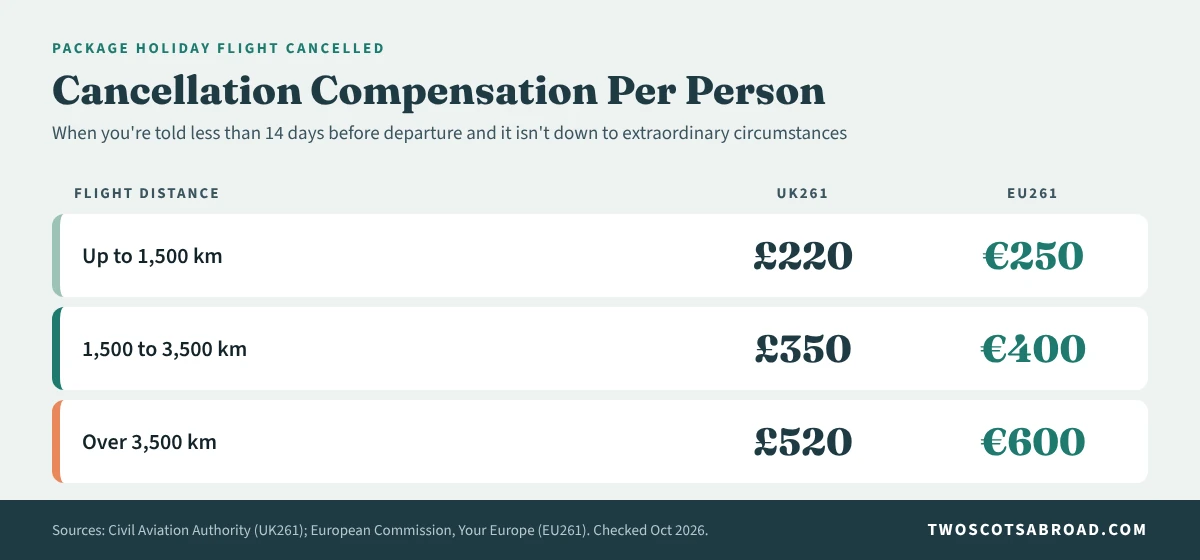
Here’s what each scheme pays per person when you’re told about the cancellation less than 14 days before departure.
- More than 14 days’ notice: no fixed compensation, but you still choose between a refund and a replacement flight.
- Less than 14 days’ notice: compensation may be due, though the CAA reduces or removes it if the replacement flight departs and arrives close to the original times.
- Extraordinary circumstances: the CAA lists extreme weather and air traffic control or airport staff strikes as reasons the airline doesn’t have to pay compensation.
Keep the airline claim to the flight itself. A clear account of the cancelled service, the notice you received and the replacement you were offered is the core of claiming flight cancellation compensation, and the airline doesn’t need your hotel or transfer problems to assess it. The same process applies when a flight is late; our guide to claiming compensation for a delayed UK flight walks through it.
How to Avoid Being Paid Twice for the Same Loss
Airline compensation and package compensation can overlap. Regulation 16(9) of the Package Travel Regulations says that where you receive compensation under passenger rights rules such as UK261 and also under the package rules, the organiser deducts one from the other to avoid overcompensation.
The easiest way to stay on top of it is one running record of every refund, payment and offer, with who made it and what it covers. Here’s an example layout:
| Payment or offer | Who offered it | What it covers | Status |
|---|---|---|---|
| Replacement flight or refund | Operating airline or organiser | The cancelled flight | Accepted or declined |
| Meals and a hotel night while waiting | Operating airline | Care while you wait to fly | Receipts sent |
| UK261 or EU261 compensation | Operating airline | The cancellation itself | Claim submitted |
| Missed transfer and lost hotel night | Package organiser | Package services you didn’t get | Price reduction requested |
| Anything left over | Travel insurer | Whatever your policy covers | Check before claiming |
Don’t claim an expense as unpaid after someone else has reimbursed it. If an offer comes with broad settlement wording, read exactly what it resolves before you accept, and keep a copy. The amount on its own won’t tell you which issues are closed.
How to Write Separate Follow-Ups to the Airline and Organiser
Use the same flight facts in every message, but ask each company only the question it can answer. A single email asking everyone to fix everything makes it harder for each company to see which part is theirs.
- To the organiser: the holiday reference, what you missed (transfer, nights, excursions) and a request for a remedy or price reduction under the package contract.
- To the operating airline: the airline booking reference, flight number, date, when you were told about the cancellation and a request for a compensation decision and any care costs.
- In both: what you’ve already been paid or offered, and by whom, so nobody has to guess.
Where to Escalate if the Airline or Organiser Says No
Complain in writing first. The CAA’s guide to how it can help says it won’t step in until you have, and you can escalate to its Passenger Advice and Complaints Team if the airline hasn’t replied within 8 weeks or you’re unhappy with the outcome. If the airline belongs to an approved alternative dispute resolution scheme, that scheme handles it.
For the holiday side, check whether the organiser belongs to a trade body such as ABTA or AITO, which run codes of conduct and arbitration for members. If it doesn’t, Citizens Advice is the next stop.
You can claim from the airline yourself. If coordinating the flight claim alongside the holiday dispute feels like too much, claims companies such as Lennuabi will assess a cancelled flight and handle the EU261 compensation claim for you. Its cancellation page describes a no-win, no-fee model, so check the commission rate before you sign up, and keep talking to the organiser about the package yourself.
Package Holiday Flight Cancelled: FAQ
Do You Claim Flight Cancellation Compensation From the Tour Operator or the Airline?
UK261 and EU261 compensation is claimed from the airline that operated, or was due to operate, the flight. The tour operator is responsible for the package services, such as transfers and hotel nights, under the Package Travel Regulations 2018.
How Much Compensation Do You Get for a Cancelled Package Holiday Flight?
Under UK261, compensation for a cancellation with less than 14 days’ notice is £220, £350 or £520 per person depending on flight distance; under EU261 it is €250, €400 or €600. It can be reduced or removed if the replacement flight runs close to the original times, and isn’t paid for extraordinary circumstances such as extreme weather.
Does Airline Compensation Reduce What the Holiday Company Pays?
It can. Regulation 16(9) of the Package Travel Regulations 2018 requires the organiser to deduct compensation paid under passenger rights rules from its own compensation, so the same loss isn’t paid twice.
What if the Flight Was Cancelled More Than 14 Days Before Departure?
There’s no fixed UK261 or EU261 compensation with more than 14 days’ notice, but you can still choose a refund or a replacement flight. Any changes to the rest of the package are a matter for the organiser under your package contract.