
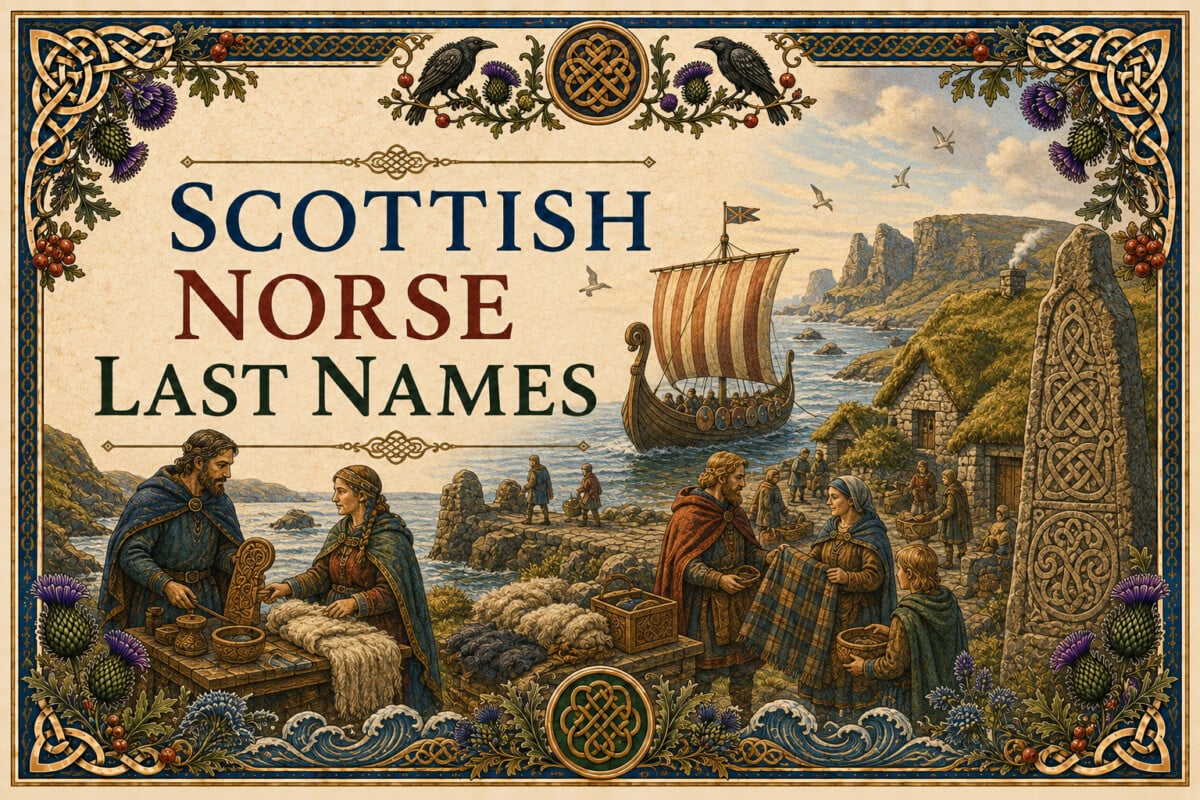
Scottish Norse last names are family names shaped by the long Norse presence in northern and western Scotland, especially Orkney, Shetland, Caithness and the Hebrides. Names such as Gunn, Raven and Harold can preserve Old Norse words or personal names, though a surname alone cannot prove descent from a particular Viking ancestor.
The useful clue is geography as much as spelling. Norse settlers established communities across Scotland’s northern isles and Atlantic coast between the Viking Age and the medieval period, where their language mixed with Gaelic, Scots and later English naming traditions.
For family-history research, a surname is a starting point, not a verdict. Spellings shifted, families moved, and many modern surnames became fixed long after the first Norse settlers arrived. Comparing a suspected Norse name with broader lists of Scottish last names beginning with G or Scottish last names beginning with M can also help separate a regional clue from a coincidence.
If you are interested in specific last or first names of the Scottish origin, try our interactive tool below:
Scottish Names Beginning With
Choose which type of Scottish name you would like to explore.
Why Norse Names Took Root in Scotland
Norse people did more than raid Scotland’s coasts. They settled, farmed, traded and built communities in places connected by sea routes to Norway, Ireland and the wider North Atlantic. Historic Environment Scotland identifies Norse settlement remains at Jarlshof in Shetland, including longhouses and outbuildings, and at the Brough of Birsay in Orkney, where a Norse settlement dates from the ninth to the 11th centuries.
Those places help explain why northern island surnames and place names can sound markedly different from Lowland Scottish names. A household might adopt or inherit a name based on a Norse-speaking forebear, a farm, an occupation or a characteristic. Over generations, the original word could be altered to suit Gaelic or Scots pronunciation.
Caithness also sits at the heart of this story. Its close maritime links with the northern isles made it part of the Norse-Gaelic world for centuries. In the Hebrides, Norse settlement met a powerful Gaelic culture, producing names and identities that cannot be sorted into neat modern boxes. Family history is rarely that obliging.
Scottish Norse Surnames and Their Meanings
The examples below are among the clearest names with Norse associations in Scotland and northern Britain. Some are direct survivals of Old Norse forms, while others are later surnames built from Norse personal names.
| Surname | Old Norse Connection | Meaning or Origin | Where the Link Is Most Relevant |
|---|---|---|---|
| Gunn | gunnr | “Battle” or “war” | Northern Scotland, including Orkney and Caithness |
| Raven | Hrafn | “Raven” | Norse cultural and personal-name tradition |
| Harold / Harald | Haraldr | Usually understood as “army ruler” | Scandinavian and Anglo-Norse naming traditions |
| Thoresen | Þórr | A patronymic built from the name Thor | Scandinavian-style family naming |
| Ormsby | Ormr + by | “Ormr’s farm” or settlement | Norse settlement-name tradition in northern Britain |
Gunn
Gunn is one of the strongest Scottish examples because it is linked to the Old Norse word gunnr, meaning battle or war. It is also associated with the Highland Clan Gunn, a connection that makes it particularly familiar in Caithness and the far north. Like many old names, its exact route into every individual family line needs documentary research.
Raven
Raven comes from the Old Norse personal name Hrafn, meaning raven. Ravens had a prominent place in Norse symbolism and storytelling, including associations with Odin. In a family-name context, Raven may have begun as a personal name or nickname before becoming hereditary in some lines.
Harold and Harald
Harold and Harald preserve a famous Scandinavian personal name, often interpreted as “army ruler.” The name is associated with figures such as Harald Hardrada, killed at the Battle of Stamford Bridge in 1066. Its appearance in Scotland can reflect the broad movement of Norse names through Scandinavian, Anglo-Norse and Scottish communities.
Thoresen
Thoresen follows a recognisably Scandinavian patronymic pattern: a son identified through a father whose name referred to Thor. The ending -sen means “son of” in Scandinavian naming traditions. That pattern is useful context, but it should not be confused with the Scottish Gaelic Mac, which also means “son” but comes from a different language family.
Ormsby
Ormsby is built from the Norse personal name Ormr, meaning serpent or dragon, plus -by, a term for a farmstead or settlement. It is a particularly clear example of how Norse place-name elements could become surnames. The -by ending is especially familiar in parts of northern England, so an Ormsby line calls for careful regional research before claiming a specifically Scottish origin.
What About MacLeod, MacAulay and Other Highland Names?
Some Scottish surnames associated with the Hebrides and western Highlands are often discussed alongside Norse heritage because Norse and Gaelic communities overlapped for generations. MacLeod, for example, is traditionally connected with Leod, a personal name often treated as Norse in origin. The surname itself uses the Gaelic patronymic prefix Mac, showing how languages could combine in one family identity.
This is an important distinction. A name can have a Norse personal-name root but a Gaelic surname form. It may also have been adopted by people who shared a region, language or lordship with Norse-descended families. In the Hebrides especially, “Norse” and “Gaelic” are often part of the same historical landscape. Names beginning with M can show the same mix of Gaelic surname forms and older personal-name influences.
How Surnames Developed After the Viking Age
Viking-age Scandinavians generally used changing patronymics, identifying a person as the son or daughter of a parent. A man known as Bjorn’s son could be called Bjornsson, while his own son might carry a different descriptive name. Permanent inherited surnames developed later and unevenly across Scotland.
That is why a modern surname ending in -son or -sen is not automatic proof of Viking ancestry. It may reflect Scandinavian naming, a later Scottish or English patronymic, or a spelling selected by record keepers. Names are durable, but they also pick up new coats of paint as they pass through parish registers, censuses and legal papers.
Where To Look for Norse Family-Name Clues
Start by mapping where the earliest documented members of your family lived. A Gunn line rooted in Caithness or Orkney carries a different historical context from the same surname first recorded in Glasgow several centuries later. Parish registers, census returns, gravestones and estate records can establish that local trail.
- Orkney: Look for families tied to parishes near sites such as the Brough of Birsay, where Norse settlement remains sit above earlier Pictish traces.
- Shetland: Use local place names and records alongside surname evidence. Jarlshof demonstrates the depth of settlement history on the islands, though archaeology cannot identify a modern family line by itself.
- Caithness: Pay attention to links with the northern isles, as well as later movement south through Scotland.
- The Hebrides: Check Gaelic variants, anglicised spellings and local naming customs. A single ancestor may appear under several spellings in historical records.
A genealogy research notebook is handy for recording variant spellings, locations and document references as you go. It sounds gloriously unglamorous, but it is far easier than trying to reconstruct a family tree from a browser-history archaeology dig. It can also help to compare unusual spellings against lists of Scottish surnames beginning with R and Scottish surnames beginning with H, since a clerk’s spelling choice could send a family line down an unexpected alphabetical path.

Genealogy Research Logbook: Genealogy Research Organizer, family Research Log to Build And Organize Your Family History, Timeline Genealogy Research, 100 Pages, Large Print 8.5 x 11 in
How To Avoid Overclaiming Viking Ancestry
Use a surname to form a research question: “Was this family established in a Norse-influenced part of Scotland?” Avoid using it as a final answer. The strongest case combines a plausible name origin with an early paper trail in Orkney, Shetland, Caithness or the Hebrides.
DNA results can add broad regional context, but they do not usually identify a named Viking ancestor or prove that one surname came down a single unbroken line. Documentary evidence remains the practical backbone of genealogical work.
Frequently Asked Questions About Scottish Norse Last Names
Do Scottish surnames prove Viking ancestry?
No. A Scottish surname with a Norse origin can point to a historical connection, especially in Orkney, Shetland, Caithness and the Hebrides, but it cannot prove direct descent from a particular Viking individual.
What Scottish surname has a Norse meaning of battle?
Gunn is linked to the Old Norse word gunnr, meaning battle or war. It has long-standing associations with northern Scotland and Clan Gunn.
Are surnames ending in -son always Viking names?
No. The ending -son is a patronymic marker meaning “son of,” but it appears in several naming traditions. It is a useful clue only when supported by geography, records and the name’s wider history.
Which parts of Scotland have the strongest Norse heritage?
Orkney, Shetland, Caithness and the Hebrides have especially strong Norse historical connections. Archaeological sites including Jarlshof in Shetland and the Brough of Birsay in Orkney preserve physical evidence of Norse settlement.
The Most Useful Way To Read a Scottish Norse Surname
A Scottish Norse surname is best read as a surviving fragment of a larger story about migration, language and local communities. Gunn may point toward an Old Norse word for battle, Raven toward Hrafn, and Ormsby toward a farm named for Ormr. The family records tell you where that fragment belongs.
For people tracing roots in the northern isles, Caithness or the Hebrides, that combination of name, place and paperwork can turn a broad Viking connection into a much more grounded family history.