
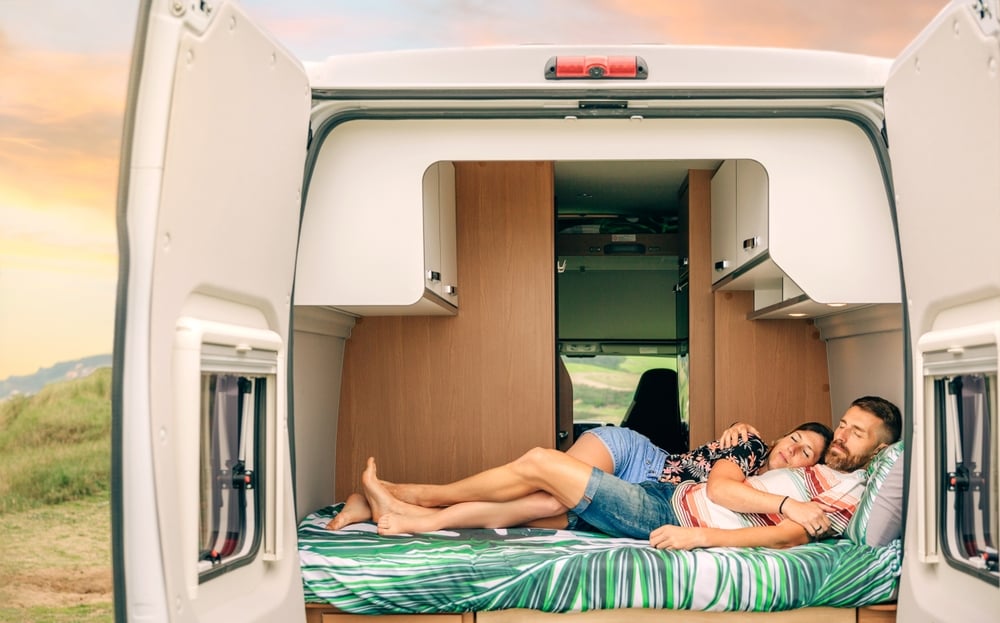
Most caravan trips are weekends, and on a two-night break the hybrid caravan sleeping layout decides how much of that time goes on camp jobs. A bed that’s made when you arrive has you asleep minutes after parking; a dinette bed gets rebuilt every night and packed away every morning, four conversions on a Friday to Sunday trip.
Below, we compare fixed beds with convertible dinettes, match bunks and twin singles to the people who travel, look at what gets traded for a proper bed, and finish with a showroom test and a check of the weights.
Why Does the Sleeping Layout Matter More on Short Trips?
On a month-long tour, an hour of setup spreads across thirty nights. On a weekend, the same hour comes out of two evenings and a Sunday morning, and it repeats every time you go away.
Picture the usual Friday: a full working week behind you, a drive ahead, and an arrival after dark, sometimes in the rain. Every job between switching off the engine and getting into bed costs energy you’ve already spent. Sunday then runs the same routine in reverse before you can hitch up and leave.
That’s often why caravans sit on driveways. If the effort of setting up starts to outweigh the weekend itself, the van stays at home. The simpler the arrival routine, the more often it tends to get used.
| Layout | Nightly bed jobs | Best for | Watch out for |
|---|---|---|---|
| Fixed island bed, walkaround | None: it travels made | Couples who go away most weekends | Takes more floor space than a corner bed |
| Fixed corner bed | None, but one person climbs over the other | Couples short on floor space | Night-time trips to the ensuite |
| Convertible dinette as main bed | Build at night, pack away each morning | Longer trips where daytime space matters | Bedding needs somewhere to live all day |
| Bunks | None: bedding stays in place | Families with children | Unused space if the kids stop coming |
| Twin singles | None | Friends or siblings | Less space left for a lounge area |

Fixed Island Bed or Convertible Dinette?
A fixed island bed takes most of the work out of arriving. The bedding stays made while you tow, so there are no cushions to shuffle and no table to drop. It’s also there in the afternoon for a nap, with nothing to convert.
A convertible dinette works hard for its space: a table for dinner and a bed at night. The price is paid twice a day. Each morning the bedding comes off and gets stowed so the table can go back up, and each evening the routine reverses. In a compact van, that bedding usually ends up on a seat or in the aisle during the day.
That trade can make sense on a long trip, where the daytime floor space gets used for weeks. It also works well as a spare bed for occasional guests. As the main bed on a weekend away, it spends limited evening hours on furniture.
Does Walkaround Access Matter?
Corner beds save floor space, but the person against the wall has to climb over their partner to get out. On a short trip, with late nights and early starts, that climb happens a lot.
An island bed with walkaround access gives each person their own side, so either of you can get up without waking the other. It’s easier to make, too, since fitted sheets go on without anyone kneeling on the mattress. Check the route from the bed to the ensuite as well: you’ll walk it half asleep in the dark, so it should be short and clear of bunk edges and slide-outs.

Which Layout Suits Families and Groups?
Purpose-built bunks give children a space of their own. Sleeping bags and pillows stay put, the walkway stays clear, and nobody has to convert the dinette at 8pm for bedtime or again at 7am for breakfast. Bunks also mean the kids going to bed doesn’t end the evening for the adults, because the living area stays a living area.
Twin single beds running along each wall suit friends or siblings travelling together. Everyone gets a proper bed, and the corridor between them is handy for sorting gear.
Choose for the group that travels most often. A couple doesn’t need permanent bunks, while a family of four will feel the nightly dinette conversion by the second trip. Occasional extra guests can take the convertible space.
What Do You Trade for a Proper Bed?
A compact floor plan has only so much room, and every feature uses some of it. An internal cooktop and sink take up floor space that could go to a bigger bed. Moving the kitchen outside, under the awning, can free up room for a larger mattress inside. The catch is that the awning becomes part of your kitchen, so check how quickly it winds out, especially for wet evenings.
Cooking outdoors also keeps heat and food smells out of the sleeping area, which you’ll appreciate on warm nights. A pop-top roof follows similar logic: it keeps the towing height low on the road and gives you standing room and airflow at camp.
This is the kind of compromise a purpose-built Hybrid Caravan is designed around. Austrack’s range, for example, includes a two-berth couples’ layout and a family version with triple bunks that sleeps up to five, so compare the floor plans against how your own group travels.
The ensuite is the other big space decision. Where it sits usually decides whether the main bed is at the front or the rear of the van, and an internal toilet and shower turns a midnight trip into a few steps across your own floor.
Can You Reach Your Storage Without Unmaking the Bed?
Under-bed storage that lifts on gas struts solves a very specific weekend problem. Raise the bed base and bulky items like recovery gear and luggage are right there, with the sheets and pillows left in place. It keeps the aisle clear, too, and in a compact van the aisle is most of your floor.
Watch for weaker versions: storage that only opens from an outside hatch, or a base that needs the bedding stripped before it lifts. Both turn a quick grab into a job. Weight matters here as well: Transport for NSW’s caravan safety advice for drivers says to pack the heaviest items low and centred over the axles.
Our guide to keeping a caravan in good shape between trips covers airing those under-bed spaces so damp doesn’t build up while the van is parked.
Run Your Friday Night Arrival Drill
Try your layout against a wet Friday arrival. The drill clocks every job from engine off to lights out, then totals the bed conversions and pack-down across a two-night trip.
 Friday Night Arrival DrillHybrid caravan
Picture pulling into a campsite on Friday night. Choose your layout and the conditions, and the drill clocks every job between switching off the engine and switching off the light, then adds up the camp chores across the whole weekend.
Lights out
Camp chores, whole weekend
Friday night, minute by minute
Watch for
How Do You Sleep Well in a Hybrid Caravan?
A short trip still depends on a good night’s sleep, because Saturday is the trip. A few things make a big difference:
- Insulation: insulated wall panels help hold the temperature steadier overnight.
- Airflow across the bed: zipped screens in a pop-top let you open up in the heat and close down in the cold, and a fan near the bed keeps air moving on still nights.
- Power at the pillow: check which outlets are within reach of the bed, what your devices draw, and whether the battery and inverter can cover them all night. A CPAP machine, fans and phone charging all add to that load.
- Ergonomics: you should be able to reach the light switches from the pillow and sit up without hitting overhead cupboards.
What Should You Check Before the Friday Drive?
The layout matters before you arrive, too. A caravan’s weights decide which cars can tow it and how relaxed the Friday drive feels. The RACQ guide to choosing a trailer and tow vehicle notes that all trailers built since August 1989 must carry a plate listing their Aggregate Trailer Mass (ATM), and that ball load shouldn’t exceed 10% of the ATM unless the manufacturer says otherwise.
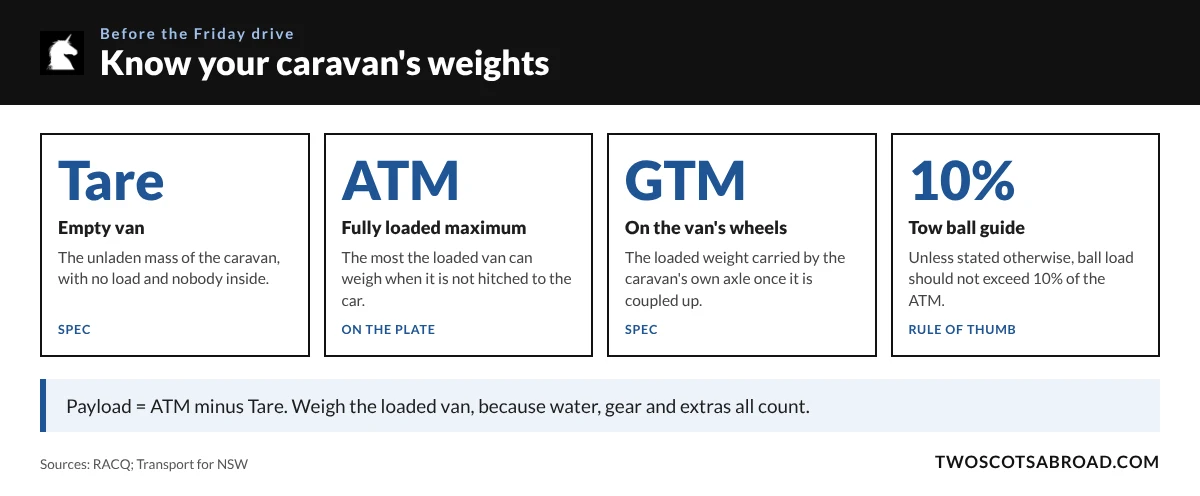
| Term | What it means | Why it matters for weekends |
|---|---|---|
| Tare | The van’s unladen weight | Your starting point before water, gas and gear |
| ATM | The maximum loaded weight, unhitched | Must sit within your car’s towing limit |
| GTM | The loaded weight on the van’s own axle when hitched | Slightly lower than ATM, as some weight moves onto the car |
| Payload | ATM minus Tare | How much gear, water and extras you can carry |
| Ball load | Weight pressing down on the tow ball | Must stay within the car’s and tow bar’s limits |
Don’t rely on brochure figures alone. Transport for NSW recommends weighing the loaded van on its jockey wheel to check the ATM, and again while hitched to check the GTM.
Suspension and dust sealing don’t change the bed, though good dust sealing means clean sheets at the end of a gravel road. A van that copes with unsealed tracks also puts quieter campsites within a Friday-evening drive. For a weekend target in spring, our guide to the NSW South Coast in spring has plenty of options, and for longer trips with more time to settle in, here’s why the Top End belongs on your driving bucket list.
How Should You Test a Floor Plan Before You Buy?
Floor plans look good on paper, so test them against a bad night. Picture an 8pm arrival in light rain after a long week, and ask what has to happen before anyone can lie down.
- Compare like for like: for each layout, list the berth count, bed type, nightly conversions and who climbs over whom.
- Count the evening steps: the layout with the fewest usually wins the weekend, even if another one photographs better.
- Run the morning too: pack-down takes time, and a fixed bed means nothing to dismantle on Sunday.
- Stand in the van: lie on the bed, reach for the switches, lift the bed base and walk to the ensuite with the lights down low.
Ten minutes of that routine in a showroom tells you more than an afternoon of brochures. For the packing side of things, our road trip hacks for an easy ride help keep the car and van organised.
Frequently Asked Questions
Is a fixed bed better than a dinette in a hybrid caravan?
For weekend trips, usually. A fixed bed travels made and needs no nightly conversion. A dinette bed suits longer trips where you want the daytime space, or as a spare bed for guests.
What is the best caravan layout for a family?
Bunks for the children plus a fixed main bed keeps both bedtime and breakfast simple. Kids sleeping on the dinette means converting it every night and every morning.
What does ATM mean on a caravan?
Aggregate Trailer Mass is the most the fully loaded caravan can weigh when it’s unhitched. It’s listed on the compliance plate of trailers built since August 1989.
How much should the tow ball weight be?
As a general guide, RACQ says ball load shouldn’t exceed 10% of the trailer’s ATM unless the manufacturer specifies otherwise. Always stay within your car’s and tow bar’s own limits.