
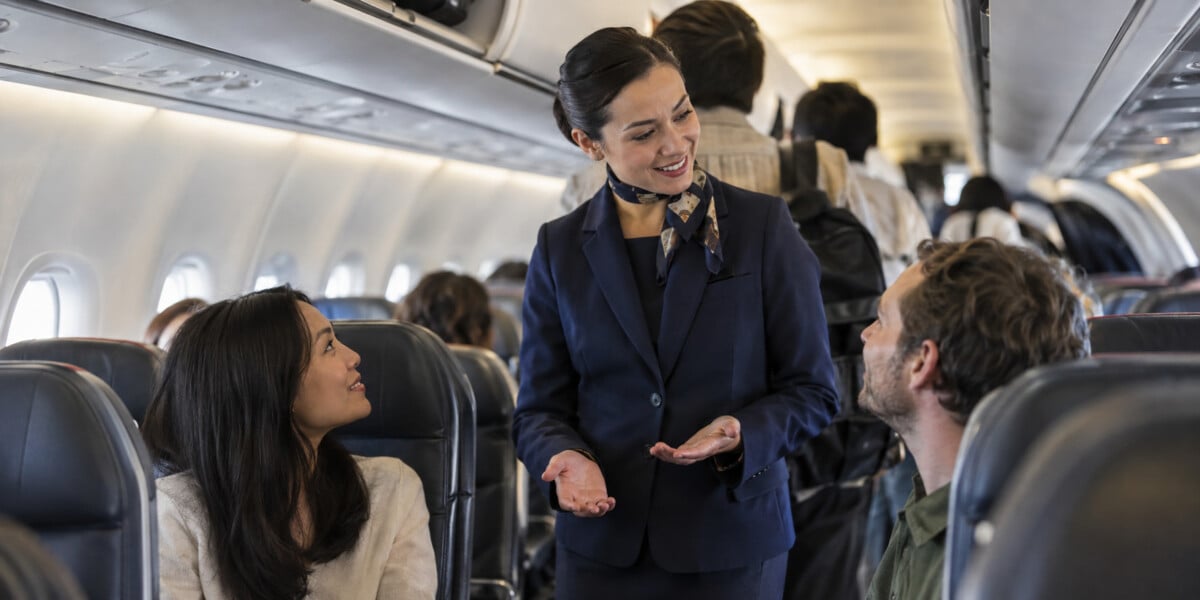
No, flight attendants do not usually have to speak multiple languages. Airlines normally require fluent communication in their main operating language, while extra languages are required or strongly preferred for specific routes and language-qualified cabin crew positions.
It is an understandable question after an international flight. Cabin crew often make announcements in more than one language and switch easily between passengers, but that does not mean every attendant on the aircraft is multilingual.
What Language Skills Do Flight Attendants Need?
Flight attendants need strong spoken and written communication skills in the language used for airline training, safety procedures, manuals and crew briefings. For airlines based in English-speaking countries, that will commonly be English.
In the United States, the legal baseline is clear. The Federal Aviation Administration rule at 14 CFR §121.391 says each required flight attendant on an applicable Part 121 service must be able to speak, read, write and understand English. The rule does not state that every required attendant must speak a second language.
That requirement reflects the safety side of the job. Cabin crew must understand operational instructions, coordinate with colleagues, give safety demonstrations and act quickly during an emergency. Passenger service is part of the role, but it is not the main reason cabin crew are carried on an aircraft.
When Is a Second Language Required?
A second language becomes important when an airline recruits for a particular route, country or customer base. These jobs are often advertised as bilingual, multilingual or language-qualified cabin crew roles.
An airline flying regularly between two language markets may want several crew members who can communicate confidently with passengers in both languages. The language need may cover routine announcements, meal queries, rebooking information after disruption and clear instructions during an unusual situation.
The requirement usually applies to the advertised role, not every flight attendant employed by the airline. A crew roster can include attendants with different language skills, allowing the airline to place suitable speakers on services where they are needed.
- A flight serving a destination where Spanish is widely spoken may have Spanish-speaking cabin crew.
- Services to parts of East Asia may include attendants recruited for Mandarin, Cantonese, Japanese or Korean language ability.
- Airlines serving multilingual home markets may value several languages across their cabin crew workforce.
- Some carriers list another language as an advantage, while reserving a firm language test for designated vacancies.
Exact language needs vary by airline and can change as routes, bases and recruitment campaigns change. Applicants should use the wording in the individual vacancy as the deciding factor.

Do International Flights Need Multilingual Cabin Crew?
International flights do not automatically require every cabin crew member to speak the language of the destination. Airlines can use translated recorded announcements, written information and a roster containing crew members who cover the relevant language needs.
Airlines also need crews to communicate with one another in a common working language. On a busy aircraft, especially during a delay or emergency, a clear shared language between crew members matters more than having every possible passenger language covered.
Passengers should not assume a flight will have a speaker of every language used at either airport. English is commonly used in international aviation, though a carrier may add other languages based on its route network and passengers. A translation app, medication details written down and key booking information saved offline can make a long journey less stressful when communication gets patchy.
How Airlines Assess Language Ability
Airlines that need bilingual cabin crew generally assess the language during recruitment. The process can include an interview, a written exercise, a role-play with a passenger or a proficiency assessment arranged by the airline.
Knowing holiday phrases is unlikely to be enough for a language-qualified position. Cabin crew may need to explain a delay, respond to a medical concern, check that a passenger understands an instruction or pass accurate information to another crew member. That calls for clear, reliable communication under pressure.
Airlines may also set their own definition of fluency. Being able to hold a conversation with family is different from using a language professionally in a crowded cabin at 35,000 feet.
Can You Become a Flight Attendant With Only One Language?
Yes. Many cabin crew jobs are open to applicants who meet the carrier’s required standard in one language, provided they satisfy the other hiring and training requirements. These commonly include age rules, right-to-work eligibility, medical fitness, background checks, reach requirements and successful completion of initial training.
A second language can still strengthen an application, particularly with international airlines and carriers operating from large hubs. It may widen the range of vacancies you can apply for, but it is not a universal entry condition.
For travellers, it also helps to remember that cabin crew are there first for safety. Good service makes a flight more pleasant, and so do a few sensible long-haul flight comfort habits, but language skills are one part of a much larger trained role.
What This Means for Passengers
It is reasonable to ask politely if a crew member speaks a language you need, particularly if the issue involves a connection, dietary requirement or medical concern. Cabin crew may be able to find a colleague who can help, although there is no guarantee on every service.
For a serious medical issue or safety concern, tell a flight attendant promptly and use simple, direct language. Keep prescriptions, allergy information and important contact details accessible during the flight. Avoid relying on a translation app alone when you need urgent assistance; airport Wi-Fi has a habit of disappearing at the least helpful moment.
And while cabin crew may make difficult situations easier, passengers should be aware that tipping a flight attendant is subject to airline policies and may not be accepted.
Frequently Asked Questions
Do All Flight Attendants Speak English?
No universal global rule applies to every airline. However, English is widely used in international aviation, and U.S. regulations require each required flight attendant on covered Part 121 operations to speak, read, write and understand English.
Do Flight Attendants Get Paid More for Speaking Another Language?
Pay arrangements depend on the airline and employment contract. Some airlines may offer language-related roles or premiums, while others may simply treat another language as a useful recruitment qualification.
Do Cabin Crew Have to Learn the Language of Every Destination?
No. Cabin crew do not need to learn every destination language in an airline’s network. Carriers generally use crew rostering, translated announcements and language-qualified roles to support services where another language is needed.
Is Being Bilingual Helpful for Cabin Crew Applications?
Yes, particularly for airlines with international route networks or vacancies that name a specific language. Applicants should still check each job listing, because a second language may be required, preferred or irrelevant for that particular cabin crew role.
