If you have a Scottish surname and a hunch about which clan it belongs to, the name is a useful clue and a poor piece of proof. Scottish surnames and clan history are tied together, but a shared surname does not prove you descend from a clan chief. The idea that everyone with a clan surname is the chief’s kin is a common misconception about clan surnames. Followers often took their laird’s name, spellings drifted, and plenty of unrelated families ended up with the same one.
The catch is that your surname can still make you part of a clan today, because clan membership runs on a different rule from blood descent. Below: what your surname can and cannot prove, how the names got attached to clans, what Scotland’s most common surnames say about clans (checked in November 2026), and how to prove a real connection with records.
Quick Answer: What Your Scottish Surname Can and Cannot Prove
Here is each common claim, how far a surname alone gets you, and where to check it properly.
Pick a claim to see whether your surname settles it, and what does.
| Claim | Does the surname prove it? | What actually settles it |
|---|---|---|
| I am descended from the clan chief | No | A documented family tree, sometimes backed by Y-DNA |
| I am a member of the clan | Yes, if it is the chief’s own surname | The chief’s rules; allegiance also counts |
| My name is a sept of the clan | Only if that chief accepts it | The individual chief or clan society |
| I can use the family coat of arms | No | A grant or matriculation from the Lord Lyon |
| I can wear the clan tartan | Custom says yes; law says anyone can | The Scottish Register of Tartans |
| My family came from the Highlands | It hints at it | Parish and statutory records |
| My ancestors spoke Gaelic | A Mac name hints at it | Census and parish records for the area |
How to read the table: “No” means the surname is not evidence on its own. A matching record trail turns a hint into a fact.
How Scottish Surnames and Clans Became Linked
Permanent surnames began to appear in Scotland around the 12th century, but they spread slowly and unevenly. Many Scottish names started as patronymics, where a son’s surname came from his father’s first name and changed with every generation. That habit died out in the Lowlands after the 15th century. In some Highland areas fixed surnames did not become the norm until the 18th century, and in parts of the Northern Isles not until the 19th.
That late start is the root of the problem. When Highland families finally settled on a surname, many chose the name of the clan whose land they lived on. Followers often adopted the clan name to curry favour with the laird, so a MacDonald in 1750 could be a chief’s kinsman, a tenant or someone who simply found the name useful.
Names were also taken away. The MacGregors are the best-known case: Scottish Acts against the “Clan Gregour” stopped families using the name for long periods, and an Act passed at Westminster on 29 November 1774 repealed the 1633 and 1693 Acts against the MacGregors. During those years many MacGregors lived under other surnames, so their descendants may carry a name with no MacGregor sound to it at all.
Highland and Lowland Surnames: What the Name Tells You About Region
A surname is better at pointing to a region and a language than to a bloodline. Mac is a Gaelic prefix meaning “son”, so MacDonald began as “son of Donald”, and the name suggests Gaelic-speaking roots somewhere back in the line. Mac and Mc are the same thing: records often switch between them for the same person, and ScotlandsPeople indexes the two spellings separately, so search both.
The Highland and Lowland split is real but leaky. The full breakdown sits in our guide to Highland and Lowland Scottish surnames; the short version is that Lowland names more often come from:
- Places and estates, such as Murray, from the old province of Moray. Our list of Scottish surnames from places covers the common ones.
- Trades, such as Smith, Taylor and Walker, all in Scotland’s top 20 today. See the Scottish surnames from occupations.
- Incomers, including Anglo-Norman families who arrived with royal land grants and Norse settlers in the north and west, covered in our guides to Norman surnames in Scotland and Scottish Viking surnames.
Highland names lean Gaelic, and the Gaelic last names guide gives 100 with meanings. The Borders are their own world again: the riding families there formed “surnames” that behaved like clans without the Gaelic, as our guide to Border Reiver surnames explains.
Migration muddies all of this. Many emigrants from Scotland changed their names on arrival in a new country, and clerks who could not spell a Gaelic name wrote down what they heard.
Does Sharing a Surname Make You a Clan Member?
Yes, in most cases. Under the Standing Council of Scottish Chiefs’ guidance, every person with the same surname as the chief is deemed a member of the clan. The same guidance says a person who offers allegiance to the chief is also recognised as a member, unless the chief decides not to accept it.
So clan membership is a matter of name and loyalty, and descent is a separate question. A Campbell in Ohio is a member of Clan Campbell whether or not any ancestor ever met an Earl of Argyll. A woman with a Smith surname whose grandmother was a Robertson can offer allegiance to the Robertson chief.
Two limits apply:
- The clan needs a recognised chief. There are about 140 clans with chiefs recognised by the Lord Lyon, and a family or name group with no recognised chief has no official position under the law of Scotland.
- Clan societies set their own rules. Joining a clan society is a separate step, and some ask for a surname or descent link before you sign up.
Septs: Why One Surname Can Belong to Several Clans
A sept is a surname associated with a clan that is not the chief’s own name, such as a family that lived on clan land or served the chief. If your surname is Smith or Reid, you have probably seen it on a dozen sept lists for different clans.
Those lists carry less weight than they look. There is no official list of recognised septs: the Standing Council says each chief decides for their own clan, and a name traditionally tied to one clan should not be claimed by another chief. The sept lists you find online come from clan societies, books and tartan sellers, each reflecting its compiler’s choices, and a common trade name like Smith can sit on several of them at once.
A sept listing tells you that a clan welcomes people with your name. It says nothing about whether your own ancestors had anything to do with that clan. Our guide to Scottish clan surnames and septs covers the common pairings and why one name turns up under several clans.
What Scotland’s Most Common Surnames Say About Clans
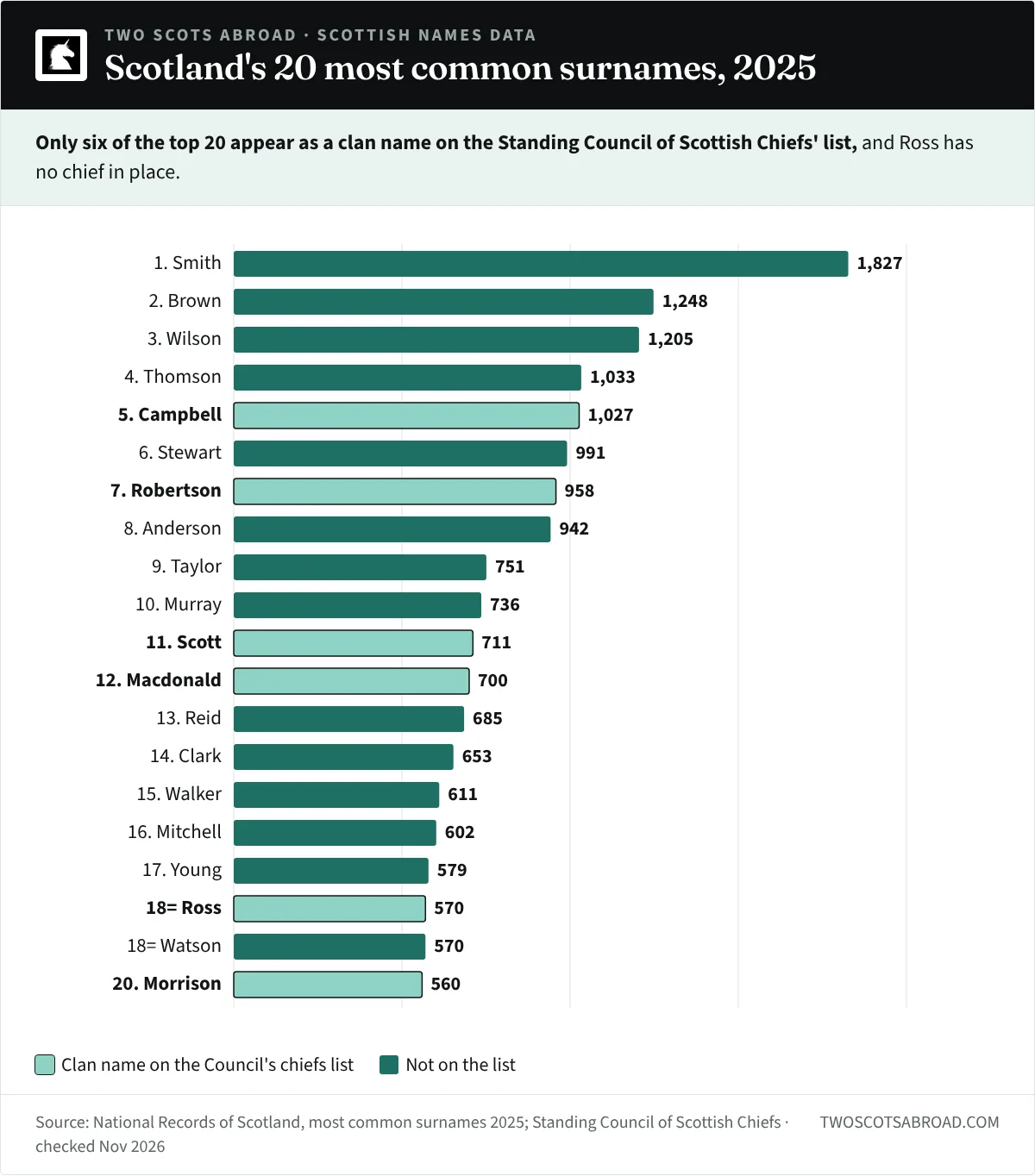
Most Scots do not carry a clan chief’s surname at all. National Records of Scotland counts surnames each year in the birth, marriage and death registers, and in 2025 Smith topped the list with 1,827 occurrences, ahead of Brown (1,248) and Wilson (1,205). We checked each of the top 20 against the Standing Council of Scottish Chiefs’ list of member chiefs in November 2026.
| Rank | Surname | Occurrences (2025) | Clan of that name on the Council’s chiefs list? |
|---|---|---|---|
| 1 | Smith | 1,827 | No |
| 2 | Brown | 1,248 | No |
| 3 | Wilson | 1,205 | No |
| 4 | Thomson | 1,033 | No |
| 5 | Campbell | 1,027 | Yes: the Duke of Argyll |
| 6 | Stewart | 991 | No |
| 7 | Robertson | 958 | Yes: Robertson of Struan |
| 8 | Anderson | 942 | No |
| 9 | Taylor | 751 | No |
| 10 | Murray | 736 | No |
| 11 | Scott | 711 | Yes: the Duke of Buccleuch and Queensberry |
| 12 | Macdonald | 700 | Yes: five Macdonald chiefs, including Lord Macdonald |
| 13 | Reid | 685 | No |
| 14 | Clark | 653 | No |
| 15 | Walker | 611 | No |
| 16 | Mitchell | 602 | No |
| 17 | Young | 579 | No |
| 18= | Ross | 570 | Listed, chief “under consideration” |
| 18= | Watson | 570 | No |
| 20 | Morrison | 560 | Yes: Morrison of Ruchdi |
How to read the table: only six of Scotland’s 20 most common surnames appear as a clan name on the Council’s list, and Ross has no chief in place. The Council’s membership is by invitation, so a missing name is not proof that no chief exists: Murray and Stewart, for example, both have long clan histories and still show “No” here. The figures count register entries, so they reflect births, marriages and deaths in 2025, and NRS counts Macdonald and McDonald as separate spellings.
For the other 14, the name is mostly Lowland, occupational or descriptive, and any clan link runs through a sept list or through where your family lived.
Coats of Arms: Why There Is No Family Crest for Your Surname
Mugs and plaques sold under your surname are selling something Scotland does not recognise. Under the rules of the Court of the Lord Lyon, which runs Scottish heraldry, there is no such thing in Scotland as a “family coat of arms”: a personal coat of arms belongs to one person at a time. A clan cannot have arms either; what you see as “the clan arms” is the chief’s personal property.
What a clan member may wear is the crest badge: the chief’s crest inside a belt and buckle carrying the chief’s motto. That badge shows loyalty to the chief. It does not claim the arms.
Arms do pass down, but only to the heir of the person they were granted to. No single coat of arms can be used by everyone with the same name, while other descendants can apply for a differenced version. Anyone living in Scotland or owning property there can petition the Lord Lyon for arms, and people overseas may be able to apply if they can prove descent from an ancestor who lived in Scotland.
Tartan: What Your Surname Entitles You To Wear
You can wear any tartan you like: in Scotland there are no laws about which tartan you may wear, just traditions. The tradition is to wear the tartan linked to your surname if there is one, or a district tartan for the area your ancestors came from.
Two things are good to know before you buy a kilt. Not every Scottish surname has a tartan, and the Register keeps its Clan/Family category for historic clans and families recognised by the Court of the Lord Lyon, with any new clan tartan approved by the chief. The link between tartan and surname is also younger than most people assume: there is no particular evidence of clan tartans before the mid-18th century, and the system tying tartans to surnames developed in the 19th.
So a tartan tells people which clan you feel part of. It is not evidence about your ancestors.
What DNA Testing Can Add to a Clan Claim
A Y-DNA test follows the direct male line, the same route a surname usually travels, so it can test whether two men with the same surname share a paternal ancestor. It cannot see your mother’s lines, and it cannot tell you about the many ancestors whose surnames you do not carry.
The Clan Donald project shows how far name and DNA drift apart. With more than 3,600 participants, it found that 19% of the men in the project descend from Somerled, the 12th-century ancestor of the chiefs, and that most Glencoe descendants carry a different male line from the one their surname implies. A matching result puts you in a family group; it still needs a paper trail to show how you connect.
How To Prove a Clan Connection With Records
The only way to turn a surname hint into proof is to build your tree backwards, one documented generation at a time, before you reach for a clan.
- Start with yourself and work back through birth, marriage and death certificates. In Scotland, compulsory civil registration began in 1855, and those statutory records give parents’ names, so they are the easiest way back to the mid-1800s. You can search both these and the Old Parish Registers on ScotlandsPeople, the official National Records of Scotland family history site.
- Move into the Old Parish Registers for earlier events. The Church of Scotland kept them before civil registration; the earliest entry is a baptism from 27 December 1553, and about 3,500 volumes survive, though they are far from complete and carry much less detail.
- Search every spelling. Try Mac and Mc, with and without a final e, and the Gaelic form. Expect patronymics in Highland records into the 18th century.
- Pin down the parish. Where your family lived matters more than the surname, because clans held land. A MacDonald from Skye and a MacDonald from Glasgow can have very different stories.
- Then contact the clan society, which can tell you how that clan treats your name, and whether your parish sits in its old lands.
Our main guide to Scottish names has the meaning of your surname if you want a starting point before you open the registers.
Scottish Surnames and Clan History FAQ
Can I Join a Clan Without the Surname?
Yes. The Standing Council of Scottish Chiefs says anyone who offers allegiance to a clan chief is recognised as a clan member unless the chief declines it, so a maternal line or a sept link is enough to approach a clan society.
Is My Surname Irish or Scottish if It Starts With Mc?
It could be either. Mac and Mc are the same Gaelic prefix meaning “son”, used in both Scotland and Ireland, so only records from the place your family lived can settle where a particular Mc line came from.
Do Women Keep Their Clan if They Marry?
Clan membership comes by birth, marriage or descent under the Standing Council’s guidance, so a woman keeps her birth clan and can also belong to her spouse’s clan through marriage.
Does Every Scottish Surname Belong to a Clan?
No. Only about 140 clans have chiefs recognised by the Lord Lyon, and common Lowland names such as Smith, Brown and Wilson have no clan of their own, though clan societies may list them as septs.
