
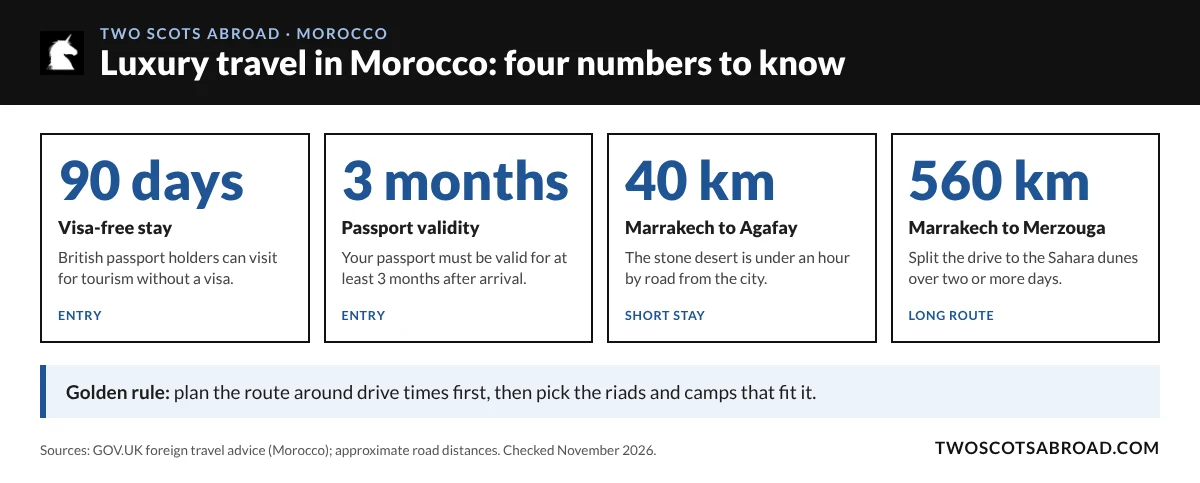
Planning luxury travel in Morocco usually starts with a hotel shortlist, but the route matters just as much. Marrakech to the Merzouga dunes is around 560 km by road, so a beautiful itinerary on paper can turn into long, tiring days in a car.
Here’s what a luxury trip to Morocco really involves, where to stay from Marrakech to the Sahara, how to plan a route that works, and how to choose a local operator.
What Does Luxury Travel in Morocco Actually Mean?
Gold taps and marble lobbies exist here, and some of Morocco’s palace hotels are among the most celebrated in the world. For most travellers, though, a luxury trip comes down to three things: privacy, access and smooth logistics.
- Privacy: the souks of Marrakech and the lanes of Fes are part of the magic, but they’re far more enjoyable when you can step out of them. That means a driver waiting at the right medina gate, a quiet riad and a desert camp away from the crowds.
- Access: a lot of Morocco works through relationships. A good guide can take you to a craftsman’s workshop, arrange a cooking class in a family home or get you a rooftop table at sunset.
- Logistics: Morocco is big, with mountain passes and long distances once you leave the main cities. Smart routing, reasonable drive times and handovers that happen without fuss matter more than any thread count.
Before you book anything, check the basics. British passport holders can visit Morocco for tourism without a visa, according to the FCDO for up to 90 days, and your passport must be valid for at least three months after you arrive.

Where to Stay in Morocco for a Luxury Trip
Your accommodation sets the tone for the whole trip. Some of the best-known addresses, by stop:
| Stop | Where to stay | What to know |
|---|---|---|
| Marrakech | Royal Mansour, La Villa des Orangers, Almaha Marrakech | Palace hotel, Relais & Châteaux riad and a riad in the Kasbah quarter |
| Fes | Palais Faraj Suites & Spa | Former palace on a hillside above the medina, with car access |
| Chefchaouen | Dar Jasmine | Small hotel above the blue town, with plenty of steps |
| Casablanca | Four Seasons Hotel Casablanca, Royal Mansour Casablanca | Oceanfront on the Corniche, or a reborn 1950s address in the centre |
| Dades Valley | Eden Boutique Hotel | A break between the High Atlas and the Sahara |
| Merzouga | Small luxury camps such as Madu Luxury Desert Camp | Tents with private bathrooms near the Erg Chebbi dunes |
Marrakech
Royal Mansour is the statement stay. Commissioned by King Mohammed VI and opened in 2010, it has no standard rooms, only private riads, and staff move around the property through a network of hidden tunnels. La Villa des Orangers, a 1930s riad near the Koutoubia Mosque, has been a Relais & Châteaux member since 2001. For a more intimate stay, Almaha Marrakech is a riad in the Kasbah quarter of the medina with a hammam and rooftop terrace.
Fes, Chefchaouen and Casablanca
Fes is the place to understand Morocco’s spiritual and intellectual heart. Its medina, Fes el Bali, is UNESCO-listed and holds the record for the largest car-free urban area by population, with around 156,000 residents. Palais Faraj sits on the hillside above it, so you get the panorama and a quieter base, plus the rare bonus of car access.
In Chefchaouen, Dar Jasmine looks over the blue-washed medina from the edge of town. It’s a lovely, slow place to stay, but you’ll climb a lot of steps to reach it. Our round-up of famous blue towns around the world explains what makes the town so photogenic.
Casablanca works well as an arrival or departure point. Four Seasons Hotel Casablanca sits on the Corniche facing the Atlantic, while Royal Mansour Casablanca reopened a 1950s landmark in the city centre in April 2024.
The Dades Valley and the Sahara
Eden Boutique Hotel near Boumalne Dades breaks up the long drive between the mountains and the desert. In Merzouga, small luxury camps such as Madu Luxury Desert Camp, at Hassi Labied, offer tents with private bathrooms near the Erg Chebbi dunes. Camps vary a lot, so ask about the tent, the bathroom and how you’ll get there, by 4×4 or camel.
How Should You Plan Your Route Around Morocco?
For the Sahara, the order matters. Routes from Marrakech usually cross the High Atlas, stop in Ouarzazate and the Dades Valley, and only then reach Merzouga. Splitting the 560 km into two or more days keeps the driving manageable. Tackle it in one go and you’ll spend most of a day on mountain roads.
| Trip length | Suggested route | Good for |
|---|---|---|
| 4 to 5 nights | Marrakech, a day in the Atlas Mountains and an evening in Agafay | Short breaks and first visits |
| 7 to 10 nights | Marrakech, Ouarzazate, the Dades Valley and Merzouga | Adding the Sahara dunes |
| 12 nights or more | Fes, Chefchaouen, the Sahara and Marrakech | A grand tour of the imperial cities |
Short on time? The Agafay desert is a stone desert around 40 km from Marrakech, close enough for a sunset dinner or a night in a camp without the long drive. If you’re flying into the north, our guide to things to do in Tangier is a good place to start a longer loop.
Use the planner below to sketch a route for your dates.
 Morocco Luxury Route Planner
Choose how long you have, when you’re going and what matters most. The planner suggests a realistic route from Marrakech and the things to check before you book.
Suggested route
Before you book
Food, Golf and Corporate Travel
Moroccan food is a highlight in its own right. In Marrakech, that might mean sunset on a medina rooftop such as Nomad, Lmida or Terrasse des Épices, a private cooking class in a riad, or a more lively evening at Comptoir Darna, where dinner comes with a show.
Golfers have plenty of choice too, with courses around Marrakech set against the Atlas Mountains and more along the Atlantic coast. A good operator will line up tee times, transfers and caddies, and plan something for anyone who isn’t playing.
Specialist agencies also arrange incentive trips, executive retreats and events, from gala dinners in palaces to team days in the Agafay desert.
Should You Book With a Local Team or an International Agency?
An international agency can book you a hotel. A team on the ground knows which suite has the best light, which guide suits your family and what to do when snow closes a mountain road. For a trip with this many moving parts, local knowledge counts.
Marrakech-based Morocco Luxury Highlights is one example. It designs private, tailor-made Morocco luxury tours as well as set itineraries it adapts to each group, covering desert journeys, food, golf and corporate travel. According to the company, its co-founder, Benoît Cordonnier, has a degree in international commerce from the University of Liège and has worked in Morocco’s luxury tourism sector for more than a decade.
Whoever you book with, ask for a written itinerary with the hotels, drive times and what’s included, and check how payments and cancellations work. Our guide to spotting holiday booking scams has more checks worth running before you pay.
Luxury Travel in Morocco FAQ
When is the best time for a luxury trip to Morocco?
Spring and autumn are the most comfortable for touring. The Met Office notes that summer in Marrakech often exceeds 37°C, while winter days are mild but nights can be cold, especially in the desert and the mountains.
How many days do you need for a luxury tour of Morocco?
Four or five nights suit Marrakech with the Atlas Mountains and Agafay. Seven to ten nights let you add the Sahara via the Dades Valley, and 12 nights or more open up Fes, Chefchaouen and the imperial cities.
Is the Agafay desert a good alternative to the Sahara?
Yes, for short stays. Agafay is a stone desert around 40 km from Marrakech, while the Merzouga dunes are usually reached over two days of driving from the city.
Do British travellers need a visa for Morocco?
No. Tourist stays of up to 90 days don’t need a visa, but your passport must be valid for at least three months after you arrive.
Can you combine golf with sightseeing in Morocco?
Yes. Many operators combine golf days with private tours, spa time and food experiences, so non-golfers have plenty to do.
A luxury trip to Morocco works best when the route and the hotels are planned together. If you’d like help putting one together, take a look at these Morocco luxury tours from a Marrakech-based team.