
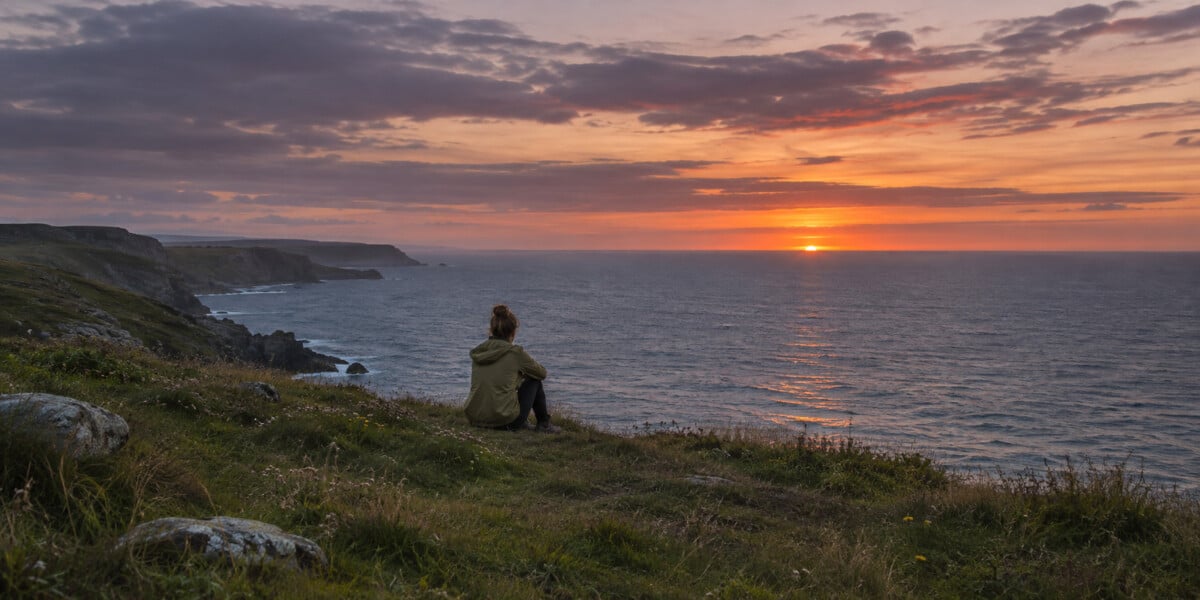
Watch a sunset on the road and you are standing in an hour that many faiths already treat as a turning point. The spiritual meaning of sunset starts with a plain fact: in several traditions the new day begins when the sun goes down, and Shabbat candles are most commonly lit 18 minutes before sunset so nobody strikes a flame once it has started.
Below, we cover what the hour means in four religious traditions, why the time and direction of sunset change so much as you travel, how to plan and watch one with intent, and what the physics adds to the picture.

What Is the Spiritual Meaning of Sunset in Religious Tradition?
In many traditions, sunset ends one day and begins the next. That makes it a change of date you can stand outside and watch happen, with no clock and no calendar needed.
Judaism: Shabbat Begins at Sunset
The Hebrew calendar counts each day from sunset, so Shabbat runs from Friday evening to nightfall on Saturday. In practice the candles go on before the sun is gone: 18 minutes is the most common custom, with communities ranging from about 15 to 40 minutes, and Jerusalem traditionally lights earliest. If you are invited to a Friday night meal while travelling, that is why the host will be watching the clock in the late afternoon.
Islam: Maghrib and the End of the Fast
Muslims pray Maghrib once the disc has fully dropped from view. Counted from midnight, it is the fourth of the five daily prayers, and during Ramadan the same moment ends the day’s fast and opens iftar. In much of the Muslim world, iftar traditionally starts with dates and water before the main meal. Travel through Morocco, Türkiye or Indonesia during Ramadan and you will see streets empty for a few minutes at sunset, then fill again.
Hinduism: Sandhya, the Junction
Hindu practice has a word for this hour. Sandhya literally means the junction of day and night, and the prayers performed at dawn and dusk take their name from it (sandhyavandana). Some traditions add solar noon as a third junction, but dusk is the one most visitors will see marked in public, with lamps, bells and conch shells at temples and ghats.
Christianity: Vespers and Evensong
Christian daily offices put Vespers in the same slot. The name comes from vesper, Latin for evening, and the Catholic Church describes Evening Prayer as taking place as dusk begins to fall. In Britain you know it as evensong, sung in cathedrals and college chapels most days of the week and usually free to attend.
| Tradition | What happens at sunset | What a traveller may notice |
|---|---|---|
| Judaism | Shabbat and festivals begin; candles lit beforehand | Shops in Jewish neighbourhoods closing on Friday afternoon |
| Islam | Maghrib prayer; iftar during Ramadan | The call to prayer, then busy cafés and food stalls |
| Hinduism | Sandhya prayers at dusk | Lamps, bells and evening aarti at temples and ghats |
| Christianity | Vespers or evensong | Choral services in cathedrals, often free and open to all |
Astrology: The Descendant on the Western Horizon
Astrology marks the same evening boundary by position on the horizon. The descendant is the degree of the zodiac sitting on the western horizon at a given moment, which is where the sun stands at sunset. In a birth chart it is the point traditionally read for how a person meets other people and forms partnerships.
Because the descendant moves through every sign in about a day, it depends heavily on time and place. The Nebula app calculates it from a birth date, a clock time and the coordinates of the birthplace, so a birth time noted to the minute gives a different descendant than one rounded to the nearest hour. If you want to read the sunset hour against your own chart while you are away, that is a sensible place to start. Treat it as reflection, the same way you would a tarot card or a horoscope column.
Four calendars, one instruction: stop the day’s work and mark the change. These traditions had the same horizon and the same daily disappearance to work with, and a boundary you can see without a clock is one anyone can keep. The hour you give to a view is an hour much of the world has already set aside.
Why Does Sunset Change as You Travel?
Sunset is a local event. By convention, sunset is the moment the upper edge of the disc sits on the horizon, assuming a level horizon and average air. The clock time, the direction and the length of the light that follows all change with latitude and date.
Latitude Changes the Time and the Length
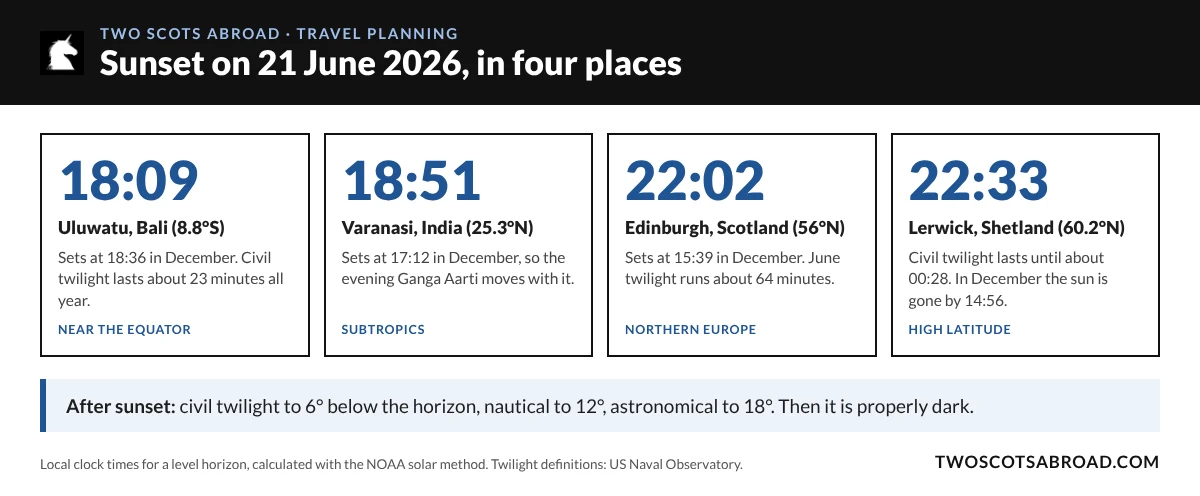
Near the equator the sun drops almost straight down, so the disc takes only about two minutes to disappear and sets close to the same clock time all year. In Uluwatu on Bali, sunset falls at 18:09 on 21 June and 18:36 on 21 December, a gap of under half an hour.
Go north and the sun slides down at a shallow angle. On 21 June 2026, Edinburgh’s sunset was at 22:02 and Lerwick in Shetland’s was at 22:33, and in December the sun is gone by mid-afternoon. If you are planning a summer Scotland road trip, those long evenings change how far you can drive and still catch the light. Around 60 degrees north, the latitude of Oslo, Helsinki and Shetland, civil twilight in late June runs on for nearly two hours. Weighing Oslo or Stockholm for a summer break is partly a choice of how late you want the light to last.
Push on to the Arctic Circle at about 66.5 degrees and around the June solstice the sun does not set at all. Farther north, that run lasts weeks.
| Place (latitude) | Sunset 21 June 2026 | Sunset 21 December 2026 | Civil twilight after sunset |
|---|---|---|---|
| Singapore (1.3°N) | 19:12 | 19:03 | About 23 minutes year-round |
| Uluwatu, Bali (8.8°S) | 18:09 | 18:36 | About 23 minutes year-round |
| Varanasi, India (25.3°N) | 18:51 | 17:12 | About 26 minutes |
| Edinburgh, Scotland (56°N) | 22:02 | 15:39 | About 64 minutes in June, 48 in December |
| Lerwick, Shetland (60.2°N) | 22:33 | 14:56 | About 115 minutes in June, 59 in December |
Times are local clock time for a level horizon, calculated with the NOAA solar method. Hills, buildings and cloud on the western horizon bring the visible sunset forward.
The Direction Moves Through the Year
The sun sets due west on only two days a year, the equinoxes, around 20 March and 22 or 23 September. Every other evening it lands off to one side. In June it sets north of west across the northern hemisphere: in Edinburgh the bearing is about 317 degrees, and in Lerwick about 325. In December it sets south of west, at about 226 degrees in Edinburgh. That swing decides whether a coastline, a pier or a temple gate faces the sun in the month you happen to visit.
Three Stages of Twilight
Once the sun is down, the light runs through three stages, each measured by how far the centre of the sun sits below the horizon.
| Stage | Sun below the horizon | What you can see |
|---|---|---|
| Civil twilight | 0 to 6 degrees | Enough light to walk and read outdoors; the brightest planets appear |
| Nautical twilight | 6 to 12 degrees | The horizon at sea fades; the brighter stars are out |
| Astronomical twilight | 12 to 18 degrees | The sky looks dark to most eyes; faint stars and the Milky Way appear on clear nights |
Rituals That Follow the Local Sunset
Ritual held at this hour follows the local sunset, so its clock time moves with the seasons. At Dashashwamedh Ghat in Varanasi, the Ganga Aarti starts soon after sunset, at around 6pm in winter and closer to 7pm in summer, and lasts about 45 minutes. Uluwatu’s Kecak fire dance on Bali is staged in a clifftop amphitheatre at 6pm, timed for sunset, which at that latitude barely shifts across the year. If you are choosing where to stay in Bali, the Bukit Peninsula puts you within reach of it.
If you end up at one of these, stand at the back and copy what those around you are doing with their shoes, hands and phones. At the aarti, visitors usually watch from the upper steps or from a boat on the river. At Maghrib, a mosque courtyard may be open to you while the prayer hall is not, and asking someone at the door takes ten seconds. A ticketed performance like the Kecak is the one setting where photographs are expected. Elsewhere, if nobody near you is holding a camera, that is your answer.
How Do You Watch a Sunset Deliberately?
A sunset watched with attention takes about an hour, plus one decision made in advance: where to stand. Make that decision first, then use the planner below to work out the timings.
 Sunset Hour Planner
Enter the local sunset time for the town you are in, then pick your latitude and season. The planner lays out the hour around it: when to arrive, when the colour usually peaks and when the useful light runs out.
- Check the time and the bearing. Look up the sunset time for the exact town you are in, since it can differ by an hour across a large country. Most sunset apps also give a bearing in degrees. If yours does not, open a compass app an hour beforehand and note where the sun is heading. West is only approximate outside the equinoxes, and on a coastline that difference can put a hillside where you expected open water.
- Arrive 30 minutes early for golden hour. The light comes in low and travels through more atmosphere, and most people miss it by arriving late. High, thin cloud takes the colour best. A thick, low bank on the western horizon flattens the hour, and you can usually see it coming an hour ahead.
- Stay 20 minutes after. The blue hour follows, when the sky holds a deep blue cast, and the colour on the clouds often peaks in the first ten minutes after the sun has gone. It gets dark faster than it looks, especially near the equator, so work out your route back before you settle in and keep some charge on your phone for a torch.
- Notice what the place does at the hour. A call to prayer, a church bell, shutters coming down or fishing boats coming in will tell you how the day is divided locally. That is the part a viewpoint list leaves out.
- Give the last ten minutes to yourself. Once the disc has gone and the colour starts, put the camera down and let one question sit: what did this day ask of me, and what am I carrying into the next one? Nothing more elaborate is needed. Each of the traditions above puts a stop here, and that stop is the practice.
Run those five steps in two or three towns on one trip and you have something to compare. The timing and the local markers will differ, but the event itself stays the same.
What Does the Science Add to the Sunset Hour?
One more fact is worth carrying with you. Near the horizon, the atmosphere bends the sun’s image upwards by about 34 arcminutes, worth roughly two minutes of time, slightly more than the width of the disc itself. So at the instant you see the sun resting on the horizon, it has already passed below it geometrically. You are watching an image of a sun that has, strictly speaking, set.
That bending adds a couple of minutes of visible sun near the equator and considerably more at high latitudes, where the sun crosses the horizon at a shallow angle. The traditions above fix the start of a new day at the disappearance of that image, which is why the boundary is settled by eye and defined locally, wherever you happen to be standing.
The hour needs no equipment and no belief to keep it. Wherever you land next, the sun will set at a time you can look up and in a direction you can face, and the people around you will have their own way of marking it. Your part is to find somewhere with a clear western view and stop while it happens.
Sunset Spiritual Meaning: FAQ
What does a sunset symbolise spiritually?
Across traditions, sunset marks an ending and a threshold. In Judaism and Islam it begins a new day, in Hindu practice it is a junction (sandhya) set aside for prayer, and in Christianity it is the time for Vespers. Many people use it as a daily point to pause and look back on the day.
Why does the Jewish day start at sunset?
The Hebrew calendar counts each day from evening to evening, so Shabbat and festivals begin at sunset. Candles are lit before sunset, most commonly 18 minutes before, so that no flame is kindled once the day has begun.
What time is Maghrib prayer?
Maghrib begins just after sunset, once the sun has fully disappeared, and its window lasts until the red twilight has gone. During Ramadan it also marks the moment the fast ends. Local mosques and prayer apps publish exact times for each town.
Why are sunsets so late in Scotland in summer?
Scotland sits between about 55 and 61 degrees north, so in June the sun crosses the horizon at a shallow angle and well to the north of west. Edinburgh’s sunset on 21 June 2026 was at 22:02, and twilight lasts about an hour after it.
What is the difference between golden hour and blue hour?
Golden hour is the period before sunset when the sun is low and the light is warm. Blue hour comes after sunset, during twilight, when the sky takes on a deep blue tone. Both are longer at high latitudes and short near the equator.
Does the sun always set in the west?
Only roughly. It sets due west on the March and September equinoxes. Between March and September it sets north of west in the northern hemisphere, and between September and March it sets south of west.