
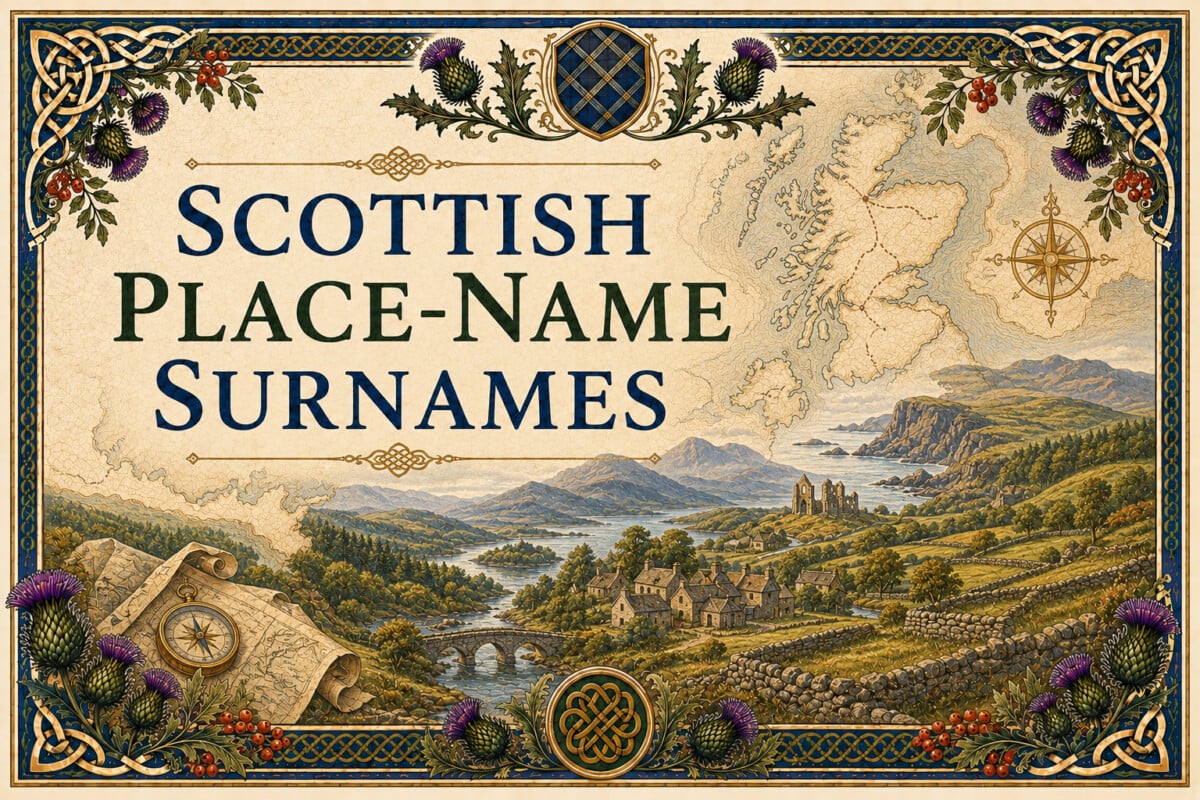
Scottish place-name surnames began as identifiers for people connected with a particular settlement, estate, district, river or landscape feature. Names such as Douglas, Crawford, Leslie, Moffat, Sutherland and Elgin can preserve a clue to where an ancestor lived, held land, came from or was known to others.
They are useful genealogy clues, but they are not automatic proof of descent from one grand clan line. A person could acquire a locational surname by moving away from a place, working on an estate, or becoming associated with a landholding. Scotland has never made family history quite that simple.
If you are interested in specific last or first names of the Scottish origin, try our interactive tool below:
Scottish Names Beginning With
Choose which type of Scottish name you would like to explore.
What Is a Scottish Locational Surname?
A locational surname, also called a place-name surname, identifies somebody through geography. The place might be a town such as Moffat or Elgin, a broad district such as Sutherland, an estate such as Leslie, or a feature in the landscape such as the waterway behind Douglas.
As surnames became more fixed in medieval Scotland, place-based names sat alongside patronymics such as MacDonald, occupational names such as Stewart, and descriptive names. The systems overlapped. One household could use a personal byname in one record and a hereditary surname in another, particularly while naming practices were still settling.
National Records of Scotland publishes surname data for Scotland, a useful reminder that surname patterns are living records as well as historical evidence. Common modern surnames reflect several traditions at once: occupational, patronymic, Gaelic, territorial and locational.
How Families Took Names From Places
The most straightforward case involved a person leaving home. Someone known in a new community as John “of Moffat” might eventually be identified simply as John Moffat. Over generations, the location could become a family name even after descendants had no continuing connection with the town.
Landholding created another route. In medieval records, people of status were often identified by the lands or estate with which they were associated. That does not mean every later bearer of the name descended from the original landholding family. Branches could form, tenants and dependants might adopt the name, and spelling was flexible long before standard forms became normal.
A third route was local description. A name tied to a river crossing, hill, wooded ground or settlement could distinguish one person from another. Scotland’s layered place names draw on Gaelic, Scots, Norse, Brittonic and later English influences, so the meaning behind a surname can be less tidy than a one-line translation suggests.
Examples of Scottish Surnames Rooted in Place
| Surname | Place Connection | What It Can Suggest |
|---|---|---|
| Douglas | Associated with places and waters named Douglas | A connection to a “dark water” name, commonly explained through Gaelic elements. |
| Crawford | Associated with Crawford in Lanarkshire and other place-name forms | A settlement or crossing name, with early linguistic roots that require careful local study. |
| Leslie | Associated with Leslie in Aberdeenshire | An ancestral link to the settlement or its surrounding lands. |
| Moffat | Associated with the Dumfries and Galloway town of Moffat | A family origin, migration point or later association with the town. |
| Sutherland | Associated with the northern Scottish region of Sutherland | A regional identifier, shaped by the area’s Norse-era naming history. |
| Elgin | Associated with Elgin in Moray | A connection to the historic Moray town or to people arriving from it. |
Douglas is one of the best-known Scottish territorial surnames. Its place-name association is usually linked to Gaelic elements often rendered as “dark water.” That description suits a water name, but it does not identify one single family branch. Multiple places carry the Douglas name, and the surname has had a long, complicated history.
Crawford is a classic example of why surname meanings need caution. It is associated with a place in Lanarkshire, and its form points toward an older settlement or crossing name. Early spellings and language changes can produce competing explanations, so a family researcher should start with the actual parish, county and date in their records before choosing a translation.
Leslie connects to the place of Leslie in Aberdeenshire. Estate and settlement names often became surnames among people who had a direct relationship with the land, then spread through marriage, migration and ordinary use. A Leslie in Canada, New Zealand or the United States may have Scottish roots, but the surname alone cannot identify the precise departure point.
Moffat points to the town in Dumfries and Galloway, while Elgin points to the Moray town. These are especially easy examples for modern readers because the place names remain prominent on maps. Still, a person called Moffat or Elgin may have inherited the name generations after their family left the area.
Sutherland is regional rather than town-based. The name is tied to Scotland’s far north and reflects the Norse perspective behind the region’s name. A regional surname can cover a much wider starting area than a village surname, so it should be treated as a direction for research, not a finished answer.
Why Unrelated Families Can Share the Same Surname
Several unrelated people could be called Moffat after arriving from Moffat, just as several people could be known as Douglas because they came from places carrying that name. The surname could therefore arise independently in more than one family.
Inheritance also complicates the picture. A surname may enter a line through maternal inheritance, adoption, remarriage, an informal name change or an ancestor’s wish to associate with a better-known local family. In historical documents, clerks wrote what they heard, which explains variations such as Stewart and Stuart without proving that every bearer belongs to one immediate branch.
The sensible approach is to treat the surname as a geographical lead. Pair it with names, occupations, addresses, parish registers, wills, land records and migration documents. A repeated surname in the same parish can be promising, but it still needs evidence.
How To Research a Scottish Place-Name Surname
- Begin with the most recent proven ancestor. Record full names, dates, spouses, occupations and every location named in certificates or family papers.
- Track spelling exactly as it appears. Douglas, Moffat and Elgin are relatively stable forms, while other surnames may shift sharply between Scots, Gaelic and Anglicised records.
- Locate the place before interpreting the name. A road atlas and a historical map can help distinguish a town, parish, estate and region with similar names.
- Check the surrounding names. Witnesses, neighbours and marriage partners may reveal the actual community network behind a surname.
- Use DNA as supporting evidence, not a shortcut. Genetic matches can suggest connections, but documentary research is needed to establish the relationship.

Scottish Surnames (Traditional Scotland)
A good Scottish surname reference book can help you compare forms and identify possible linguistic roots. Use it after you have gathered documents, not as a substitute for them. A neat meaning in a book is satisfying; a dated record connecting your ancestor to a parish is better.

Philip's Navigator Scotland: The Best of Scotland: Spiral (Philip's Road Atlases)
Reading the Landscape Behind the Name
Scottish place-name surnames are miniature maps. Douglas may preserve a water-related name, Crawford a settlement or crossing, Leslie an Aberdeenshire connection, and Sutherland a regional identity shaped by northern history. They show how closely community, land and identity could be tied.
For people building a family tree, the best question is not “What does my surname prove?” It is “Which Scottish places should I investigate next?” That small change keeps the research grounded and leaves room for the surprises that make genealogy entertaining.
Frequently Asked Questions
Are Scottish place-name surnames always linked to a clan?
No. Some locational surnames became associated with prominent families or clans, but many simply identify a connection to a place. Sharing a surname does not automatically establish clan membership or a close family relationship.
Does a surname such as Moffat mean my family came from Moffat?
It suggests that an ancestor may have been associated with Moffat in Dumfries and Galloway, but the connection may be distant. The name could have been inherited long after a family left the town.
Why do Scottish locational surnames have different spellings?
Spelling was not consistently standardised in older records, and Scotland’s place names developed across several languages. Clerks, ministers and census enumerators often wrote names according to local pronunciation.
Is Douglas a place-name surname?
Yes. Douglas is strongly associated with Scottish places and waterways bearing that name, commonly interpreted through Gaelic as a name connected with dark water. It has also become associated with major historical families, which adds another layer to research.
What records are most useful for researching Scottish surnames?
Start with civil registration records, census returns, church registers, wills, valuation rolls and land records where available. The strongest results come from matching a surname to a specific parish and time period.