
Scottish first names that start with C include some of the best-known names in Scotland, such as Callum, Cameron, Campbell and Catriona, alongside older Gaelic forms like Cailean, Caoilte and Caitrìona. If you want a name with Scottish roots, this letter gives you a good mix of familiar choices and more traditional options.
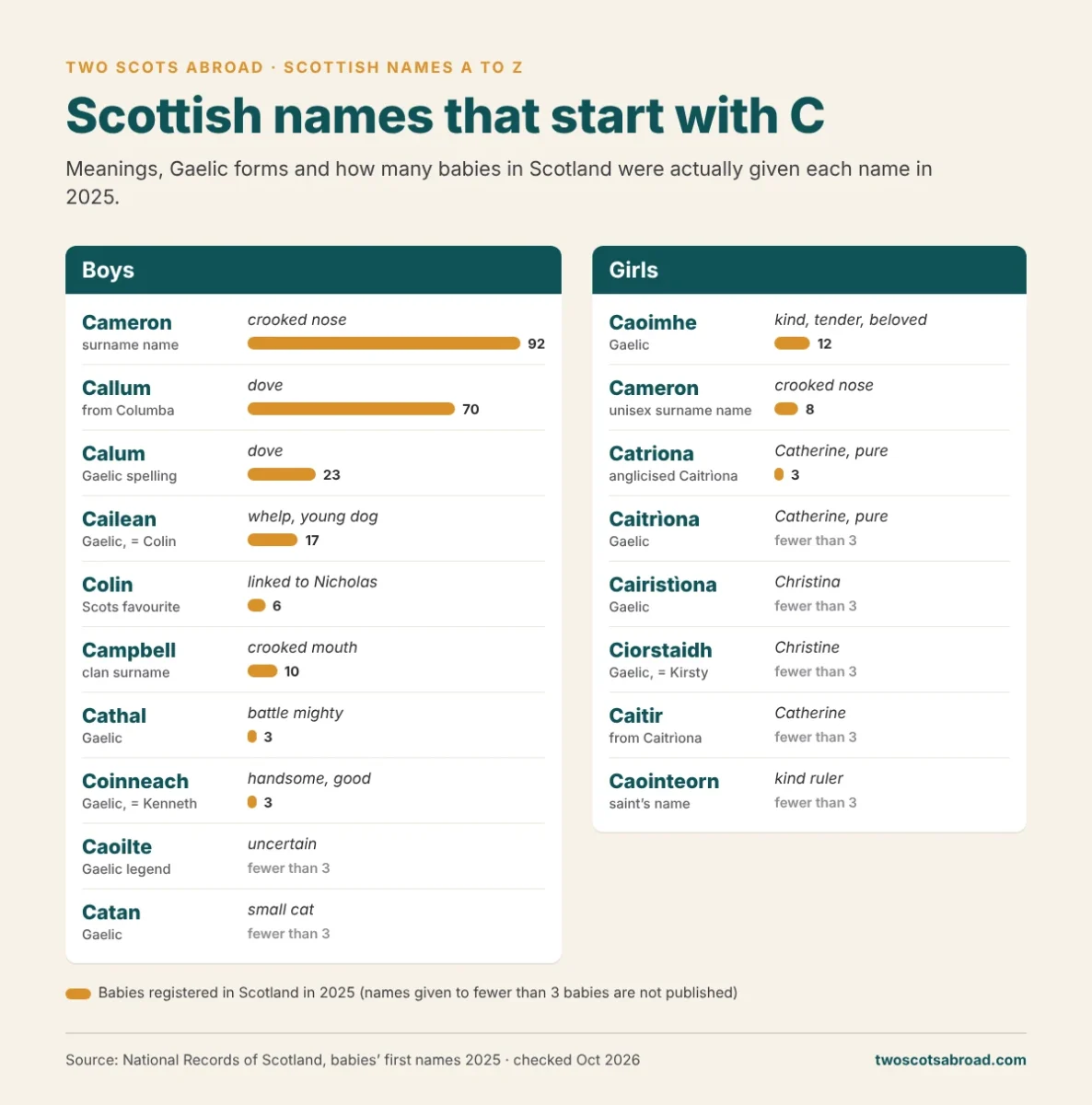
Quick answer: the most-used Scottish C names in Scotland right now are Cameron (92 baby boys in 2025) and Callum (70), according to National Records of Scotland. For something more Gaelic, look at Calum, Cailean, Coinneach and Cathal for boys, or Caitrìona, Cairistìona, Ciorstaidh and Caoimhe for girls.
- Most popular in Scotland: Cameron, Callum, Calum, Cailean
- Gaelic girls’ names: Caitrìona (Catherine), Cairistìona (Christina), Ciorstaidh (Kirsty), Caoimhe
- Gaelic boys’ names: Calum (dove), Cailean (young dog), Coinneach (handsome), Cathal (battle mighty)
- Genuinely rare: Catan, Caitir, Caointeorn, Cathella
- Easiest outside Scotland: Callum, Cameron, Colin, Catriona
This guide is part of our Scottish Names collection. Browse our complete Scottish Names directory for A–Z first names, surnames, Gaelic names, meanings, and themed collections.
In Scotland, names often come from a few different strands at once. Some are Gaelic names, some are Scots forms, some began as surnames, and some are anglicised versions of older spellings. That is why a single name can appear in more than one form, with pronunciation changing a bit depending on family, region and language background.
This guide pulls together Scottish C names that are actually used or recorded in Scottish naming lists, with meaning, pronunciation, origin and famous bearers where they help. We have kept to names with a genuine Scottish connection, not random modern inventions with a C stuck on the front.
We checked the meanings against Gaelic name references and the popularity figures against the National Records of Scotland baby names data for 2025 (published May 2026), so the numbers below are the latest available as of November 2026.
Scottish Names Beginning With
Choose which type of Scottish name you would like to explore.
How Scottish Naming Traditions Shape C Names
Scottish first names do not all come from one source. You will see traditional Gaelic names, Scots names, anglicised forms and surnames that crossed into first-name territory. A name like Callum sits comfortably in modern Scotland, but its root goes back to Columba, the Latin word for dove. A name like Campbell started life as a surname, while Caitrìona is a Gaelic form tied to Catherine.
That mix is part of the charm. Some parents want a name that is unmistakably Scottish but easy for people in Glasgow, London, New York and Sydney to say on the first go. Others want the full Gaelic spelling, accents and all. Both approaches are common, and both can still feel grounded in Scotland.
If you are building a shortlist, it also helps to decide what sort of Scottish name you want:
- Traditional Gaelic, such as Cailean, Caoimhe or Caitrìona
- Scots or anglicised forms, such as Callum or Catriona
- Surname-style names, such as Cameron, Carson or Campbell
- Modern familiar choices with Scottish roots, such as Colin
If you only want the headline facts, this is the whole letter on one page, with how many babies in Scotland actually got each name in 2025:
Scottish Boy Names That Start With C
Callum
Gaelic spelling: Callum or Calum
Pronunciation: CAL-um
Meaning: from Columba, meaning dove
Origin: Scots and anglicised Scottish form linked to the Latin name Columba.
Why people like it: Callum is one of those names that feels easy, warm and unmistakably Scottish without being hard to spell. It is popular across the UK and has travelled well beyond Scotland too. In recent Scottish baby-name records, Calum and Callum have both stayed in regular use, which helps explain why the name still feels current rather than stuck in one generation.
Famous bearer: Callum Keith Rennie is well known in film and television, though the name itself is especially associated with Scotland.
Calum
Gaelic spelling: Calum
Pronunciation: CAL-um
Meaning: dove
Origin: Scottish form related to Callum and Columba.
If you like the sound of Callum but want the slightly leaner Scottish spelling, Calum does the job nicely. You will see both forms in Scotland. The shorter version often looks a touch more traditional, especially alongside other names in Scottish culture and heritage.
Famous bearer: Calum Scott has made the spelling more visible internationally, even if the name itself is not uniquely his.
In 2025, 23 baby boys in Scotland were registered as Calum, compared with 70 for Callum. Strictly speaking, Calum is the Gaelic spelling and the double L is the anglicised one.
Cailean
Gaelic spelling: Cailean
Pronunciation: KAL-yen or KA-len
Meaning: whelp or young dog
Origin: traditional Gaelic name, connected with Colin in some naming traditions.
Cailean has a softer look on the page than some Gaelic names, but it can still trip up non-Scots at first glance. If you want something visibly Gaelic without feeling too obscure, it is a strong contender.
There is real clan history here too: Cailean Mòr, a 13th-century nobleman, is traditionally seen as the forebear of the Campbells, which is why the chief of Clan Campbell is still known in Gaelic as MacCailein Mòr. Seventeen boys in Scotland were named Cailean in 2025.
Cameron
Gaelic spelling: Camshron is the Gaelic surname form, though Cameron is the everyday first-name spelling
Pronunciation: KAM-er-un
Meaning: usually given as crooked nose
Origin: surname turned first name, long associated with Scotland.
Cameron is one of the best-known Scottish C names and has had serious staying power. It works as a boy’s name and also has long-standing unisex use. If meanings matter a lot to you, this one is not exactly poetic, but surname names rarely are. It has also stayed highly visible in Scotland for years, which is part of why it still feels familiar without sounding tired.
Famous bearer: Cameron Mackintosh is one notable public figure with the name.
Popularity: Cameron was the most-used Scottish C name for boys in 2025, with 92 registrations (48th place), and 8 baby girls were given it too.
Campbell
Gaelic spelling: Caimbeul is the Gaelic surname form
Pronunciation: KAM-bul
Meaning: crooked mouth
Origin: Scottish surname used as a first name.
Campbell is a clan name with real weight in Scotland. As a first name, it feels brisk and surname-smart. It is also one of the more recognisable Scottish options for families who like names such as Cameron, Carson or Collins. If clan-linked names appeal, it sits naturally beside other names and places people already associate with Scotland, from Highland history to Scotland’s islands.
Carson
Gaelic spelling: no standard Gaelic first-name form in common use
Pronunciation: KAR-sun
Meaning: uncertain, but used as a Scottish surname
Origin: surname name with Scottish use.
Carson sits in that modern surname-name lane that many parents like. It feels familiar in the US and UK, which can be handy if you want a Scottish-linked name that nobody needs a pronunciation guide for.
Carter
Gaelic spelling: linked in some Scottish records to Mac Artair through anglicisation
Pronunciation: KAR-ter
Meaning: often occupational in English, though also linked in Scotland to son of Arthur through Mac Artair
Origin: mixed English and Scottish use.
Carter is not purely Scottish, but it appears in Scottish naming references because of that anglicised surname connection. If you want a name that works internationally but still has a Scottish thread, it is a reasonable maybe.
Cathal
Gaelic spelling: Cathal
Pronunciation: KA-hal
Meaning: battle mighty
Origin: traditional Gaelic name.
Cathal is more often associated with Ireland in everyday use, but it appears in Scottish Gaelic name lists too. It has an older, warrior-style meaning and a clean, strong sound.
Caoilte
Gaelic spelling: Caoilte
Pronunciation: KOOL-cha or KOOL-tcha
Meaning: uncertain; the name is best known from Caílte mac Rónáin, a warrior of the Fianna in Gaelic legend
Origin: traditional Gaelic legendary name.
This is one for people who want something distinctly Gaelic. Caoilte appears in legend and carries far more old-world character than a mainstream choice like Cameron. It is lovely, but you would need to be comfortable correcting pronunciation now and then.
Catan
Gaelic spelling: Catan
Pronunciation: KA-tan
Meaning: small cat
Origin: traditional Gaelic name.
Catan is rare, short and memorable. The meaning gives it a slightly lighter feel than many old Gaelic boys’ names, which tend to go full battle mode.
Colin
Gaelic spelling: often linked with Cailean in Scottish use
Pronunciation: KOL-in
Meaning: often connected to people of victory through Nicholas traditions, or interpreted differently in Gaelic lines
Origin: used in Scotland for generations.
Colin has had a long run as a polished, easy-to-live-with name. It is less sharply Scottish on sight than Callum or Calum, but it has deep roots in Scottish naming and still feels classic. It has slipped from peak popularity in recent decades, which may actually suit parents who want something familiar without hearing it shouted across every playground.
Famous bearer: Colin Firth has helped keep the name familiar, even if his fame is not especially Scottish.
Coinneach
Gaelic spelling: Coinneach
Pronunciation: roughly KUN-yakh
Meaning: from Gaelic caoin, handsome, good
Origin: traditional Gaelic name, anglicised as Kenneth.
Coinneach is the Gaelic name behind Kenneth, so it is a lovely option if there is a Kenneth or Kenny in the family tree and you want to honour him without repeating the name. It is properly rare now, with only 3 baby boys registered as Coinneach in Scotland in 2025. The -ach ending trips up English speakers, so expect a bit of coaching.
Scottish Girl Names That Start With C
Most Scottish girls’ names beginning with C are Gaelic forms of familiar names, so it helps to know the English equivalent before you fall for the spelling. For more names in the same style across the whole alphabet, see our list of traditional Gaelic girl names with pronunciation.
Caitrìona
Gaelic spelling: Caitrìona
Pronunciation: ka-TREE-na
Meaning: Gaelic form of Catherine, traditionally associated with pure
Origin: Gaelic translation form used in Scotland.
Caitrìona is one of the most recognisably Scottish Gaelic girls’ names beginning with C. It looks elegant, sounds lovely and carries a strong heritage feel. The accent matters in Gaelic spelling, though many families outside Scotland simplify it.
Famous bearer: Caitríona Balfe has made a very similar Gaelic spelling more familiar to international audiences.
Catriona
Gaelic spelling: Catriona is the Scots and anglicised form, related to Caitrìona
Pronunciation: ka-TREE-na
Meaning: from Catherine, traditionally linked with pure
Origin: Scots and anglicised Scottish use.
If you like the sound of Caitrìona but want less explanation around spelling, Catriona is the practical choice. It is well established in Scotland and has a literary, slightly refined feel. It also tends to strike a good balance between heritage and usability, much like some of the choices in our guide to rare Scottish girl names with Gaelic roots.
Famous bearer: Catriona Shearer, the Scottish broadcaster, is one clear Scottish example.
Caitir
Gaelic spelling: Caitir
Pronunciation: KAH-cheer
Meaning: usually explained as a form that grew out of Caitrìona (Catherine)
Origin: traditional Gaelic name, sometimes anglicised as the unrelated Clarissa.
Caitir is compact, old and much less common than Caitrìona. If you want a Scottish Gaelic C name that feels genuinely unusual, this one deserves a look. Just be prepared for a lifetime of spelling it out over the phone.
Cairistìona
Gaelic spelling: Cairistìona
Pronunciation: roughly car-ish-CHEE-na
Meaning: from Latin, follower of Christ
Origin: Gaelic form related to Christina.
This is a bigger, more formal Gaelic name, and it has that rolling rhythm many traditional Highland names carry well. It is less likely to be chosen by families who want a simple school-register option, but it has real presence.
Ciorstaidh
Gaelic spelling: Ciorstaidh (also Ciorstag)
Pronunciation: roughly KYUR-stee
Meaning: Gaelic form of Kirsty, itself a Scottish pet form of Christine, follower of Christ
Origin: Scottish Gaelic.
If Cairistìona feels like a lot of name, Ciorstaidh is its friendlier wee sister. Kirsty is about as Scottish as a girl’s name gets, and the Gaelic spelling keeps the sound while looking far more distinctive on paper. Fewer than three girls were registered with it in 2025, so it is genuinely uncommon.
Caoimhe
Gaelic spelling: Caoimhe
Pronunciation: KWEE-va
Meaning: kind, tender, beloved
Origin: traditional Gaelic name found in Scottish Gaelic lists.
Caoimhe is more widely recognised in Ireland, but it also appears in Scottish Gaelic naming references. The meaning is lovely, and the spelling is pure Gaelic, which means many people outside Gaelic-speaking circles will need help with it. That is not a flaw, just part of the package.
It is also the most-used Gaelic C name for girls in Scotland right now: 12 baby girls were named Caoimhe in 2025, against just 3 for Catriona.
Caointeorn
Gaelic spelling: Caointeorn
Pronunciation: roughly KUIN-chorn
Meaning: kind ruler
Origin: old saint’s name in Gaelic tradition.
This is one of the rarer names in the group and definitely a specialist pick. If your taste runs to saints, folklore and names with almost no chance of sharing a classroom slot, Caointeorn has that covered.
Cathella
Gaelic spelling: Cathella
Pronunciation: kath-ELL-a
Meaning: a blend form linked to Catherine
Origin: Scots form noted in Scottish name lists.
Cathella feels softer and more decorative than the sharper Gaelic forms above. It is a niche choice, but an interesting one if you want Scottish roots with a more unusual finish.
Unisex and Surname-Style Scottish C Names
Some Scottish first names that start with C cross between boy, girl and surname-style use more easily than others. The strongest examples are Cameron and Campbell. Carson also fits here, especially for families who like modern surname names.
All three started life as family names, so if you want the clan and surname story behind them, our guide to Scottish last names that start with C picks up where this one leaves off.
These names work well if you want something that feels recognisable in both the UK and the US. They are also easier choices if you love Scotland but do not want a name that needs pronunciation coaching every time you introduce your child. Not every family wants to deliver a mini Gaelic lesson before the coffee arrives.
Which Scottish C Names Are Easiest Outside Scotland?
If ease of use matters, the simplest options are Callum, Calum, Cameron, Campbell, Carson, Colin and Catriona. These names are familiar in English-speaking countries, and most people will get reasonably close on the first attempt.
The names most likely to need explanation are Caoilte, Caoimhe, Caitrìona, Cairistìona and Caointeorn. That does not make them harder to love. It just means you are choosing a name with a stronger Gaelic identity, which often comes with a bit of teaching attached.
Quick Picks by Style
- Best known: Callum, Cameron, Colin, Catriona
- Most traditional Gaelic: Cailean, Caoilte, Coinneach, Caitrìona, Cairistìona, Ciorstaidh
- Surname style: Cameron, Campbell, Carson
- Soft meanings: Callum or Calum, both linked to dove; Caoimhe, linked to kindness and tenderness
- Strong meanings: Cathal, meaning battle mighty
- Most unusual: Catan, Caointeorn, Caitir
How To Choose Between Gaelic and Anglicised Forms
If your family speaks Gaelic, has Highland or Island roots, or simply wants a name that keeps the original form, the Gaelic spellings may feel important. Names like Caitrìona and Cailean carry that connection more visibly than their anglicised cousins.
If you want something easier in school forms, passports and everyday life abroad, the anglicised or Scots forms can be the smoother option. Catriona and Callum are good examples. They still feel Scottish, but they ask less of people who have never seen Gaelic spelling before.
Neither route is more authentic than the other in day-to-day Scottish life. Many Scottish families use both forms across generations, and some move between them depending on context.
If you want to compare Gaelic and English forms side by side for other letters, our list of 100+ Scottish Gaelic names for boys, girls and unisex is the quickest place to do it.
FAQ About Scottish First Names That Start With C
What is the most popular Scottish first name that starts with C?
Cameron is the most popular Scottish C name in Scotland at the moment, with 92 baby boys registered in 2025, followed by Callum on 70 (National Records of Scotland). Callum and Cameron are among the best-known Scottish C names internationally. In modern use, both are widely recognised and strongly associated with Scotland, and both have appeared repeatedly in Scottish baby-name rankings over the years.
Is Callum a Scottish name?
Yes. Callum is a Scottish form connected with Columba, meaning dove. It is one of the clearest examples of a Scottish C name that has travelled well.
Is Catriona a Scottish name?
Yes. Catriona is a Scots and anglicised Scottish form related to the Gaelic Caitrìona. Both are used as Scottish girls’ names.
What Scottish girl names start with C?
Scottish girl names beginning with C include Caitrìona, Catriona, Caitir, Cairistìona, Ciorstaidh, Caoimhe and Caointeorn. Some are strongly Gaelic, while others are easier anglicised forms.
What Scottish boy names start with C?
Scottish boy names beginning with C include Callum, Calum, Cailean, Cameron, Campbell, Carson, Cathal, Caoilte, Catan, Colin and Coinneach. The list ranges from familiar modern names to older Gaelic choices.
Are Cameron and Campbell really Scottish first names?
Yes. Both names come from Scottish surnames and are widely used as first names. That surname-to-first-name jump is common in Scottish and wider British naming traditions.
What does Callum mean?
Callum means dove. It comes from the Latin name Columba, best known through St Columba, the Irish monk who founded the monastery on Iona in 563.
What is the Gaelic for Catherine and Kenneth?
The Scottish Gaelic form of Catherine is Caitrìona, anglicised as Catriona. The Gaelic form of Kenneth is Coinneach, which means handsome or good.
How do you pronounce Caoimhe?
Caoimhe is usually said KWEE-va. The mh makes a v sound in Gaelic, which is why the spelling looks nothing like the way it is said.
Final Thoughts
If you want Scottish first names that start with C, you are not short of good options. Callum, Calum, Cameron and Catriona are the easiest wins for many families. If you want something more deeply rooted in Gaelic, Cailean, Caitrìona, Caoilte and Caoimhe offer stronger language ties and a bit more individuality.
The best choice usually comes down to one simple question: do you want a name that feels Scottish on sight, or one that feels Scottish once you know the story behind it? Both can be right. Scotland has been doing layered naming traditions for centuries, so a little complexity is part of the fun.
Not quite found the one? Carry on to Scottish first names that start with D and keep working through the alphabet.
If you are building a longer shortlist, pair this guide with our Scottish Names hub, plus our guides to Scottish girl names and Scottish boy names.