
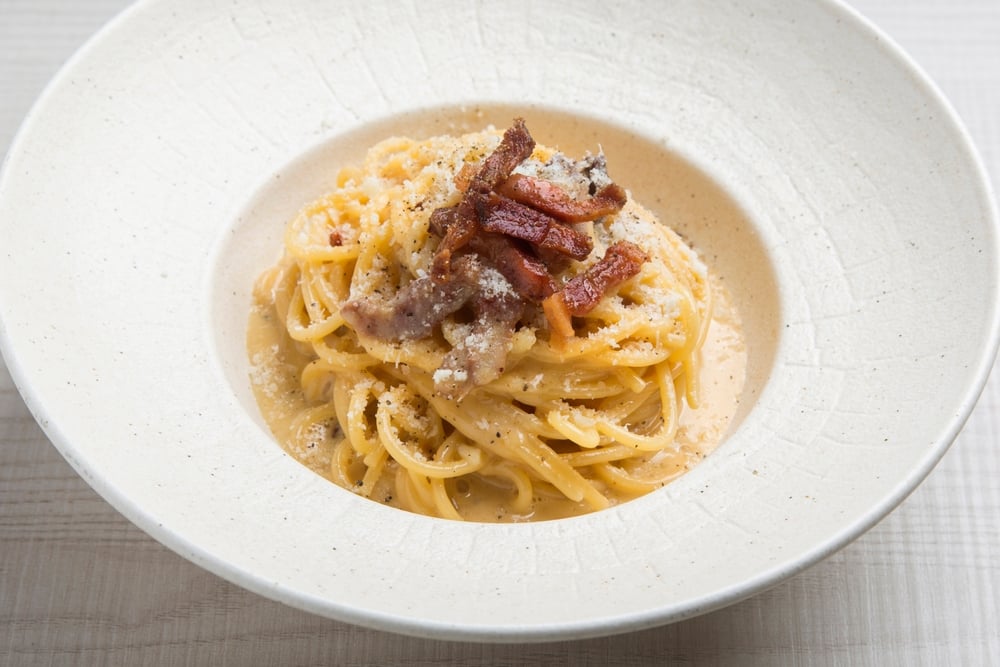
Most Rome souvenirs have a short shelf life, and the best one to bring home is knowing how to make carbonara. It weighs nothing, and it beats the alternative: since 12 April 2025, travellers from EU countries can’t bring cheese or cured meats into Great Britain for personal use.
Below you’ll find why the obvious edible souvenirs get stopped at the border, what really goes into a Roman carbonara, how to pick a cooking class in Rome that teaches it, and a step-by-step method for making it at home.
Why Can’t You Just Bring the Ingredients Home?
The natural instinct is to fill your case with the good stuff: a wedge of Pecorino Romano, a vacuum-packed slab of guanciale, maybe a jar of something from a deli near Campo de’ Fiori. If you’re flying back to Scotland, England or Wales, that plan stops at the airport.
GOV.UK’s guidance is blunt: you cannot bring meat or dairy products from any EU country into Great Britain for your own use. The restriction was brought in to stop the spread of foot and mouth disease after outbreaks in Europe, and it applies to sealed, labelled and duty free products too. That covers guanciale, pancetta, salami and every Italian cheese.
If you declare banned food at the border, Border Force will take it away and destroy it. If you don’t, the government says you could face penalties of up to £5,000 in England, and an unlimited fine on prosecution elsewhere in Great Britain. Travelling to Northern Ireland follows separate rules, so check GOV.UK before you pack if that’s where you’re heading.
| Souvenir | Can it go in your case to Great Britain? | Better idea |
|---|---|---|
| Guanciale or pancetta | No, pork products from the EU are banned | Buy from an Italian deli at home |
| Pecorino Romano or Parmigiano | No, dairy from the EU is banned | Look for imported PDO cheese at home |
| Dried pasta | Yes, if it contains no meat or dairy | Bring a bag of a shape you can’t find at home |
| Wine or limoncello | Yes, within your alcohol allowance | Check duty free limits before you buy |
| The cooking skill | Yes, always | Take a class while you’re in Rome |

The ingredients can be bought at home. A good Italian deli or a well-stocked supermarket will usually have guanciale or pancetta and imported Pecorino Romano. What you can’t buy at home is the knack of putting them together, and that’s the part worth bringing back.
What Actually Goes in a Roman Carbonara?
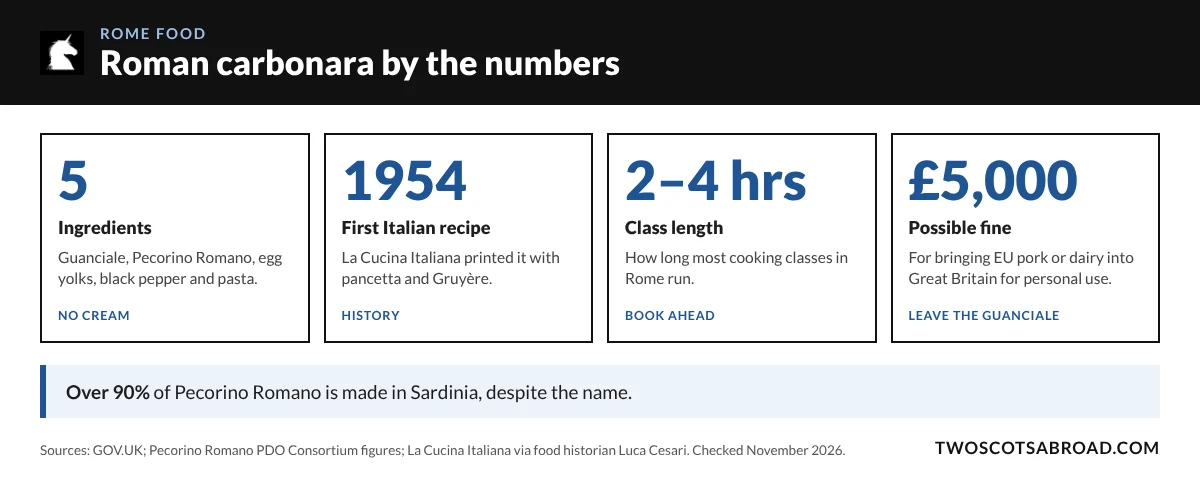
It’s a short list: guanciale, Pecorino Romano, egg yolks, black pepper and pasta. That’s the whole dish as Rome cooks it today.
- Guanciale is cured pork cheek. It’s fattier than pancetta, which comes from the belly, and that fat matters because it melts into the pan and becomes half the sauce.
- Pecorino Romano is a hard, salty sheep’s milk cheese. Despite the name, most of it isn’t made near Rome: in the 2024/25 season Sardinia produced 92% of all Pecorino Romano, with the rest from Lazio and the province of Grosseto in Tuscany.
- Egg yolks (sometimes with a whole egg or two) give the sauce its richness and body.
- Black pepper goes in generously, freshly ground.
- Pasta is usually spaghetti, though rigatoni and tonnarelli are common in Rome too.
There’s no cream in a Roman carbonara, and no garlic, onion, mushrooms or peas either. The silky texture comes from egg yolks, cheese, rendered pork fat and a splash of the starchy water the pasta cooked in.
Is Carbonara as Old as Romans Make Out?
Not really, and that’s part of its charm. Romans can be strict about a recipe that’s younger than many of their grandparents.
Carbonara barely appears in print before the 1950s. Food historian Luca Cesari traces the first published recipe to a 1952 restaurant guide from Chicago, and the first Italian one to the August 1954 issue of the magazine La Cucina Italiana. That 1954 recipe used pancetta, Gruyère and garlic, which would cause a riot in a Roman trattoria today.
According to Italy Magazine’s history of the dish, guanciale only replaced pancetta in a cookbook in 1960, and cream turned up regularly until the 1990s. Nobody knows for certain who invented carbonara. The popular story that it grew out of American soldiers’ bacon and egg rations after the liberation of Rome in 1944 is repeated a lot, but it’s a theory, without hard proof.
The version you’ll eat in Rome now, with guanciale, Pecorino and yolks only, is the one that settled over the last few decades. It’s the one worth learning.
Where Does Carbonara Go Wrong at Home?
Nearly every failed carbonara fails in the same ten seconds. The egg and cheese mixture goes into a pan that’s still on the heat, and you end up with spaghetti and scrambled eggs. It’s edible, but it isn’t what you were promised.
The fix is simple to describe and surprisingly hard to do. The pan comes off the heat, the pasta goes in with a little of its cooking water, and only then do the yolks and cheese follow, with lots of fast stirring. The leftover warmth thickens the sauce without setting the egg.
| Problem | What causes it | How to fix it |
|---|---|---|
| Scrambled, grainy sauce | The pan was too hot when the eggs went in | Take the pan off the heat first and let it cool for a moment |
| Sauce too thick or claggy | Not enough pasta water, or the cheese went in too fast | Add pasta water a spoonful at a time and keep stirring |
| Sauce too thin and runny | Too much water, or the pan was too cool | Toss over the lowest heat for a few seconds, stirring constantly |
| Lumps of cheese | Cheese grated too coarsely or added all at once | Grate it finely and whisk it into the yolks first |
| Too salty | Pecorino, guanciale and salted pasta water all add salt | Salt the pasta water lightly and taste before seasoning |
A recipe can tell you all of that. What it can’t show you is what “warm enough but not too hot” looks like in your own pan, or how loose the sauce should be before it tightens on the plate. That’s the part you need to see someone do.
Why Learn Carbonara in a Cooking Class in Rome?
This is where a few hours in a Roman kitchen earns its place on the itinerary. A chef stands next to you, tells you to take the pan off the heat now, and you watch the sauce turn glossy instead of lumpy. Seeing it happen once makes the written recipe make sense afterwards.
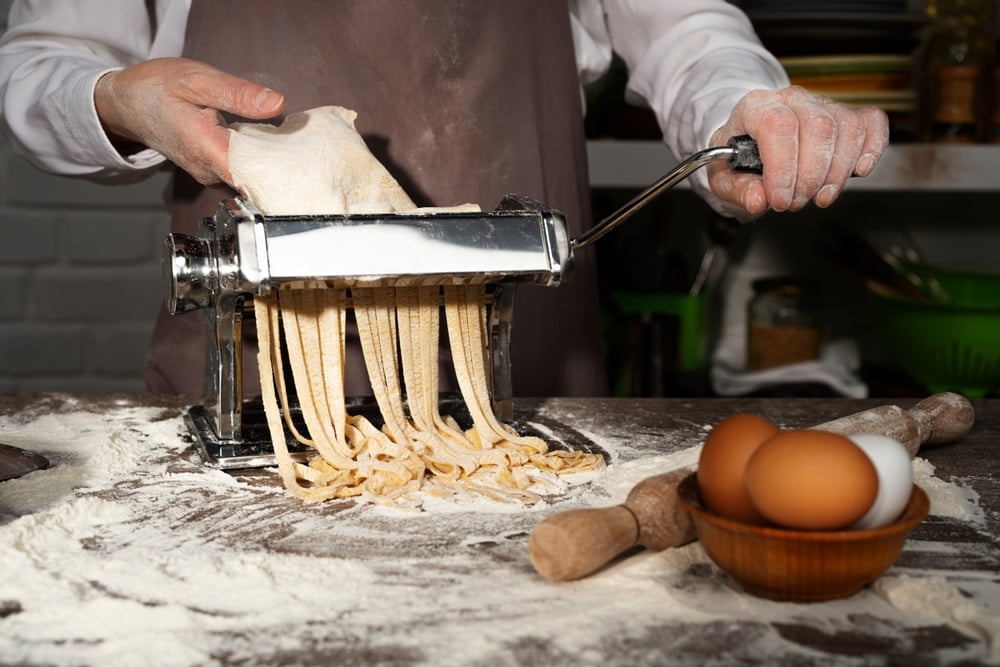
Most classes also have you make pasta from scratch with flour and eggs, kneading and rolling it by hand. Then you sit down and eat what you’ve made, often with a glass of wine. It’s a hands-on way to spend part of a day in the city, and it works in any weather.
There are plenty of pasta making classes in Rome to compare, and most of the classes listed there run between two and four hours, with prices on the site starting at around €32 per person. You don’t need any cooking experience. Most classes are aimed at complete beginners and mixed groups of travellers.
As with any class, the menu, group size and what’s included vary from listing to listing, so read the details of each one before you book.
How Do You Choose a Cooking Class That Fits Your Trip?
One thing worth knowing before you book: not every class teaches carbonara. Plenty focus on fresh fettuccine or ravioli, and a lot finish with tiramisu. Those are great fun, but if your goal is to master one of the Roman sauces, check that carbonara (or cacio e pepe or amatriciana) is named on the menu.
Location matters more than you’d think. Many classes meet a short walk from the Pantheon, Piazza Navona, the Vatican or the Colosseum, so they slot in neatly after a morning of sightseeing. A late afternoon class also takes care of dinner, which is handy if you’re trying to squeeze Rome into a day or want to be fed before heading out to see Rome at night.
A few practical points before you book:
- Travelling with children? Look for a family class. They’re built around getting little hands in the dough, and some charge less for children.
- Vegetarian, gluten free or avoiding dairy? Add it to your booking and message the organiser to confirm what they can adapt. Carbonara itself is built around pork, cheese and egg, so ask what the swap will be.
- Check what you’re cooking versus watching. Some classes are fully hands-on; others include a demonstration for part of the menu.
- Check the meeting point and end time, especially for evening classes, so you know how you’ll get back to your hotel.
- Wear comfortable shoes and clothes you don’t mind getting floury. You’re on your feet for most of the class.
- Book a few days ahead in busy months, as popular time slots and small groups fill first.
Not sure which kind of class suits you? Use the picker below to narrow it down.
 Rome Cooking Class Picker
Tell the picker when you are free, who is cooking and what you want to learn. It suggests what kind of Rome cooking class to look for and what to ask before you book.
Class to look for
Check before you book
Fit it into your day
How Do You Make Carbonara at Home?
Here’s a straightforward version for four people, based on the classic Roman method. Treat the quantities as a starting point and adjust to taste.
| Ingredient | For 4 people | Notes |
|---|---|---|
| Spaghetti or rigatoni | 400g | Dried pasta is traditional |
| Guanciale | 150 to 200g | Pancetta is the usual substitute |
| Egg yolks | 4, plus 1 whole egg | Use the freshest eggs you can |
| Pecorino Romano | About 60 to 80g, finely grated | Keep a little back for serving |
| Black pepper | Plenty, freshly ground | Toast it briefly in the pan if you like |
- Cut the guanciale into short strips or small cubes. Put it in a cold, dry frying pan and cook it gently until the fat runs and the edges crisp. Turn off the heat.
- Whisk the yolks and the whole egg with most of the grated Pecorino and lots of black pepper until you have a thick paste.
- Cook the pasta in boiling water salted more lightly than usual, as the cheese and guanciale are already salty. Scoop out a mugful of the cooking water before you drain it.
- Tip the drained pasta into the pan with the guanciale and its fat, with a splash of the cooking water. Toss well. The pan should be warm but no longer sizzling.
- With the heat off, pour in the egg and cheese mixture and stir fast, adding more pasta water a little at a time until the sauce turns smooth and glossy and coats the pasta.
- Serve straight away, with the rest of the Pecorino and another twist of pepper on top.
Can’t find guanciale? Pancetta is the most common stand-in. Purists will wince, but it’s a far better swap than reaching for a jar of ready-made sauce. Smoked bacon changes the flavour more, so use it only as a last resort.
A note on safety: carbonara relies on residual heat, so the eggs stay lightly cooked. If you’re pregnant or cooking for anyone more vulnerable to food poisoning, check the NHS advice on eating lightly cooked eggs first.
What Else Should Food Lovers Do in Rome?
A cooking class pairs well with the rest of Rome’s food scene. Spend a morning browsing a neighbourhood market such as Campo de’ Fiori or the covered market in Testaccio, then try the other Roman pasta classics in a trattoria: cacio e pepe, amatriciana and gricia, which is essentially carbonara without the egg.
Once you’ve learned what good carbonara tastes like, you’ll be able to spot the difference on menus too. A version made to order with guanciale and a glossy, clinging sauce is what you’re after.
If Rome is part of a longer Italian trip, our southern Italy travel guide covers where to go next, and our round-up of Italian regions that reward the curious traveller has ideas well away from the crowds.