
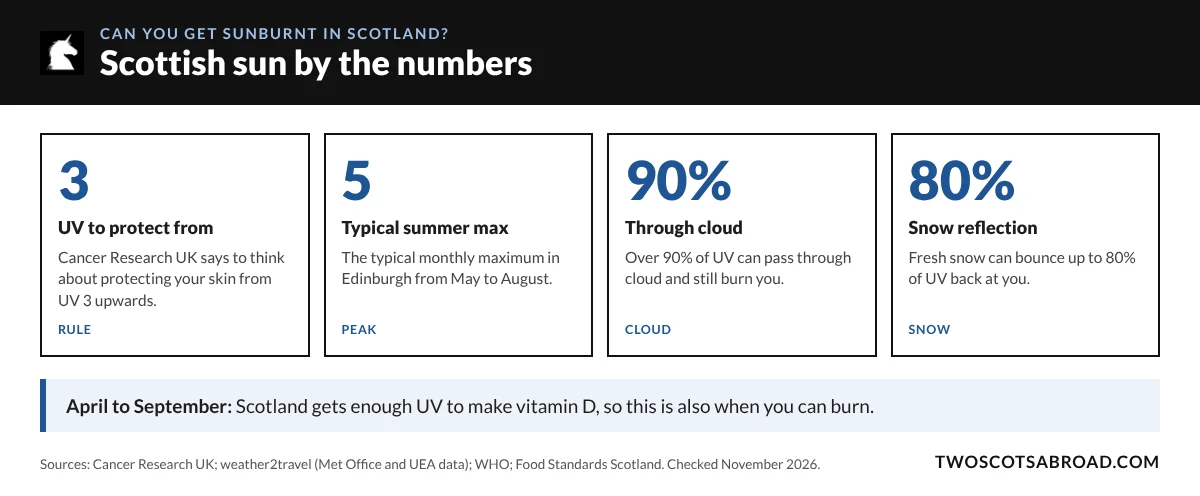
You’ve packed for rain, wind and midges, but can you get sunburnt in Scotland? Yes, and usually on a day that doesn’t feel hot. Cancer Research UK says to think about protecting your skin from UV 3 upwards, and Edinburgh’s typical UV maximum sits at 5 from May to August.
Here’s when the Scottish sun is strongest, where you’re most likely to burn, who burns fastest, and what to wear and pack, with a quick sun risk checker for your trip.
Why Does the Scottish Sun Catch People Out?
UV and temperature are two different things. UV follows the height of the sun, so it peaks around the June solstice whether the air is 12°C or 25°C. The warmest weather tends to arrive later in the summer, which is why May and June do so much damage: the sun is close to full strength while you’re still in a fleece.
Wind makes it worse. A cool sea breeze or a blustery ridge keeps your skin from feeling hot, so you never get that prickly warning that sends you looking for shade.
Then there’s the length of the day. Edinburgh gets around 18 hours of daylight in June, and a hill day or a slow drive up the west coast can easily turn into eight or ten hours outside without anyone planning it that way.
Cloud is poor protection, too. Cancer Research UK says over 90% of UV can still pass through cloud, and the bright, hazy overcast Scotland does so well in summer blocks very little of it.
What Is the UV Index in Scotland by Month?
These are the typical monthly maximums for Edinburgh from weather2travel’s Edinburgh climate averages, which are built on Met Office and University of East Anglia data. Glasgow and Fort William run close to them.
| Month | Typical max UV index | Daylight (hours) | What to do |
|---|---|---|---|
| January | 0 | 8 | No sun protection needed |
| February | 1 | 10 | No sun protection needed |
| March | 2 | 12 | None, unless you’re on snow |
| April | 3 | 14 | Cover up around midday |
| May | 5 | 16 | Protect skin from 11am to 3pm |
| June | 5 | 18 | Protect skin from 11am to 3pm |
| July | 5 | 17 | Protect skin from 11am to 3pm |
| August | 5 | 15 | Protect skin from 11am to 3pm |
| September | 3 | 13 | Cover up around midday |
| October | 1 | 10 | No sun protection needed |
| November | 1 | 8 | No sun protection needed |
| December | 0 | 7 | No sun protection needed |

For context, the UK Health Security Agency says the highest UV index recorded in the UK is usually 8, and only in southern England. Scotland sits a notch or two below that, but a 5 still clears Cancer Research UK’s threshold of 3 comfortably.
Scotland’s vitamin D advice backs up the calendar. In its vitamin D advice for Scotland, Food Standards Scotland says the country only gets enough of the right kind of sunlight to make vitamin D between April and September. The rays that make vitamin D are the same ones that burn, so the two seasons line up.
Hot spells push things further. The Met Office’s UK climate extremes records list Scotland’s highest temperature as 34.8°C, at Charterhall in the Borders on 19 July 2022. On days like that the whole country goes taps aff. Check the UV forecast alongside the rain radar you’re already refreshing.
Check Your Own Trip
Pick your month and plans below to see the typical UV and what’s worth packing.
 Scotland Sun Risk Checker
Pick your month, what you are doing and how easily you burn. The checker gives you the typical UV for that time of year, what the day out adds to it and a short list of what to wear and pack.
Typical UV for your trip
What to wear and pack
Where Are You Most Likely to Get Sunburnt in Scotland?
On the Hills
The World Health Organization’s guidance on UV and altitude says UV levels rise by about 10% for every 1,000 metres you climb. The summit of Ben Nevis is 1,345 metres up, so the sun there is roughly 13% stronger than at sea level in Fort William.
Exposure matters more than height, though. Above the tree line there’s no shade at all, and a Munro day often starts under cloud that burns off by late morning, when you’re hours from the car. The usual casualties are the back of the neck, the ears, the calves and the backs of the knees.
Long-distance routes add up fast because you’re out all day, every day. If you’re weighing up a multi-day route, our guide to self-guided walking holidays in Scotland compares the main trails. For a gentler first summit, Carn Aosda, the easiest Munro in Scotland, starts just over 250 metres below the top.
On Beaches, Ferries and the Water
The WHO says dry sand reflects about 15% of UV and sea foam about 25%, so at the coast you get it from below as well as above. A cold wind on a white-sand beach hides what the sun is doing, and ferry decks, kayaks and paddleboards work the same way.
Even the city beaches count. A sunny afternoon on one of the Edinburgh seaside day trips by train, from Portobello to North Berwick, is plenty of time to burn.
On Spring Snow
Snow is the big reflector: the WHO says it can bounce back as much as 80% of UV. A bright March or April day at Cairngorm or Glencoe will catch the underside of your chin and nose, which is a strange place to peel. Our guide to when and where it snows in Scotland covers when the ski centres usually have cover.
Here are the numbers worth remembering:
Who Burns Fastest in the Scottish Sun?
This is general information and isn’t medical advice. If you have a skin condition, take medication that makes you sensitive to light or notice a changing mole, speak to a pharmacist or GP.
Cancer Research UK lists the people most at risk as those with skin that burns easily, lighter skin, light hair or eyes, lots of moles or freckles, or a history of sunburn. That describes a good chunk of the home population (the Scots word is peely-wally) and plenty of visitors with Scottish or Irish roots. Darker skin burns less easily, but it still burns.
Children need extra care. On a beach day, a long-sleeved swim shirt and a cap with a neck flap will save you an argument about sun cream every couple of hours.
The numbers at home aren’t great either. Cancer Research UK figures reported by STV show melanoma cases in Scotland have risen above 1,600 a year for the first time. Holidays abroad and sunbeds play a part, but that’s a lot for a country with this weather.
What Should You Wear in the Scottish Sun?
On a Scottish hill or beach there’s rarely any shade, so clothing does most of the work. Sun protective fabric carries a UPF rating, and the Skin Cancer Foundation explains that UPF 50 fabric blocks 98% of the sun’s rays. An ordinary white T-shirt manages a UPF of about 7, and only about 3 once it’s wet. In Scotland it will get wet.
That’s why it’s worth treating a sun layer the way you’d treat a waterproof: it lives in the bag from April onwards. Specialist UPF brands make long-sleeved tops, swim shirts and hats for exactly this. equatorsun, a UK family business that has specialised in sun protective clothing since 2006, sells women’s sun protection clothing alongside men’s and kids’ ranges, and says each piece is tested to the AS/NZS 4399 or EN 13758 standard and certified UPF 50+.
| Activity | What to wear |
|---|---|
| Hill days and long-distance walks | Long-sleeved UPF top or sun hoody, brimmed hat with a chin strap, neck gaiter, sunglasses |
| Beach, kayak, paddleboard or wild swimming | Long-sleeved swim shirt, legionnaire cap or strapped hat, swim leggings if you burn easily |
| City days and castles | Brimmed hat, sunglasses, sunscreen on face and neck |
| Spring skiing | Goggles or wraparound sunglasses, SPF 30 or higher on nose, lips and under the chin |
Hats are where Scotland differs from a beach holiday. One without a strap is a hat you’ll watch sail into a loch, and a baseball cap leaves your ears and neck out. Look for a brim all the way round and a cord or chin strap, or a legionnaire cap with a neck flap on the water.
Long sleeves earn their place twice on the west coast in summer, because covered arms and a covered neck also give the midges less to aim at.
Do You Need Sun Cream in Scotland?
Yes, from April to September on any day you’ll be outside around the middle of the day. Cancer Research UK recommends sunscreen with at least SPF 30 and 4 or 5 stars. If your arms and legs are covered, one small tube will last the week: face, ears, neck, hands, and the backs of your knees if you walk in shorts. Reapply regularly, and always after swimming or a sweaty climb.
You don’t need to bring it from home. Chemists and supermarkets stock it, though the shop in a small Highland village may only have one bottle of factor 15, so buy it in town.
Short spells of sun are fine. Food Standards Scotland says 10 to 15 minutes of unprotected Scottish sun is safe for everyone, as long as you cover up or put sunscreen on before your skin starts to redden.
Sunburn in Scotland FAQ
Do you need sunscreen in Scotland?
Yes, from April to September if you’ll be outside for more than a short spell around midday. From October to March the typical UV maximum in Edinburgh is 2 or lower, so most people won’t need it, unless they’re on snow.
Can you get sunburnt on a cloudy day in Scotland?
Yes. Cancer Research UK says over 90% of UV can pass through cloud. Thick, dark rain cloud blocks more, but bright, hazy overcast blocks very little.
What is the highest UV index in Scotland?
The typical monthly maximum in Edinburgh is 5, from May to August. The UK Health Security Agency says the highest level recorded anywhere in the UK is usually 8, and only in southern England.
Is the sun stronger in the Highlands?
A little, at height. The WHO puts the increase at about 10% for every 1,000 metres. The bigger difference is that you spend all day outside with no shade.
Do I need a sun hat for Scotland in summer?
If you’re walking, sailing or spending time on beaches, yes. Choose one with a brim all the way round and a chin strap, because the wind will test it.
Pack for Sun as Well as Rain
Scotland’s weather can do four seasons before lunch, and the sunny one is the easiest to forget. Check the UV forecast, keep a long-sleeved layer and a strapped hat in your bag from April, and put sun cream on whatever’s left showing. You’ll still get the rain, but you won’t fly home with a red nose and a story about Skye.