

Self-catering is one of the best ways to keep a Swiss holiday affordable, so a holiday apartment or chalet with a proper kitchen is a popular choice. When a broken appliance strikes, though, the fridge, cooker or washing machine you were counting on can quickly change how your stay goes.
Here’s what to check before you book, how a breakdown can affect your trip, how to report it to your host, and why you should talk to them before arranging any repair or agreeing to costs.
What Should You Check Before Booking a Swiss Apartment or Chalet?
Listings often say “fully equipped kitchen” without saying what that means. If you plan to cook most nights or you’re staying a week or more, ask the host before you pay:
| Ask about | Why it matters |
|---|---|
| Fridge and freezer size | A small bar fridge won’t hold a week’s shopping for a family |
| Hob, oven and microwave | Some studios only have two hob rings and no oven |
| Dishwasher | Handy after a long day on the slopes or trails |
| Washing machine and dryer | Many Swiss buildings share a laundry room instead of having one in each flat |
| Laundry access and times | Shared machines are usually booked by time slot under the house rules |
| Who to call if something breaks | You want a name and number, ideally for evenings and weekends too |
Laundry is the one that catches visitors out. In many Swiss apartment buildings, tenants share the machines and use them on a washing schedule set by the house rules, so a listing that mentions “laundry” may mean a slot in the basement rather than a machine in the flat. If you’re booking a longer stay with outdoor gear to wash, ask exactly how it works.
It’s also worth reading recent reviews for mentions of the kitchen and appliances, and checking the cancellation policy before you commit.

How Can a Broken Appliance Affect Your Stay?
Some breakdowns are a small hassle, while others can knock out a big part of what you booked. Here’s roughly how they compare:
| What breaks | How it affects your stay | A short-term workaround |
|---|---|---|
| Fridge or freezer | Food spoils and self-catering gets hard | A cool box, a spare fridge from the host, or shopping daily |
| Cooker or hob | No hot meals at home | A plug-in hob from the host, or eating out until it’s fixed |
| Washing machine | No clean kit on a long or active trip | The building’s shared laundry room, if guests can use it |
| Heating or hot water | A serious problem, especially in winter | An urgent repair or a move to another apartment |
| Dishwasher or small appliances | An annoyance more than a problem | Washing up by hand or a replacement from the host |
How much it matters also depends on how long you have left. With one night to go, a workaround is usually enough. With a week ahead of you, you’ll want a repair date or an alternative agreed in writing.
What Should You Do First When Something Breaks?
Start with safety, then the paperwork:
- Switch it off. If an appliance smells of burning, sparks or leaks, unplug it or turn it off at the socket if it’s safe to do so.
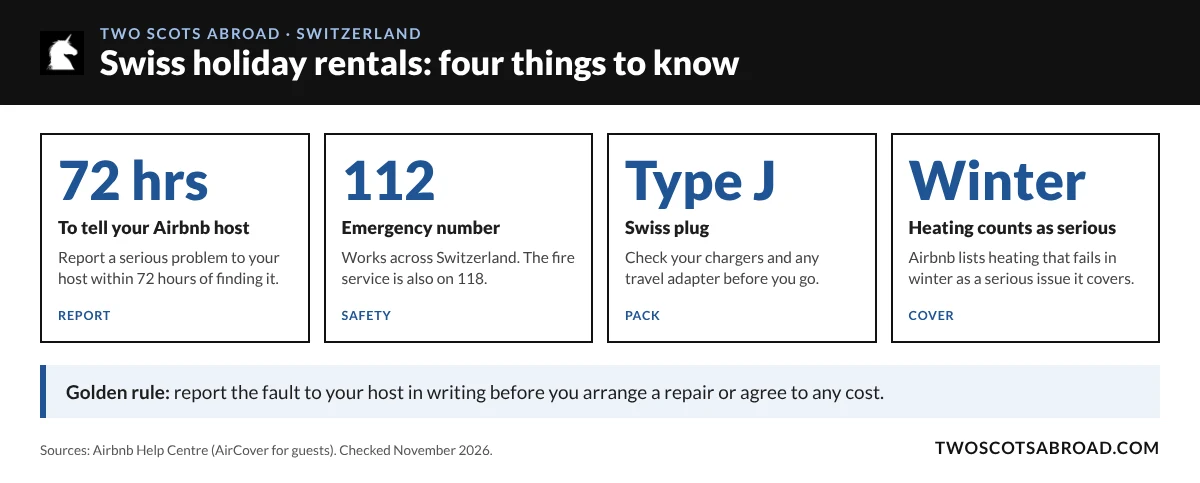
- Get out if you smell gas. Leave the apartment without using switches or flames, then call 112 or the fire service on 118 from outside.
- Limit water damage. If a washing machine or dishwasher is leaking, turn off its water supply if you know where it is, and tell your host straight away.
- Take photos or a short video. Record the fault and any error code on the display.
- Check the manual or the house folder. A tripped fuse, child lock or closed water tap is a quick fix you can sort yourself.

Use the helper below to get your next steps and a short message for your host.
 Broken Appliance Helper for Swiss Rentals
Pick what’s broken, how you booked and how long you have left. The helper gives you the next steps and a short message you can send to your host.
First step
Next steps
Message to your host
How Do You Report the Problem to Your Host?
Report it as soon as you can, in writing, through the booking platform’s messaging or by email. A message gives you a dated record if you later need to ask for a refund or a move. A phone call is fine for anything urgent, but follow it up in writing.
If you booked through Airbnb, the timing matters. Its policy asks guests to contact the host within 72 hours of finding a problem, with photos or video, and to contact Airbnb if the host doesn’t respond or can’t fix it. Airbnb treats heating that isn’t working in winter, or a missing major amenity such as a kitchen, as a serious issue, but a minor fault like a broken toaster isn’t covered.
When you message your host, keep it short and specific:
- What’s broken, when you noticed it and what you’ve already tried
- Whether there’s any safety risk or water damage
- When a repair is likely, and whether someone needs access to the apartment
- What alternatives they can offer in the meantime, such as a spare appliance, use of a shared laundry room, a move to another unit or a partial refund
Why Should You Contact the Host Before Arranging Repairs?
It’s tempting to call a repairer yourself, especially if your host is slow to reply. In a holiday rental, though, the appliance belongs to the owner, so get their go-ahead first. There are good reasons for this:
- You may end up paying. Without written agreement, there’s no guarantee the host will refund a call-out you booked yourself.
- The host may already have someone. Many owners and agencies use a regular repairer or have a warranty or service contract on their appliances.
- Access and insurance. The owner may need to arrange access, and work they didn’t approve can cause disputes if something goes wrong.
- Your booking protection. Platform policies usually expect you to give the host a chance to fix the issue first.
If the host asks you to help, or you’re on a longer let and they approve a repair in writing, a nationwide firm can save time. Swiss Pro Service, specialists in household appliance repair and assistance across Switzerland, works with washing machines, dishwashers, fridges, ovens and hobs from brands such as Bosch, Miele and Siemens. Confirm with your host who pays and who will be there to let the technician in before anyone is booked.
Whatever you agree, keep it in writing: the repair date, who pays, and any refund or discount for the days you’re without the appliance.
What Changes on a Longer Stay?
If you’re renting for a month or more, the rules look more like a normal tenancy. Read your rental agreement and the house rules carefully, since Bern’s university housing guide notes that house rules often govern rest periods and shared areas, including the laundry room. Check how faults should be reported and if you’re expected to deal with small jobs, such as replacing a light bulb, yourself.
On any stay, pack a few things that make life easier if a kitchen appliance does fail: a cool bag for food shopping, a few reusable containers and the right plugs for your chargers. Switzerland uses its own Type J sockets, so our guide to travel adapters by plug type is worth a look before you go.
Heading to the Alps? Our round-up of beginner-friendly ski resorts in Europe has more ideas, and if you’re flying from Scotland, here’s the news on direct Glasgow to Zurich flights.
Swiss Holiday Apartment FAQ
Who pays to fix a broken appliance in a holiday rental?
The owner normally pays to repair their own appliances, unless the damage was caused by the guest. Agree any costs with your host in writing before work goes ahead.
Can I get a refund if the kitchen stops working?
It depends on your booking terms and how serious the problem is. On Airbnb, a missing major amenity such as a kitchen can count as a serious issue, so report it to your host within 72 hours and contact Airbnb if it isn’t resolved.
Do Swiss holiday apartments have washing machines?
Some do, but many buildings share a laundry room, with machines booked by time slot under the house rules. Ask the host before you book.
What number do I call in an emergency in Switzerland?
Call 112, the European emergency number, or 118 for the fire service.
Should I call a repairer myself if my host doesn’t answer?
Contact the booking platform first. Only book a repair if your host or the platform agrees in writing, so you’re not left with the bill.
A bit of checking before you book and a quick, clear message if something breaks will keep a broken appliance from spoiling your trip. Ask the questions up front, report problems in writing and let your host handle the repair.