
Comparing travel adapter features by plug type and power limits comes down to three checks: which plug types the adapter covers, whether it is grounded and fused, and how much power its USB ports deliver. The last one has moved quickly, because USB Power Delivery now allows up to 240W over one cable, up from 100W.
This guide covers the plug types you will meet abroad, whether you need a voltage converter, how grounding and fuses work, what USB-C wattage means and which adapter suits which trip.
Travel Adapter Features by Plug Type: What You Will Meet Abroad
Countries use 15 plug shapes, labelled with letters from A to O. An adapter only changes the shape of the pins, so the first job is matching the types on your route. The US, Canada and Japan run on roughly 100V to 120V, while most of Europe, the UK and Australia use 220V to 240V.
| Plug Type | Pins | Earth Connection | Where You Will Find It |
|---|---|---|---|
| A | Two flat parallel pins | None | USA, Canada, Japan |
| B | Two flat pins plus a round pin | Yes | USA, Canada |
| C | Two round pins | None | Much of continental Europe |
| E and F | Two round pins, with a hole (E) or side clips (F) for earth | Yes | France, Germany, Spain, the Netherlands |
| G | Three rectangular pins, fuse in the plug | Yes | UK, Ireland, Malta, Cyprus |
| I | Two angled flat pins, optional earth pin | Optional | Australia, New Zealand, China |
A Type C plug fits both E and F sockets, which is why one slim adapter handles most of mainland Europe for chargers with two pins. Anything with a three-pin plug needs an adapter that passes the earth connection through. Italy (L), Switzerland (J), Denmark (K) and Brazil (N) have their own sockets that also take a two-pin Type C plug, while India and South Africa use the large round-pin Types D and M.
Do You Need a Travel Adapter or a Voltage Converter?
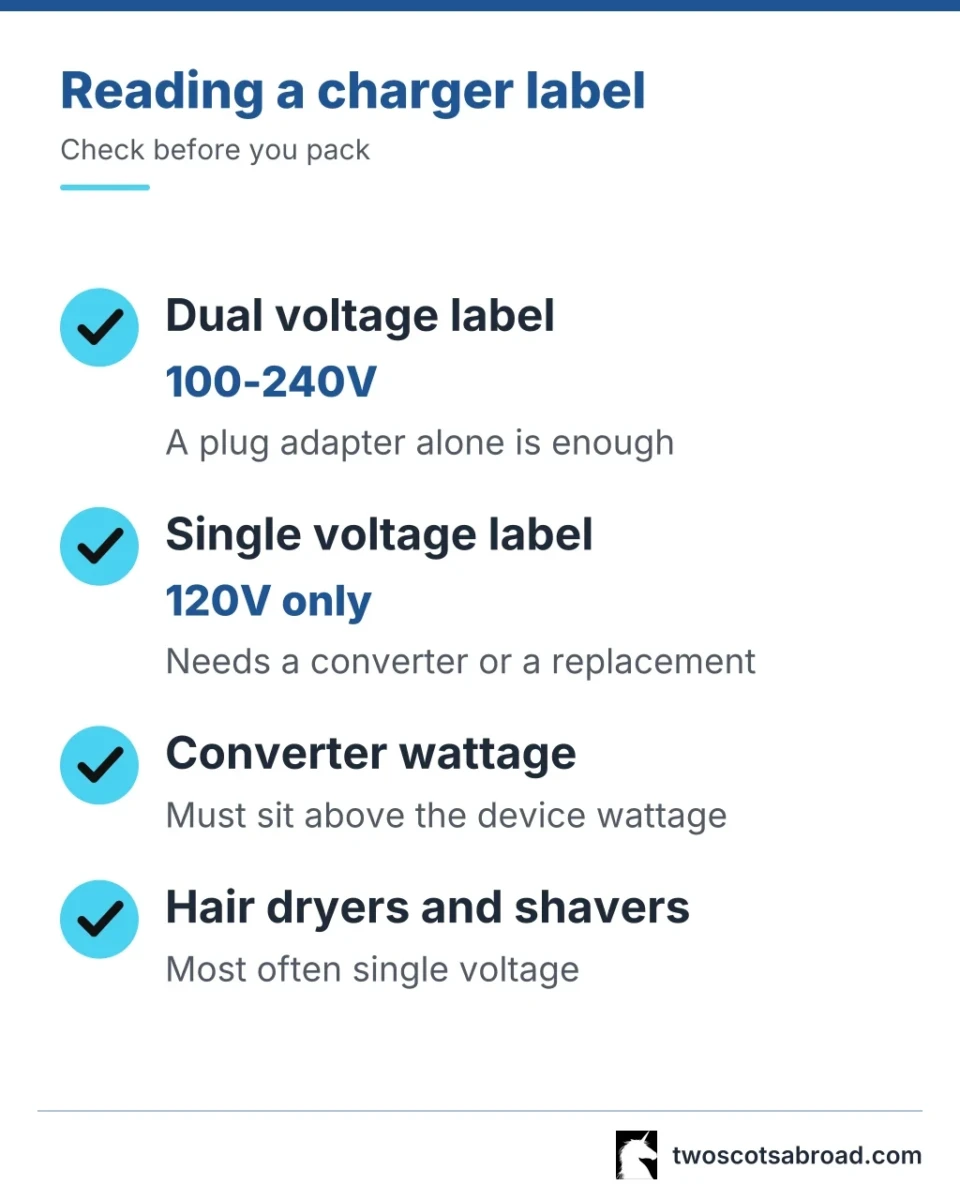
Most phone, laptop, tablet and camera chargers are dual voltage, and a charger labelled 100-240V needs only a plug adapter. Read the input line printed on the charger itself.
A device labelled for 120V only is a different problem. A Type G adapter changes the plug shape and nothing else, so that device receives 230V in the UK and can be damaged. Hair dryers, curling tongs and some older shavers or toothbrush bases are the usual single-voltage offenders. Check the label, or leave them at home and use the hotel dryer.
If you do need a converter, its wattage rating must sit above the wattage of the device. Heating appliances draw the most, which is why they are the hardest to run abroad.
Grounding and Fuse Protection on Travel Adapters
Grounding matters for devices with three-pin plugs, such as some laptop power bricks and kettles. An adapter with no earth pass-through may still let them run, but you lose the protective earth connection, so use a grounded adapter for them. Chargers with two pins have no earth to pass on, so a basic ungrounded adapter does them no harm.
The UK is the awkward case. A Type G plug carries its own fuse, and the socket has shutters over the live and neutral holes that the longer earth pin pushes open. Adapters for UK sockets should be fused and sized to suit, and BS 8546:2016 is the British standard that covers travel adapters. A cheap adapter with no fuse and a plastic dummy earth pin may work, but it skips the protection British sockets rely on.
USB Ports and Power Limits
A USB-C port on an adapter is only useful if its wattage matches what you charge. USB Power Delivery was limited to 100W before the 3.1 revision in May 2021, which raised the ceiling to 240W. Phones sip a fraction of that, while a laptop may want 60W or more.
- Per-port output: multi-port chargers usually share a headline wattage between ports, so the figure for one port can be much lower than the total.
- Cable rating: a 240W charge needs a cable rated for it as well as a capable charger.
- Adapter rating: the body of the adapter lists its own maximum, and everything plugged in at once should stay under it.
Choosing a Travel Adapter by Trip Type
- One country in Europe: a small Type C adapter is enough for two-pin chargers. Add a grounded Type E/F adapter if you carry a laptop with a three-pin plug.
- UK and Ireland: pick a fused Type G adapter.
- Several regions on one trip: a universal adapter with sliding or swappable pins covers A, C, G and I, at the cost of extra bulk and moving parts.
- Laptop plus phone: look for a USB-C port with the per-port wattage your laptop charger needs.
Frequently Asked Questions
Can One Travel Adapter Cover Several Countries?
Yes. A universal adapter with sliding or interchangeable pins handles several plug types, though it is bulkier than a single-purpose adapter and still does not convert voltage.
Do Phone Chargers Need a Grounded Adapter?
Most phone chargers have two pins and no earth connection, so an ungrounded adapter works for them. Grounded adapters are for devices with three-pin plugs.