
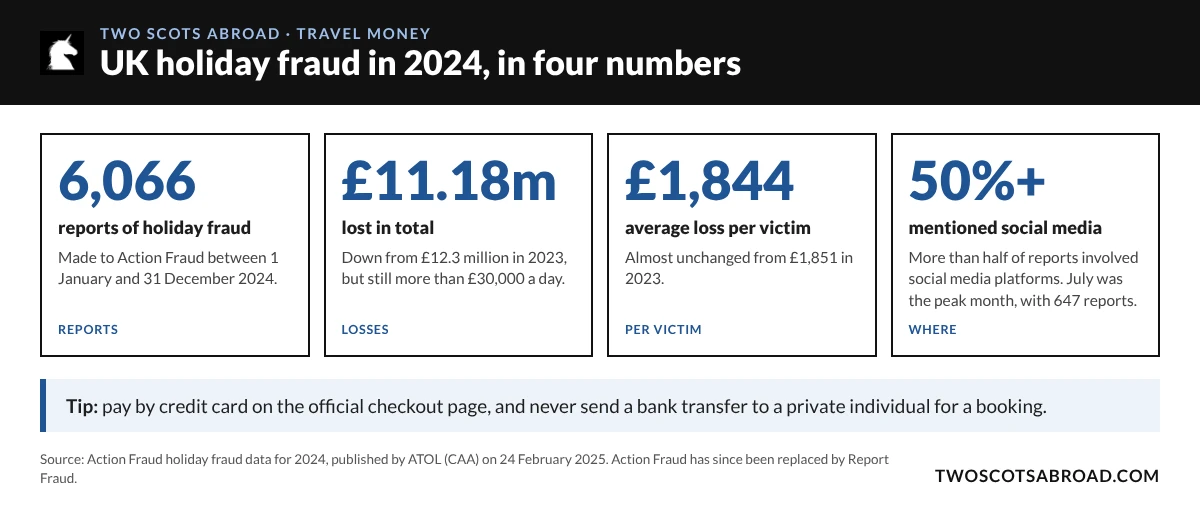
A holiday deal that looks too good can be a genuine bargain or a fake booking, and spotting a travel booking scam comes down to a few quick checks. Action Fraud’s holiday fraud figures for 2024 show 6,066 reports and £11.18 million lost by UK holidaymakers, an average of £1,844 each.
Below: the warning signs that matter more than the price, the most common scams, the checks to run before you pay, which payment methods protect you, and what to do if you have already been caught.

Is a Cheap Travel Deal a Red Flag on Its Own?
No. Airlines and hotels change prices constantly, and flash sales, error fares and last-minute room rates are real. A low price earns a closer look, but what the seller asks you to do tells you far more than the price itself.
The biggest warning sign is a request to move away from the platform you found the deal on. If a rental host asks to carry on the conversation on WhatsApp, or offers a discount for paying them directly, the platform loses its record of the deal and its ability to help. Airbnb, for example, says in its guidance on paying and communicating through Airbnb that guests who pay outside the platform lose its AirCover protection.
The same trick turns up well beyond travel. Freelance marketplaces see scammers pulling conversations and payments off the site for exactly the same reason, and Moonlock walks through how to tell a legitimate offer from a scam using the Fiverr version of the problem as its example. Swap “freelancer” for “host” and most of the warning signs carry straight over to booking accommodation.
Watch for missing detail too. A listing for a “luxury resort with ocean views” with no property name or street address gives you nothing to check. Neither does a countdown timer that resets every time you reload the page. If the seller cannot tell you exactly where you are staying, do not send a deposit.
One more thing worth doing before you get excited about a headline price: use our guide to calculating a trip’s real cost. A deal that only looks cheap because it leaves out taxes, transfers or a hefty deposit is not much of a deal, scam or no scam.
What Are the Most Common Travel Booking Scams?
Not every fake booking site looks dodgy, which is how these scams work. Action Fraud found that more than half of 2024’s holiday fraud reports mentioned social media, and some scammers used fake ABTA, ATOL or ABTOT branding to make a booking look protected. Here is how the main types play out.
| Scam | What it looks like | The giveaway | What to do |
|---|---|---|---|
| Fake search ads | A paid result above the real airline or hotel, with a phone number for “customer service” | You reach someone pretending to work for the company | Skip sponsored results and type the official web address yourself |
| Cloned hotel or airline sites | A copy of a real site with the same logos, photos and contact details | A web address with extra hyphens, misspellings or swapped characters | Check the address letter by letter before paying |
| Hijacked rental listings | Real photos and details from a genuine property, reposted with the scammer’s contact details | A deposit requested by bank transfer to a personal account | Book only through the platform, and run a reverse image search on the photos |
| Messages from a hacked hotel account | A message through your booking app or by email saying your card failed and the room will be cancelled | A payment link, or a request to re-enter card details outside the normal checkout | Check the booking in the official app, or call the hotel on a number from its own website |
| “Free” cruises and prizes | You have won a trip, but fees are due before the tickets are released | A genuine prize does not need you to pay to collect it | Do not pay; search the company name with “scam” and “complaint” |
| Fake flight-change messages | An unexpected text or email about a cancelled or changed flight, with a link | A link or payment request you did not expect | Check the booking directly on the airline’s own app or website |
Booking.com has said it will never ask for card details by phone, email, text or WhatsApp, as reported in Travel Weekly’s report on the Booking.com phishing alert. That makes the hacked-hotel-account version easier to spot once you know the rule: if a message asks for your card number anywhere other than the checkout page, treat it as a scam until proven otherwise.
 Is This Travel Deal Legit? Red Flag Checker
Tick everything that applies to the deal you are looking at. The checker weighs the warning signs and tells you what to do next. Treat the result as a guide and use it alongside the checks below.
Verdict
What to do next
Checks to Run Before You Book a Holiday Online
You do not need to spend an evening investigating every offer. These checks take a few minutes and catch the most common traps.
- Go to the website yourself. Type the address into your browser rather than following a link in an email, text or advert. If you search for it, scroll past the sponsored results, which can be fakes.
- Check the web address carefully. Look for extra hyphens, misspelled names, characters swapped for lookalikes, or a change from .co.uk to .org or similar.
- Check the protection claims. If a company shows an ABTA logo, confirm it with ABTA’s own advice on avoiding travel fraud and its member search. For flights and flight-inclusive packages, use the CAA’s Check for ATOL tool and make sure the company name matches the website exactly.
- Look for complaints. Search the company or property name with words such as “scam”, “review” and “complaint”, and read beyond the first glowing review.
- Confirm the booking directly. Find the hotel’s phone number on its official website and ask them to confirm your reservation exists.
- Check the photos. A reverse image search can show that the pictures belong to another property or came from an older listing.
- Get the details in writing. Before paying, have the full address, the total price, the payment schedule and the cancellation terms.
Phishing messages and fake log-in pages are a big part of this, so it is worth tightening up your phone and accounts before you travel too. Our guide to adding digital security to your pre-trip checklist covers the basics.
Which Payment Methods Protect You When Booking Travel?
How you pay matters as much as where you book. In the UK, a credit card gives you a legal claim against the card company if something goes wrong; most other methods give you far less.
| Payment method | Protection if the booking is fake | Worth knowing |
|---|---|---|
| Credit card | Strongest: Section 75 makes the card company jointly liable | Covers items costing over £100 and up to £30,000, even if you only paid the deposit on the card (MoneySavingExpert’s Section 75 guide) |
| Debit card | Chargeback: you can ask your bank to reverse the payment | A card-scheme process rather than a legal right, with time limits |
| Payment through the booking platform | The platform’s own refund and support rules | Lost as soon as you pay the host or hotel outside the platform |
| Bank transfer | Weak: very hard to recover once sent | ABTA warns never to send money directly into a private individual’s account |
| Gift cards and cryptocurrency | Very little | Scammers favour them because the money is nearly impossible to recover |
Be especially wary of anyone who insists on one of the weaker methods, or who refuses every normal option and only takes one particular payment app. The FTC’s summer travel scam alert explains how scammers impersonate travel companies through search adverts and why requests for wire transfers, gift cards, payment apps or cryptocurrency should set alarm bells ringing. It is worth a read before paying for any booking, particularly a non-refundable one.
If you are sorting cards and currency for a trip anyway, our travel money checklist for a holiday abroad covers which cards to take and how to pay safely once you are there.
What to Do If You Have Already Paid a Scammer
Act fast. The sooner your bank knows, the better the chance of stopping or reversing the payment.
- Call your bank or card issuer straight away. In the UK you can dial 159, the Stop Scams UK bank fraud line, to reach your bank’s fraud team. Explain what happened and ask whether the payment can be stopped, disputed or charged back.
- Report it. In England, Wales and Northern Ireland, report to Report Fraud, the service that replaced Action Fraud, online or on 0300 123 2040. In Scotland, call Police Scotland on 101. In the US, report to the FTC at ReportFraud.ftc.gov.
- Forward the evidence. UK readers can forward scam emails to report@phishing.gov.uk and scam texts to 7726, as set out in the GOV.UK guidance on reporting scams and phishing.
- Tell the platform and the real company. Report the listing or message to the booking site, and let the genuine hotel, airline or ABTA know if their name was used.
- Keep everything. Screenshots of the listing, messages, payment receipts and the website address all help your bank and the police.
A low price is no bargain if the booking turns out to be fake. And when two similar rooms cost about the same, the one with free cancellation is usually the better buy: it gives you time to check, and a way out if something feels off.
Travel Booking Scam FAQs
How can I tell if a holiday booking website is fake?
Check the web address letter by letter, look for a real street address and company details, search the name with “scam” and “complaint”, and confirm any ABTA or ATOL claim on the official member and ATOL search tools. Be suspicious of a site that only accepts bank transfer.
Is it safe to pay a holiday rental host directly?
It is risky. Paying outside the platform you booked on usually removes its refund and support protection, and the major platforms prohibit hosts from asking for off-platform payment. A discount for paying directly is a classic warning sign.
Does paying by credit card protect a holiday booking?
In the UK, Section 75 makes your card company jointly liable for single purchases costing over £100 and up to £30,000, including holidays, even if you only put the deposit on the card. Debit cards rely on chargeback instead, which is not a legal right.
Can I get my money back after a bank transfer to a scammer?
Sometimes, but it is much harder than with a card payment. Contact your bank immediately, report the fraud, and keep all the evidence. The faster you act, the better your chances.
Where do I report holiday fraud in the UK?
In England, Wales and Northern Ireland, report to Report Fraud at reportfraud.police.uk or 0300 123 2040. In Scotland, call Police Scotland on 101. Forward scam emails to report@phishing.gov.uk and scam texts to 7726.