

Planning a trip when travelling with a wheelchair user takes more homework than a standard holiday, and the details decide whether it works. Timing matters from the start: the Consumer Council’s guide to air travel assistance advises UK and EU travellers to request airport assistance at least 48 hours before flying.
But airport assistance is only one piece of the holiday. A hotel can have a step-free entrance and a bathroom that does not work for the traveller. A taxi can advertise wheelchair access but have insufficient headroom for someone travelling in their chair. Getting those details confirmed before paying saves a lot of troubleshooting later.
Below, we cover what to note about the traveller and their chair, how to check a hotel room is really accessible, how to fly with a wheelchair and its battery, and how to sort transport at the other end. There are also practical checks for sightseeing, equipment hire, insurance and a backup plan if something goes wrong.
Quick answer: Start with the wheelchair user’s own priorities and assistance needs. Record the chair’s measurements, confirm the specific hotel room features in writing, clear the equipment and battery with every operating airline, and book suitable ground transport before you travel. Build the itinerary around the whole journey, including toilets, transfers and time to rest.
What Should You Know About the Traveller Before You Book?
This guide is general travel information and is not medical advice. Questions about transfers, seating, pressure care or equipment should go to the traveller’s own doctor, occupational therapist or wheelchair service.
Before you pick a destination, sit down with the person who uses the wheelchair and talk through a normal day. Every booking that follows depends on the answers, so be specific:
- How do they transfer to a bed, toilet or car seat, and do they need help or a hoist?
- Do they need a shower chair, grab rails on a particular side or a roll-in shower?
- How far can they comfortably self-propel, and how long can they sit before needing a break?
- What medication, chargers and spare parts must travel in hand luggage?
- Can they use a standard vehicle seat, or do they need to remain in their wheelchair during road journeys?
- What help do they want from travelling companions, and what do they prefer to do independently?
Keep the traveller involved in the decisions throughout. Some wheelchair users walk short distances; others cannot stand or transfer without equipment. Neither tells you what somebody wants from a holiday. Ask about the things they want to do first, then work out the access needed to make those plans possible.
Agree on assistance before you leave, particularly if someone will be helping with transfers or personal care. Do not assume a friend, hotel employee or taxi driver can safely provide the same support as a trained carer. Any unfamiliar transfer method needs to be discussed with the traveller and, where appropriate, their usual professional support team.
Create a Wheelchair Information Sheet
Next, write down the chair’s specifications. Airlines, cruise lines, taxi firms and tour operators will ask, and it is much easier to read them off a sheet than measure the chair in a busy terminal. Keep one copy on your phone and a printed copy in your bag.

| What to record | Why you’ll need it |
|---|---|
| Width, length and height when set up | Hotel doorways, lifts and taxi entrances |
| Folded or dismantled size | Car boots, aircraft holds and possible cabin stowage |
| Total weight and heaviest removable piece | Ground handling, vehicle loading and lifting arrangements |
| Combined weight of the traveller and chair, where needed | Checking vehicle lift and ramp capacity |
| Battery type, number of batteries and watt-hour (Wh) rating | Airline approval for power chairs |
| How to fold it, isolate the power and engage freewheel | Helping handlers move the chair according to its instructions |
| Manufacturer, model and serial number | Repair enquiries, equipment identification and insurance claims |
| Approved lifting and transport securement points | Avoiding damage and checking suitable road transport |
Measure the chair in the configuration in which it will actually travel. A headrest, footplate or bag can change the overall dimensions. For an accessible vehicle, also give the provider the traveller’s seated height in the chair, since an entrance can be wide enough but too low.
Size and weight shape the whole trip. Some folding manual chairs fit in ordinary car boots, but that still depends on the car, luggage and who can load the chair. A heavy rigid power chair usually needs a vehicle with suitable access and securement equipment. If the traveller needs powered mobility but wants something easier to transport, it is worth comparing travel power wheelchairs from Marc’s Mobility, a US mobility retailer. Its listing for the Jazzy Carbon 27, for example, gives a weight of 27.8 lbs without the battery. Check the folded size, battery rating and seat fit against the traveller’s needs before buying, ideally with their wheelchair service or therapist.
A lighter chair is only useful if it provides the support the person needs. Compare seating, controls, terrain suitability and transport arrangements as well as lifting weight. If using a different chair for the holiday, allow time to try it before departure rather than discovering its limitations at the airport.
How Do You Choose a Destination That Works?
Look beyond lists of accessible attractions and check the journeys between them. A museum might have excellent access while the route from the nearest station involves steep streets, broken pavements or a bridge with steps.
Start with a sample day: leaving the hotel, reaching one main attraction, finding lunch, using a suitable toilet and returning. If those connections work, you have a useful base for the rest of the itinerary.
- Terrain: Check hills, cobbles, gravel, sand and pavement condition along the actual routes you expect to use.
- Location: A central hotel may reduce the number of accessible taxis needed, but confirm that its surrounding streets are manageable.
- Toilets: Identify facilities that suit the traveller’s transfer and equipment needs, including any changing facilities required.
- Weather: Consider how heat, rain, snow or ice could affect outdoor plans, equipment use and waiting for transport.
- Backup options: Have an alternative activity if a lift breaks, a route is blocked or the weather changes.
Recent photographs and detailed accounts from wheelchair users can help you spot questions to ask. Treat them as a starting point, though: another traveller’s chair, transfer needs and tolerance for slopes may be different.
How Do You Check a Hotel Room Is Really Accessible?
“Accessible” means different things at different properties. In the United States, the 2010 ADA Standards for door clear width generally specify a minimum clear opening of 32 inches, with additional requirements in certain circumstances. That is the usable opening, not simply the width of the door itself. A room can meet an applicable standard and still not suit the person you are travelling with. Other countries use their own standards.
Skip the central reservations line where possible and contact the hotel itself. Ask someone who can inspect the room, such as the front desk or maintenance team, for actual measurements:
- Bed height from the floor to the top of the mattress, so you can compare it with the chair’s seat height for transfers.
- Bathroom door clear opening and the manoeuvring space inside.
- Clearance under the bed, if you are bringing a mobile hoist.
- Whether the shower is roll-in, or a bath with a bench.
- Clear space on the required side of the bed and toilet.
- Lift door opening and internal dimensions, including space for a companion where needed.
Check the Bathroom Layout, Not Just the Shower
A photograph of a shower does not tell you whether the traveller can reach it, turn inside the bathroom or transfer to the toilet. Ask which side the toilet transfer space is on, where the grab rails sit and whether the bathroom door opens into the space needed for manoeuvring.
If a shower seat is provided, confirm its type, dimensions and stated weight capacity. A fixed wall seat and a wheeled shower chair serve different purposes. Check for a shower threshold, the position of the controls and whether equipment can be positioned as the traveller needs.
For a hoist, the space underneath the bed is only part of the check. You also need room to position and move the equipment. Confirm the exact hoist and sling arrangements with the supplier and the traveller’s support team; do not assume any available sling will be suitable.
Confirm the Route Through the Hotel
Ask about the route from the vehicle drop-off to reception, the room, breakfast and any facilities you intend to use. Check whether the accessible entrance is open at your arrival time and whether access relies on staff fetching a portable ramp or unlocking a separate door.
Ask for photos of the room you will actually get, then confirm the room type and essential features in writing. A general accessibility request does not explain whether you need a roll-in shower, a particular transfer side or hoist clearance. If your trip involves several hotels, our trip planning guide and free spreadsheet can help you keep each property’s measurements and confirmations in one place.
A useful message is: “Please confirm that our booked room has a step-free route from the entrance, a bathroom clear opening of [measurement], a [shower type], and clear transfer space on the [left/right] side of the bed and toilet.” Add the traveller’s actual requirements rather than copying a generic checklist.
Before paying a non-refundable rate, ask what happens if the required room or lift becomes unavailable. Also discuss the hotel’s emergency evacuation arrangements and any assistance the traveller would need. Reconfirm essential details shortly before departure.
How Do You Fly With a Wheelchair?
Tell the airline about the wheelchair and any assistance when you book, then confirm it again before you travel. In the UK and EU, special assistance is provided free of charge under the applicable rules. Requesting it at least 48 hours ahead gives the airline and airport time to arrange staff and equipment.
Describe the assistance needed in practical terms: whether the traveller can walk to a seat, use aircraft steps or transfer without help. An airport wheelchair request alone may not explain the need for an aisle chair, a boarding lift or a particular transfer arrangement.
Check Every Flight and Operating Airline
For a codeshare, the airline selling the ticket may be different from the one operating the aircraft. Confirm equipment acceptance and assistance with every operating carrier, including the return journey. Keep copies of their responses with the booking.
Give the airline the chair’s dimensions in its agreed transport configuration. Ask whether it fits through the cargo door and can travel in the required position on each aircraft type. Battery acceptance does not establish that the chair itself will fit.
A nonstop flight reduces the number of times the chair is loaded and unloaded. If a connection is necessary, allow time for disembarkation, assistance, toilet stops and any transfer between terminals. Ask whether the traveller’s own chair will be available during the connection and what happens if the itinerary changes.
On flights covered by US rules, assistive devices do not count toward the baggage limit. The US Department of Transportation’s wheelchair guidance and its assistive-device stowage, damage and delay guidance explain equipment handling. Arrange gate checking so the traveller can remain in their chair as long as possible, and discuss its return as close as possible to the aircraft door. If they cannot walk to their seat, request an aisle chair and explain the transfer assistance required.
Plan for the Time On Board
For a standard airline journey, plan on transferring into an aircraft seat rather than remaining in a personal wheelchair during the flight. Ask about the seat location, movable armrests and any airline-approved seating or transfer equipment the traveller needs.
Check the aircraft’s toilet arrangements before booking, especially for longer journeys. An onboard wheelchair may help someone reach the lavatory without providing the space or support needed to use it. The UK Civil Aviation Authority’s assistance guidance also explains that airline staff are not expected to provide personal help with eating, taking medication or using the toilet.
Discuss personal care and seating needs with the traveller and their usual professional support team where appropriate. Keep essential supplies within reach during the flight, rather than relying on access to a bag stored several rows away.
Protect the Chair From Damage
Damage or delay can disrupt the whole holiday. According to DOT figures, reporting US carriers mishandled 1.38 percent of the wheelchairs and scooters they checked across 2023. That is a historical figure covering mishandling, including damage and delay, rather than a current damage-only rate.
Before handing over the chair:
- Remove the cushion and other loose items the traveller needs. Remove components such as a joystick or armrests only where the manufacturer’s instructions allow and the airline has agreed how they will travel.
- Attach a laminated card showing the model, handling instructions, approved lifting points and how to engage freewheel or isolate power where applicable.
- Photograph the chair from every side at the gate, including vulnerable components and any existing damage.
- Label detachable parts and retain the baggage tag, equipment form and any written handling arrangements.
Use the manufacturer’s transport instructions rather than a generic checklist for disconnecting cables or moving the chair. Point out parts that must not be used as lifting handles. Keep a copy of the instructions with you as well as attached to the chair.
Know What to Do if the Chair Is Damaged or Delayed
Inspect the chair as soon as it is returned. Check the controls, wheels, brakes, footrests and seating components as appropriate, and do not use it if something appears unsafe.
If something breaks, submit a written report to the airline before you leave the airport where possible. Our luggage guide covers general reporting habits, but a wheelchair claim needs to be handled as a mobility-equipment issue. Take photographs, get a reference number and explain how the problem affects the traveller’s ability to move, transfer or use suitable seating.
Request a suitable loan chair and a clear repair or replacement plan. Explain any essential seating, control or support requirements; a basic airport wheelchair may not meet them. Keep receipts for related expenses and follow the airline’s written claim procedure and deadlines.
The US rule finalised in December 2024 includes delayed-chair return requirements of 24 hours for domestic flights and US international flights lasting 12 hours or less, and 30 hours for longer US international flights. These are return deadlines for delayed equipment, not promises that a damaged chair will be repaired within that time. The DOT explanation of the wheelchair protections sets out those distinctions.
Check the current position: DOT has paused enforcement of four specified provisions of the 2024 rule, including its new presumption of airline liability, through 30 April 2027. The pause does not cover the whole rule or remove existing obligations concerning airline-caused damage. Consult DOT’s current notices when dealing with a claim. On flights covered by US disability rules, ask for the airline’s Complaints Resolution Official if an access problem cannot be resolved by frontline staff.
On international journeys, compensation limits can cover less than the value of a specialist chair, so check that your travel insurance covers mobility equipment. Our True Traveller and World Nomads insurance comparison gives a starting point for questions to ask, but confirm the current policy wording and suitability for the traveller’s circumstances.
Check the Battery Rules Early
Lithium batteries have their own rules, and a general label such as “airline approved” is not enough. Confirm the battery chemistry, rating, number of batteries and removal arrangements with the operating airline before booking.
The ICAO dangerous goods documentation for mobility aids provides technical background. For practical US guidance, the FAA’s wheelchair and mobility-device battery page distinguishes batteries removed for travel from batteries that remain installed and adequately protected by the chair’s design.
Where a lithium-ion battery must be removed under the applicable mobility-aid rules, it generally must not exceed 300 Wh and must travel in the cabin, protected against damage and short circuit. The spare allowance is generally one battery up to 300 Wh or two up to 160 Wh each. Properly protected installed batteries are treated differently, so 300 Wh is not a universal limit for every power wheelchair configuration.
Airlines can impose stricter requirements. American Airlines’ mobility battery rules, for example, state that from 31 March 2027, lithium-ion mobility batteries must be removable, rated at no more than 300 Wh and carried in the cabin. Its announced policy also requires the Wh rating on the manufacturer’s label and excludes devices with non-removable lithium-ion batteries from that date.
Photograph the original battery label and keep the manufacturer’s instructions available. If the rating or battery type is unclear, ask the manufacturer before seeking airline approval. Do not assume rules for an ordinary power bank apply to a wheelchair battery, or vice versa.
For the destination, check the charger’s input-voltage label and plug requirements. A plug adapter changes the connection, not the voltage. Ask the equipment supplier if you are unsure, and confirm that the hotel has a suitable charging location.
| When | What to do |
|---|---|
| Before booking | Check aircraft fit, battery acceptance, transfer arrangements and essential onboard facilities |
| When booking | Declare the wheelchair, battery type and assistance needed for every flight |
| At least 48 hours before | Reconfirm UK/EU assistance, boarding arrangements and equipment handling; follow any earlier airline deadlines |
| Before departure day | Confirm arrival time, prepare documents and charge equipment according to its instructions |
| At the gate | Photograph the chair, secure or remove agreed components and review handling instructions |
| On arrival | Inspect the chair and report damage or delay promptly, ideally before leaving the airport |
The graphic below brings together five useful reference numbers. Read it alongside the qualifications in this guide.
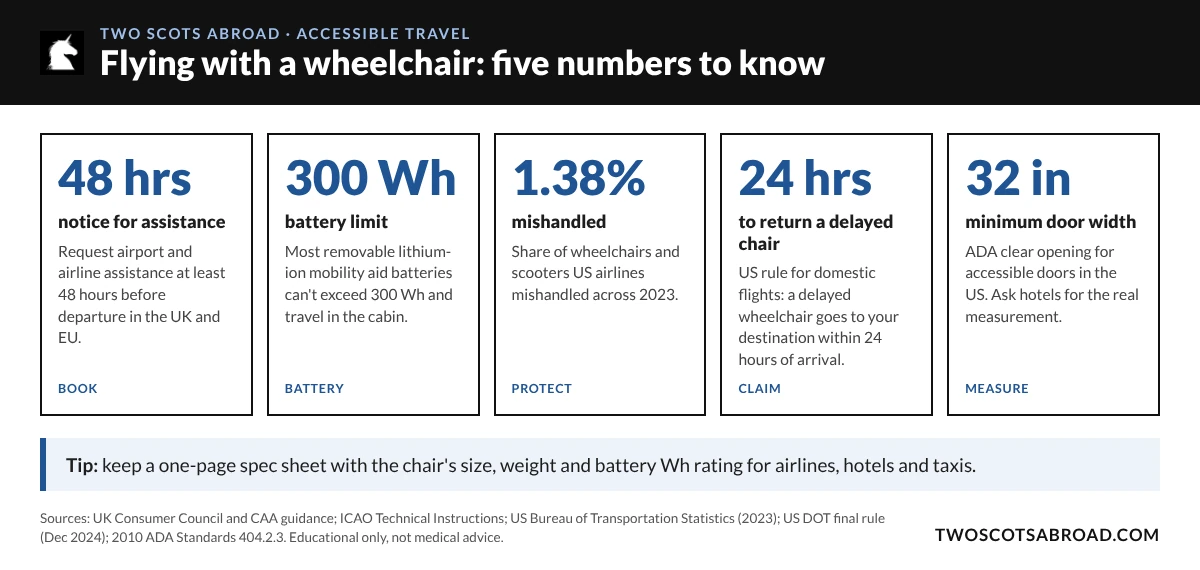
Graphic notes: The 48-hour recommendation relates to arranging UK/EU assistance. The 300 Wh figure applies to relevant removed lithium-ion mobility batteries, rather than every installed battery. The 1.38% rate is historical 2023 data. The US delayed-chair deadline is 24 hours for domestic and qualifying shorter international flights, and 30 hours for longer international flights. The 32-inch doorway figure is a US accessibility standard, not a guarantee that a particular room will suit every chair.
How Do You Sort Ground Transport Before You Land?
The airport-to-hotel leg is where plenty of trips come unstuck. Accessible taxis exist in many cities but can be scarce, and waiting for one after a long flight is no fun. Pre-book an accessible taxi or van with a suitable ramp or lift, and send the company the chair’s dimensions and weight. If you plan to drive yourselves, specialist firms in many countries hire out wheelchair-accessible vans with side or rear entry.
State whether the traveller will transfer to a vehicle seat or remain in their wheelchair. For someone travelling in the chair, confirm that the provider can accommodate that specific chair and use the appropriate wheelchair securement and occupant restraint systems. Follow the chair manufacturer’s transport instructions.
- Confirm the entrance width, headroom and usable interior space.
- Check the ramp or lift capacity against the load it will carry.
- Make sure there is space for companions, luggage and any additional equipment.
- Ask whether the driver provides boarding assistance and what that includes.
- Get the meeting point, waiting-time policy and flight-delay arrangements in writing.
- Keep a contact number and an alternative provider available.
For a hire car, the vehicle category alone does not confirm boot space or transfer suitability. Ask about the actual model, boot opening and seat arrangement. If adapted controls are needed, arrange them in advance and check licence, insurance and driver requirements directly with the supplier.
Check the Whole Public Transport Route
Public transport varies hugely by city. In London, Transport for London’s wheelchair access page says all bus routes use low-floor vehicles with a ramp and a wheelchair space, and all black cabs have a wheelchair ramp, but only around a third of Tube stations are step-free.
Step-free access to a platform does not always mean level boarding onto a train. Check boarding ramps, interchange routes and the destination station as well as the starting point. Recheck lift availability on the day, and confirm any device dimensions, weight limits or assistance arrangements with the operator.
Build in time for a missed service or an unavailable wheelchair space. A route that is manageable without luggage may be more difficult on arrival day, so consider whether a booked transfer would make that particular journey easier.
Check Cruise Ports Individually
Cruising adds another check. At tender ports, the ship anchors offshore and passengers go ashore in small boats, which may not be accessible for a particular wheelchair user. Look at how passengers disembark at each port before you book.
Ask the cruise line about the specific ship, cabin and itinerary, including gangway arrangements, tender restrictions and accessible shore transport. A ship’s accessible facilities do not establish that every port excursion will work. Confirm how wheelchair spaces on excursions are reserved and whether any transfer is required.
How Do You Plan Accessible Sightseeing?
Choose one main activity per day initially, then add more if the journeys and facilities allow. Time spent waiting for assistance, using a longer step-free route or finding a suitable toilet still takes time out of the day.
Ask attractions which areas are accessible, rather than whether the attraction as a whole is accessible. A historic building might provide access to the ground floor only. A viewpoint might have a suitable visitor centre but a stepped route to the view.
- Check the accessible entrance and whether it needs advance arrangements.
- Ask about route surfaces, gradients, lifts and temporary closures.
- Confirm toilet facilities and whether they meet the traveller’s needs.
- Check wheelchair viewing positions and seating arrangements for performances.
- Ask whether companion tickets or access reservations are available and what evidence, if any, is required.
For restaurants, check the entrance, table arrangement and toilet access separately. A step-free dining room does not help much if the only toilet is downstairs. When booking, explain the space needed and ask staff to keep the route clear.
For beaches and outdoor activities, ask about the actual equipment and route available. A beach wheelchair may require a companion to push it, and using it may involve a transfer. Confirm availability, booking requirements and suitability before building the day around it.
What Should You Pack or Hire?
Pack around what would be difficult to replace during the first day or two. Keep essential medication and personal supplies with the traveller, subject to the relevant security and airline rules. Check destination rules for medication and carry supporting documents where required.
Useful items may include the chair’s charger, approved spare components, a basic repair kit suited to the chair, equipment instructions and weather protection. Check airline restrictions before packing tools, liquids or battery accessories.
If hiring a hoist, shower chair or other equipment, confirm the exact model, dimensions, capacity and delivery arrangements. Ask who assembles it, demonstrates its use and handles faults. Make sure the hotel agrees to accept delivery and that the equipment will be ready before it is needed.
Save the supplier’s out-of-hours contact details. Where the traveller depends on an item for essential daily activities, discuss a realistic backup if it fails or arrives late.
What Should Your Insurance and Backup Plan Cover?
Check the actual policy terms rather than relying on a general statement that medical equipment is included. A policy’s single-item limit may be much lower than the replacement cost of a specialist wheelchair.
- Confirm the declared value of the chair and any accessories.
- Ask about cover for loss, accidental damage, theft and airline handling.
- Check whether temporary equipment hire and related transport costs are covered.
- Declare medical conditions as required and confirm cover for planned activities.
- Ask what authorisation is needed before paying for repairs, replacement equipment or additional accommodation.
Keep purchase records, serial numbers and equipment photographs accessible offline. Save contacts for the airline, hotel, transfer company, insurer and a local repair or hire supplier. Share the practical itinerary with travelling companions, while keeping sensitive medical information limited to those who need it.
A useful backup plan answers three questions: how will the traveller get around if the chair is unavailable, where can they stay if the booked room cannot be used, and who can help outside normal office hours? Confirming those options is more useful than carrying a long list of unverified phone numbers.
Travelling With a Wheelchair User FAQs
Does a Wheelchair Count Toward Your Baggage Allowance?
On flights covered by US rules, assistive devices do not count toward baggage limits. UK and EU rules also provide for free carriage of mobility equipment, subject to applicable conditions. Confirm the number of devices, aircraft capacity and battery arrangements with the operating airline.
Can You Take a Power Wheelchair Battery on a Plane?
Often, yes, but acceptance depends on the battery type, rating, protection and airline policy. Relevant removed lithium-ion mobility batteries generally must be 300 Wh or less and travel in the cabin. Properly protected installed batteries can be treated differently. Give every operating airline the exact details before booking.
How Much Notice Do Airports Need for Wheelchair Assistance?
In the UK and EU, request assistance at least 48 hours before departure, ideally when booking. If you book later, contact the airline immediately. Assistance providers should still make reasonable efforts without advance notice, but arrangements can take longer. Follow the relevant airline’s procedures for other jurisdictions and specialist equipment.
What Should You Ask a Hotel About an Accessible Room?
Ask for the bed height, bathroom clear door opening, shower type, transfer space and any under-bed clearance needed for a hoist. Request photos and measurements of the intended room, check the route through the hotel, and get the essential features confirmed in writing.
Can You Stay in Your Wheelchair During a Flight?
For a standard airline flight, plan to transfer into an aircraft seat and have the personal chair stowed. Confirm boarding, transfer and seating arrangements with the airline, including any approved support equipment needed.
Can a Wheelchair User Travel Alone?
Many do. Whether a particular journey works depends on the traveller’s needs, the assistance available and applicable airline safety requirements. Airport assistance does not necessarily include personal care during the flight, so confirm any support needed for eating, medication or toileting before booking.
Is It Better to Bring a Wheelchair or Hire One?
That depends on fit, support needs and the journey. The traveller’s own chair has the advantage of familiarity and any individual adjustments. Hiring may work for some trips, but confirm the exact equipment and suitability in advance. A generic hire chair may not replace a customised seating system.
What if the Airline Returns a Damaged Wheelchair?
Document the damage and notify the airline promptly, ideally before leaving the airport. Get a written reference, request suitable temporary equipment and ask for the repair or replacement process. For unresolved disability-related issues on US-covered flights, request the airline’s Complaints Resolution Official. Contact your insurer as required by the policy.
Accessible travel comes down to asking specific questions early and planning around the person taking the trip. Document the chair, get room details in writing, agree on flight handling and book suitable transport before you land. Leave enough flexibility for the traveller to enjoy the destination at their own pace.
This article is for general information only and does not replace advice from a doctor, occupational therapist or wheelchair service.