

Ask an AI tool where to go on holiday and you may get an impressive list that bears little resemblance to the trip you can actually take. A destination can look lovely while being over budget, awkward to reach or completely wrong for someone who wants to be in bed by ten.
Useful AI travel prompts explain the practical details behind your plans: when you can go, what you can spend and how you enjoy travelling. They also ask for a manageable shortlist, rather than another twenty places to research.
A clearer brief can improve the relevance of the suggestions. It does not guarantee accurate prices, workable connections or up-to-date entry requirements. Treat the response as a starting point you can refine and check.

Start With a Specific Travel Brief
Before opening a chatbot, write down the details that would change your choice of destination. Separate requirements from preferences: a step-free room might be essential, while a sea view would simply be nice.
| Include in Your Prompt | Useful Detail | Why It Matters |
|---|---|---|
| Dates and duration | The year, travel dates, number of nights and any flexibility. | Distinguishes full holiday days from arrival and departure time. |
| Departure point | Your airport or station and whether connections are acceptable. | Keeps transport practical. |
| Budget | Currency, total or per-person amount, and what it must cover. | Prevents confusion between a hotel budget and a whole-trip budget. |
| Travel party | Number of adults, children’s ages where relevant and room requirements. | Helps narrow accommodation and activity suggestions. |
| Daily pace | Walking limits, rest breaks and preferred number of activities. | Gives the itinerary a realistic shape. |
| Priorities and deal-breakers | Food interests, accessibility needs, quiet evenings or activities to avoid. | Makes the shortlist easier to assess. |
If you are still deciding what you can afford, start with our guide to saving money for travel. Set a spending limit you are comfortable with before asking a tool to build a holiday around it.
Check What Your AI Tool Can Actually Do
The tool matters as well as the prompt. Web search, access to booking information and the ability to read links or files vary between products and settings. Typing “use today’s prices” does not, by itself, give a chatbot access to live fares.
PhocusWire’s coverage of generative AI in travel follows developments across travel technology. For your own planning, check the features available in the tool you are using and look for supporting sources in its response.
If it cannot retrieve current information, use it to organise ideas or compare details you supply. Keep estimated prices clearly separate from quotes you have checked for your dates.
An AI Travel Prompt You Can Adapt
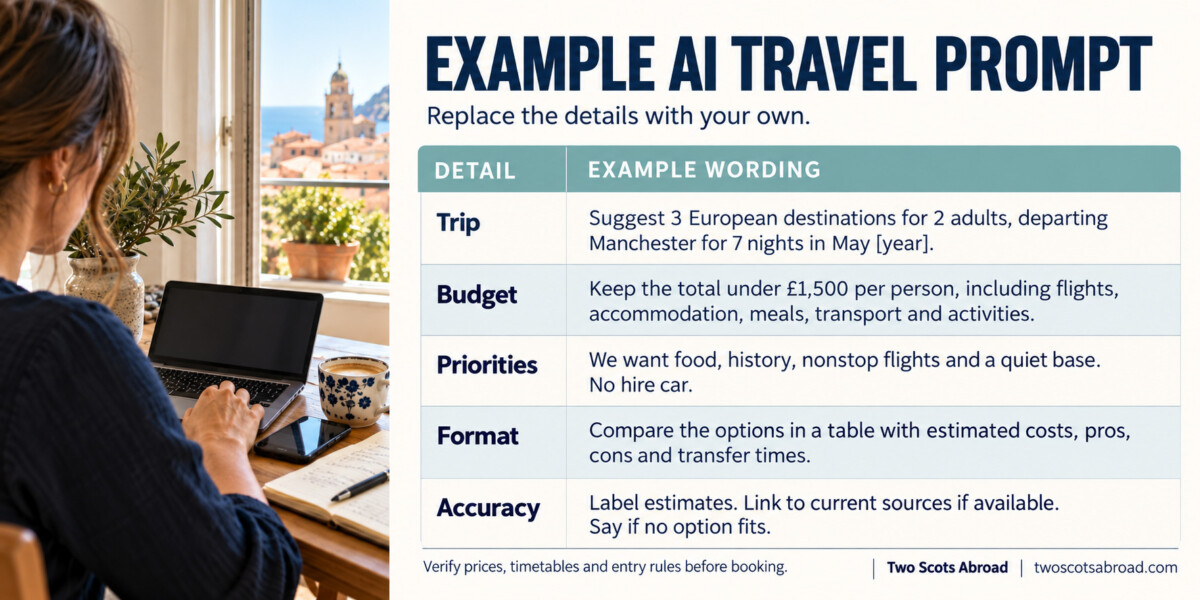
[Replace the example details below with your own. The budget is an illustrative limit, not a claim about what a particular holiday will cost.]
Suggest three destinations for two adults travelling for seven nights in May [year], departing from Manchester. Our maximum budget is £1,500 per person, including return flights, a shared private room, food, local transport and activities.
We prefer non-stop flights, local food, historic neighbourhoods and one main activity each day. We want quiet evenings and do not want to hire a car.
Suggest three European destinations for two adults travelling from Manchester for seven nights in May [YEAR].
Our budget is £1,500 per person, including return flights, accommodation, meals, local transport and activities.
We enjoy food and history, want nonstop flights and prefer a quiet base with restaurants within walking distance. We do not want to hire a car.
Compare the destinations in a table covering:
- Why each destination suits our preferences
- Estimated costs per person, broken down by category
- Airport transfer options and approximate journey times
- Main advantages and drawbacks
Clearly label estimates and explain your assumptions. If you can access current sources, check and link to them. Otherwise, say what you cannot verify and do not present prices or schedules as confirmed.
If no destination meets all our requirements, explain which constraint would need to change.
Finish with a short checklist of details we should confirm before booking, including prices, flight schedules, attraction opening hours and entry requirements.
Compare the options in a table. Explain why each fits, its main drawback and what still needs checking. If you can search current sources, link them. Label unverified costs and transport details as estimates. If none fits the brief, explain what would need to change.
Ask the tool to clarify any missing detail that would substantially change its recommendations. It is better to settle whether your budget includes flights before receiving a beautifully formatted plan you cannot afford.
Explain What You Enjoyed on Previous Trips
“We like authentic places” leaves plenty open to interpretation. Describe the experience you want: independent cafés, a market within walking distance, a small hotel or time to explore without a guide.
You could add: “On our last trip, we enjoyed staying near restaurants and spending mornings walking without a fixed plan. We disliked changing hotels and booking something for every afternoon.” That gives the tool a clearer preference to work with than a broad label such as luxury, adventure or relaxation.
Use Follow-Up Questions to Make Decisions
Once you have a shortlist, use follow-up questions to narrow it. Ask for a short explanation tied to your priorities, plus the disadvantages of each option.
- Which option involves the least travel after landing, and what supports that estimate?
- Which neighbourhoods fit our preference for quiet evenings and nearby restaurants?
- What would we need to remove if we shortened the trip by two nights?
- Which recommendation fails one of our essential requirements?
Continuing in the same conversation is convenient, but do not assume every earlier detail will be retained or applied correctly. Restate your fixed dates, budget and requirements when asking for a substantial revision.
Turn the Shortlist Into a Realistic Itinerary
Once you have chosen a destination, give the tool your arrival and departure times, accommodation area and any bookings already made. Ask it to group nearby activities and allow for meals, queues and transport.
Build an itinerary for the dates and timings above. Keep arrival day light and group sights by area. On full sightseeing days, include one main activity each morning with an optional afternoon stop. Show estimated door-to-door travel time and flag opening hours or tickets that still need checking. Leave enough time for the airport journey on departure day.
Then read the plan alongside a map. A short train ride can still involve a lengthy walk to the station, a wait and another journey at the far end. Our guide to planning a trip itinerary offers a practical framework for organising the details.
Verify the Details Before You Book
A convincing explanation is not verification. Google’s own guidance on AI responses notes that Gemini can be wrong about both facts and how it works. Asking an AI whether it is certain does not replace checking the underlying information.
| AI Suggestion | What to Check | Where to Confirm It |
|---|---|---|
| A flight or train connection | Exact dates, stations or airports, connection time and baggage allowance. | The airline or transport operator’s current booking information. |
| An attraction visit | Opening day, timed entry, closures and ticket availability. | The attraction’s official website. |
| A hotel or trip budget | Total price, taxes, mandatory fees, room occupancy and cancellation terms. | The relevant booking page and terms for your dates. |
| Visa or entry advice | Requirements for your nationality, travel purpose, route and transit stops. | The destination’s immigration authority or embassy. |
| Accessibility or dietary suitability | The specific facilities or arrangements you need. | The property, venue or operator directly. |
Open the sources yourself and check that they support the claim for your dates. An official homepage is not evidence that a particular departure exists or a room is available.
You can ask the tool to list uncertain details, but that list may be incomplete. Keep your own record of confirmed bookings and outstanding checks.
Use AI for Packing Without Oversharing
For a packing draft, supply the trip length, planned activities, laundry access and baggage allowance. Ask for quantities and separate essentials from optional items, then compare the result with our carry-on packing guide and your airline’s current rules.
Share only the personal information needed for the task. A travel brief rarely needs passport numbers, payment details or booking references. Describe practical accessibility needs without uploading medical records, and check the service’s privacy settings before sharing documents.
The most useful result is a shortlist that fits your priorities and a plan you have checked. Give the tool a clear brief, refine the awkward parts and leave some space for enjoying the trip once you get there.