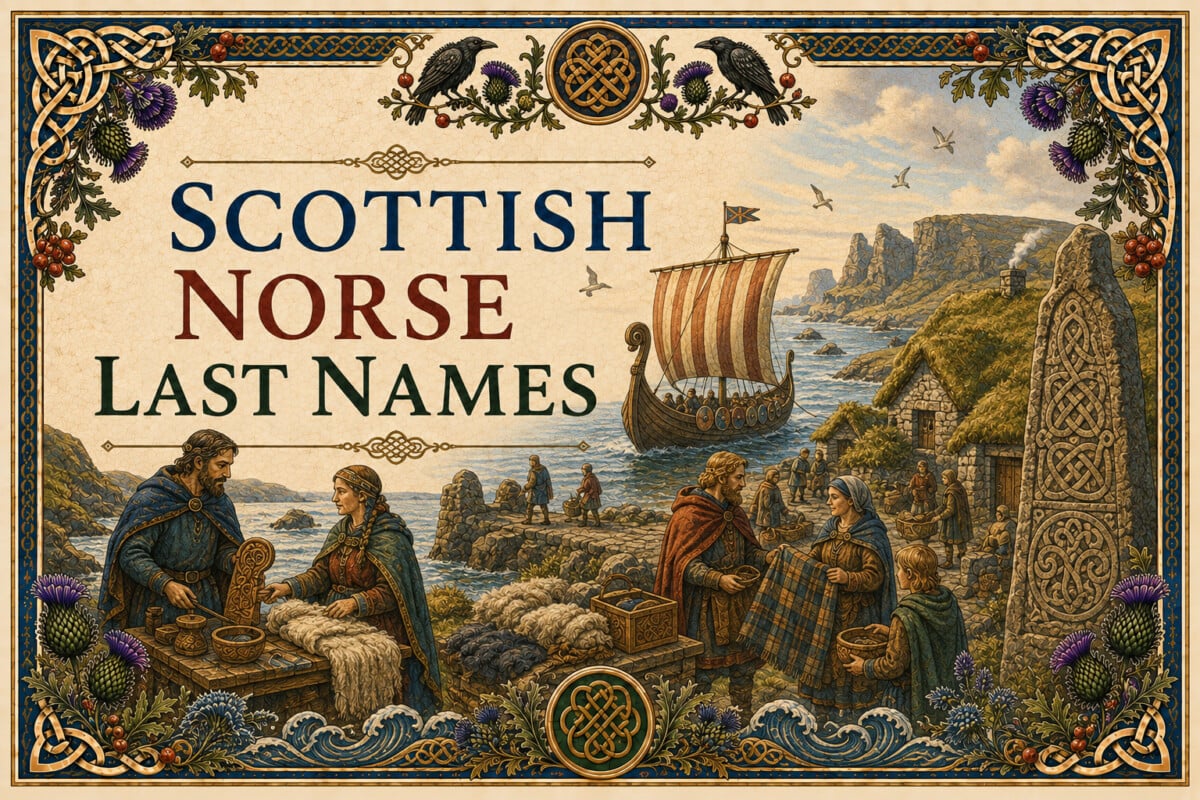
Scottish Viking surnames come in three main types: Norse personal names wrapped in a Gaelic Mac, such as MacLeod, MacAulay, MacIver and MacAskill; Orkney and Shetland farm names, such as Linklater, Isbister and Kirkness; and island son-of names that froze into surnames, such as Manson, Jamieson and Williamson. Add the Caithness name Gunn and you have the best-known Norse surnames in Scotland. Shetland used changing patronymics until about 1800, according to the Shetland Family History Society, so many of its surnames are only around two centuries old.
Scottish Norse last names are family names shaped by the long Norse presence in northern and western Scotland, especially Orkney, Shetland, Caithness and the Hebrides. Names such as Gunn, Raven and Harold can preserve Old Norse words or personal names, though a surname alone cannot prove descent from a particular Viking ancestor.
The useful clue is geography as much as spelling. Norse settlers established communities across Scotland’s northern isles and Atlantic coast between the Viking Age and the medieval period, where their language mixed with Gaelic, Scots and later English naming traditions.
For family-history research, a surname is a starting point, not a verdict. Spellings shifted, families moved, and many modern surnames became fixed long after the first Norse settlers arrived. Comparing a suspected Norse name with broader lists of Scottish last names beginning with G or Scottish last names beginning with M can also help separate a regional clue from a coincidence.
This guide is part of our Scottish Names collection. Browse the full Scottish Names directory for first names, surnames and Gaelic lists, or read our guide to Shetland and Orkney Norse first names for the other half of the islands’ Viking story.
This page is for you if your family name has a northern or island ring to it and you want to know whether the Viking link is real, likely or wishful thinking. Use the checker below to look up your surname, then read the sections on how each type of Norse surname formed and the five island names that only look Norse.
Two Scots Abroad · Scottish names
Surname Origin Checker: Scottish Viking surnames
40 surnames with a Norse story, and 5 that only look the part. Type your surname, or filter by the kind of Norse link and the part of Scotland it belongs to.
No surnames match that. Clear a filter or try a shorter search.
If you are interested in specific last or first names of the Scottish origin, try our interactive tool below:
Scottish Names Beginning With
Choose which type of Scottish name you would like to explore.
Why Norse Names Took Root in Scotland
Norse people did more than raid Scotland’s coasts. They settled, farmed, traded and built communities in places connected by sea routes to Norway, Ireland and the wider North Atlantic. Historic Environment Scotland identifies Norse settlement remains at Jarlshof in Shetland, including longhouses and outbuildings, and at the Brough of Birsay in Orkney, where a Norse settlement dates from the ninth to the 11th centuries.
Those places help explain why northern island surnames and place names can sound markedly different from Lowland Scottish names. A household might adopt or inherit a name based on a Norse-speaking forebear, a farm, an occupation or a characteristic. Over generations, the original word could be altered to suit Gaelic or Scots pronunciation.
Caithness also sits at the heart of this story. Its close maritime links with the northern isles made it part of the Norse-Gaelic world for centuries. In the Hebrides, Norse settlement met a powerful Gaelic culture, producing names and identities that cannot be sorted into neat modern boxes. Family history is rarely that obliging.
Orkney and Shetland stayed Norse the longest. Orkney was pledged to Scotland by Christian I in 1468 and Shetland followed the next year, and as the money was never paid, the islands stayed Scottish. In the Hebrides the replacement of older place names with Norse ones was, in the same article’s words, almost total, and the Outer Hebrides council factfile still lists MacLeod, MacAulay and MacIver among the common island surnames.
The three types of Scottish Viking surname
Almost every Scottish surname with a real Norse link fits one of three patterns. Knowing which one yours belongs to tells you where to look for the paper trail.
| Type | How it formed | Examples | Where |
|---|---|---|---|
| Norse name in Gaelic dress | A Norse first name became Gaelic, then took the Gaelic Mac, meaning son of | MacLeod, MacAulay, MacIver, MacAskill, MacCorquodale, Lamont | Hebrides, Skye, Argyll |
| Orkney or Shetland farm name | A family was known by the farm it held, and the farm name stuck | Linklater, Isbister, Kirkness, Clouston, Corrigall, Rendall | Orkney, Shetland |
| Northern Isles patronymic | A son-of name that changed every generation until it was frozen as a fixed surname | Manson, Jamieson, Williamson, Nicolson, Hughson | Shetland, Orkney, Caithness |
The first type is the one most people mean by Norse-Gaelic. The Norse-Gaels were, as their Wikipedia entry puts it, a people of mixed Gaelic and Norse ancestry and culture who dominated the Irish Sea and Scottish Sea regions from the 9th to the 12th centuries. Their Norse names went into Gaelic and came out the other side as Mac surnames: Ljótr became Leòd and then MacLeod, Óláfr became Amhlaidh and then MacAulay.
The farm names are an Orkney and Shetland speciality. Endings such as bister, from Old Norse bólstaðr, meaning a farm or dwelling place, and setter, an out-pasture, are everywhere on the islands’ maps, and families who held those farms took their names. That is why an Orkney phone book reads like an Ordnance Survey map.
The son-of names are the sneakiest. Jamieson or Williamson look like ordinary Lowland Scots names, and in their words they are. What makes them Norse in habit is how late Shetland kept changing them with each generation, long after the rest of Scotland had settled on fixed surnames.
How common are Norse surnames in Scotland today?
Gunn, Manson and the big Mac names are still well up the national list. The National Records of Scotland count for 2025, based on surnames in that year’s birth, marriage and death registers, puts MacLeod at 537 entries once you add the Macleod and Mcleod spellings together, which NRS counts separately. Gunn had 93 and Manson 66. The farm names are far rarer on the mainland: Linklater scraped onto the list with 12, and Isbister, Kirkness and Clouston fell below the cut-off of ten.
Go back to the 1881 census and the islands look very different. Sinclair was top in Orkney with 995, with Flett, Rendall, Linklater, Clouston and Kirkness all in the top 30, while Shetland’s list was dominated by son-of names: Williamson (1,219), Johnson (897), Jamieson (872), Nicolson (547) and Manson (498), according to the counts collected by British Surnames for Shetland and for Orkney.
| Surname | Type | Scotland 2025 (NRS) | Orkney 1881 | Shetland 1881 |
|---|---|---|---|---|
| MacLeod (Macleod + Mcleod) | Norse name in Gaelic dress | 537 | ||
| MacAulay (all three spellings) | Norse name in Gaelic dress | 143 | ||
| MacIver (all three spellings) | Norse name in Gaelic dress | 90 | ||
| Gunn | Norse name kept | 93 | ||
| Manson | Northern Isles patronymic | 66 | 176 | 498 |
| Williamson | Northern Isles patronymic | 252 | 1,219 | |
| Jamieson | Northern Isles patronymic | 199 | 872 | |
| Nicolson | Northern Isles patronymic | 68 | 547 | |
| Flett | Norse name kept | 21 | 518 | |
| Rendall | Orkney farm name | 27 | 511 | |
| Linklater | Orkney farm name | 12 | 381 | |
| Isbister | Orkney farm name | Under 10 | 195 | |
| Sinclair (Norman, not Norse) | Looks Norse, is not | 267 | 995 |
Scottish Norse Surnames and Their Meanings
The examples below are among the clearest names with Norse associations in Scotland and northern Britain. Some are direct survivals of Old Norse forms, while others are later surnames built from Norse personal names.
| Surname | Old Norse Connection | Meaning or Origin | Where the Link Is Most Relevant |
|---|---|---|---|
| Gunn | gunnr | “Battle” or “war” | Northern Scotland, including Orkney and Caithness |
| Raven | Hrafn | “Raven” | Norse cultural and personal-name tradition |
| Harold / Harald | Haraldr | Usually understood as “army ruler” | Scandinavian and Anglo-Norse naming traditions |
| Thoresen | Þórr | A patronymic built from the name Thor | Scandinavian-style family naming |
| Ormsby | Ormr + by | “Ormr’s farm” or settlement | Norse settlement-name tradition in northern Britain |
Gunn
Gunn is one of the strongest Scottish examples because it is linked to the Old Norse word gunnr, meaning battle or war. It is also associated with the Highland Clan Gunn, a connection that makes it particularly familiar in Caithness and the far north. Like many old names, its exact route into every individual family line needs documentary research.
Alexander MacBain’s Etymological Dictionary of the Gaelic Language (1911) traces it to Gunni, the name of a son of Olaf, a Caithness chief in the Orkneyinga Saga, and a short pet form of longer names that start with gunnr. The clan came from Caithness and settled in Kildonan in Sutherland, and Gunn still had 93 entries in Scotland’s 2025 registers.
Raven
Raven comes from the Old Norse personal name Hrafn, meaning raven. Ravens had a prominent place in Norse symbolism and storytelling, including associations with Odin. In a family-name context, Raven may have begun as a personal name or nickname before becoming hereditary in some lines.
Harold and Harald
Harold and Harald preserve a famous Scandinavian personal name, often interpreted as “army ruler.” The name is associated with figures such as Harald Hardrada, killed at the Battle of Stamford Bridge in 1066. Its appearance in Scotland can reflect the broad movement of Norse names through Scandinavian, Anglo-Norse and Scottish communities.
In the Gaelic west the same name went into a Mac surname instead: Harailt gave MacRaild, a small Skye family that the Gaelic scholar Ronald Black counts among the island families of Norse extraction.
Thoresen
Thoresen follows a recognisably Scandinavian patronymic pattern: a son identified through a father whose name referred to Thor. The ending -sen means “son of” in Scandinavian naming traditions. That pattern is useful context, but it should not be confused with the Scottish Gaelic Mac, which also means “son” but comes from a different language family.
Ormsby
Ormsby is built from the Norse personal name Ormr, meaning serpent or dragon, plus -by, a term for a farmstead or settlement. It is a particularly clear example of how Norse place-name elements could become surnames. The -by ending is especially familiar in parts of northern England, so an Ormsby line calls for careful regional research before claiming a specifically Scottish origin.
Norse-Gaelic surnames from the Hebrides and Argyll
These are the names where a Viking first name hides inside a Gaelic surname. The meanings come from MacBain’s dictionary and from Ronald Black’s The last Norsemen in the Isles?, which lists eleven Skye families of Norse extraction.
MacAulay
Origin: MacAmhlaidh, from Old Norse Óláfr. Meaning: son of Óláfr (Olaf), read as the gods’ relic or heir. Where: Hebrides and Skye. Today: 143 in 2025 (Macaulay 63, Mcauley 46, Mcaulay 34), NRS.
The Lewis MacAulays were centred on Uig, on the west coast of the island. Óláfr was a royal name across the Norse world, and MacBain reads it as the relic, or heir, of the gods. Expect three spellings in the records, Macaulay, McAuley and McAulay, and count them all if you are tracing a line.
MacIver
Origin: MacÌomhair, from Old Norse Ívarr. Meaning: son of Ívarr (Ivor). Where: Hebrides and Skye. Today: 90 in 2025 (Maciver 38, Mcivor 33, Mciver 19), NRS.
Ìomhar, the Gaelic form of Ívarr, gave both the surname and the first name Ivor. MacIvers turn up in two places, Argyll and Lewis, so the region your earliest record comes from matters more than the spelling.
MacAskill
Origin: MacAsgaill, from Old Norse Ásketill. Meaning: son of Ásketill, the gods’ cauldron. Where: Hebrides and Skye. Today: 41 in 2025 (Macaskill), NRS.
Ásketill, the gods’ cauldron, is about as pagan as a Scottish surname gets. The MacAskills are tied to Rubh’ an Dùnain on Skye, and the MacAskills of Rubh’ an Dùnain Society hosts Ronald Black’s article on the island’s Norse families.
MacCorquodale
Origin: Mac Corcadail, from Old Norse Þorketill. Meaning: son of Thorketill, Thor’s cauldron. Where: Argyll and the west. Today: Under 10 a year (not in the NRS list).
The Norse Thorketill, Thor’s cauldron, shrank to Torquil in Gaelic and gave this surname, first recorded as Makcorquydill in 1434. It is rare today, with fewer than ten entries a year in Scotland’s registers, which makes it one of the more distinctive names on this page.
Lamont
Origin: MacLaomainn, from Old Norse lögmaðr. Meaning: lawman, the lawspeaker. Where: Argyll and the west. Today: 55 in 2025, NRS.
A rare case of a Norse job title becoming a surname. The lögmaðr was the lawspeaker, and Clan Lamont held most of the Cowal peninsula in Argyll for centuries. There were 55 Lamonts in Scotland’s 2025 registers.
MacSorley
Origin: Somhairle, from Old Norse Sumarliði. Meaning: son of Somerled, the summer sailor (a viking). Where: Argyll and the west. Today: 19 in 2025 (Mcsorley), NRS.
Somerled, killed at Renfrew in 1164, carried a Norse name that MacBain translates as summer sailor, which is a polite way of saying viking. Clan Donald and the MacDougalls both claim him, and MacSorley keeps his name in its plainest form.
What About MacLeod, MacAulay and Other Highland Names?
Some Scottish surnames associated with the Hebrides and western Highlands are often discussed alongside Norse heritage because Norse and Gaelic communities overlapped for generations. MacLeod, for example, is traditionally connected with Leod, a personal name often treated as Norse in origin. The surname itself uses the Gaelic patronymic prefix Mac, showing how languages could combine in one family identity.
A book on Scottish clans and tartans is helpful for the Highland and Hebridean families listed here.

We earn a commission if you buy through this link, at no extra cost to you.
MacBain is blunter about it: Leòd comes from the Norse Ljótr, a common Norse name that meant ugly. Leod himself is said to have died around 1280. If you want the Gaelic side of the same name, our guide to Scottish Gaelic surnames and their meanings covers Mac Leòid alongside MacDonald and MacKenzie.
This is an important distinction. A name can have a Norse personal-name root but a Gaelic surname form. It may also have been adopted by people who shared a region, language or lordship with Norse-descended families. In the Hebrides especially, “Norse” and “Gaelic” are often part of the same historical landscape. Names beginning with M can show the same mix of Gaelic surname forms and older personal-name influences.
Clan membership adds another layer, since a clan could take in families with quite different surnames. Our explainer on how Scottish clan surnames work goes through that in more detail.
Orkney and Shetland surnames from farms and fathers
The Northern Isles produced two kinds of surname the rest of Scotland barely has. Fiona Sinclair’s notes on Orcadian families, drawn from old rentals and family histories, show how many Orkney names are simply farms, while Shetland’s records are full of fathers’ names that stopped changing.
Linklater
Origin: farm of Linklater (Lynkclet), Sandwick, Orkney. Meaning: named after the farm. Where: Orkney. Today: 12 in 2025, NRS; 381 in Orkney in 1881.
Linklater of that Ilk, meaning the family named after its own land, held a threepenny land in Sandwick, written Lynkclet in the old rentals. With 381 in Orkney in 1881, it was the 13th most common name in Orkney.
Isbister
Origin: Old Norse austr + bólstaðr. Meaning: the easterly farm. Where: Orkney. Today: Under 10 a year (not in the NRS list); 195 in Orkney in 1881.
Bister is the Norse bólstaðr, a farm, and Isbister is the easterly farm, according to the Shetland Amenity Trust. There are Isbisters in both island groups, so a family with this name could come from either.
Kirkness
Origin: farm of Kirkness, Sandwick, Orkney. Meaning: church + headland (kirk, ness). Where: Orkney. Today: Under 10 a year (not in the NRS list); 224 in Orkney in 1881.
From the farm of Kirkness in Sandwick, built from two of the most common Orkney place-name elements, kirk (church) and ness (a point of land). It had 224 bearers in Orkney in 1881 and fewer than ten entries a year in Scotland’s registers today.
Rendall
Origin: parish of Rendall, Orkney. Meaning: the place name reads valley of the Renna. Where: Orkney. Today: 27 in 2025, NRS; 511 in Orkney in 1881.
Named after the parish of Rendall, which Northlink’s guide to Orkney place names reads as valley of the Renna. Rendall was the sixth most common Orkney surname in 1881, with 511 people.
Flett
Origin: Norse family name. Meaning: not certain. Where: Orkney. Today: 21 in 2025, NRS; 518 in Orkney in 1881.
One of the few Orkney names the old family histories call Norse outright, tracing it to a Harald Flett, Danish by family. It was the fourth most common surname in Orkney in 1881, with 518.
Manson
Origin: Magnusson, son of Magnus. Meaning: son of Magnus. Where: Caithness and Sutherland. Today: 66 in 2025, NRS; 498 in Shetland and 176 in Orkney in 1881.
The Manson surname is an anglicised Magnusson, son of Magnus, most common in Caithness, Orkney and Shetland, and counted as a sept of Clan Gunn.
Jamieson
Origin: son of James (Shetland patronymic). Meaning: son of James. Where: Shetland. Today: 199 in 2025, NRS; 872 in Shetland in 1881.
The Shetland Family History Society uses this exact name to explain the old system: Robert, the son of James Hughson, would be Robert Jamieson. Shetland had 872 Jamiesons in 1881. If yours is a Shetland line, our guide to Scottish last names beginning with J has the wider Scottish picture.
Williamson
Origin: son of William (Shetland patronymic). Meaning: son of William. Where: Shetland. Today: 252 in 2025, NRS; 1,219 in Shetland in 1881.
The second most common surname in Shetland in 1881, with 1,219, just behind Smith. It is the clearest sign of how a son-of system works out over time: the commonest fathers’ names end up as the commonest surnames.
How Surnames Developed After the Viking Age
Viking-age Scandinavians generally used changing patronymics, identifying a person as the son or daughter of a parent. A man known as Bjorn’s son could be called Bjornsson, while his own son might carry a different descriptive name. Permanent inherited surnames developed later and unevenly across Scotland.
How unevenly is striking. The Scottish surnames entry on Wikipedia says patronymics died out in the Lowlands after the 15th century, lasted until the 18th century in the Gaelic-speaking Highlands, and were still common in Shetland in the first half of the 19th century.
That is why a modern surname ending in -son or -sen is not automatic proof of Viking ancestry. It may reflect Scandinavian naming, a later Scottish or English patronymic, or a spelling selected by record keepers. Names are durable, but they also pick up new coats of paint as they pass through parish registers, censuses and legal papers.
Where To Look for Norse Family-Name Clues
Start by mapping where the earliest documented members of your family lived. A Gunn line rooted in Caithness or Orkney carries a different historical context from the same surname first recorded in Glasgow several centuries later. Parish registers, census returns, gravestones and estate records can establish that local trail.
- Orkney: Look for families tied to parishes near sites such as the Brough of Birsay, where Norse settlement remains sit above earlier Pictish traces.
- Shetland: Use local place names and records alongside surname evidence. Jarlshof demonstrates the depth of settlement history on the islands, though archaeology cannot identify a modern family line by itself.
- Caithness: Pay attention to links with the northern isles, as well as later movement south through Scotland.
- The Hebrides: Check Gaelic variants, anglicised spellings and local naming customs. A single ancestor may appear under several spellings in historical records.
For the farm names in particular, it helps to know how place-name surnames work in general, and our guide to Scottish surnames from places covers the mainland versions of the same habit.
A genealogy research notebook is handy for recording variant spellings, locations and document references as you go. It sounds gloriously unglamorous, but it is far easier than trying to reconstruct a family tree from a browser-history archaeology dig. It can also help to compare unusual spellings against lists of Scottish surnames beginning with R and Scottish surnames beginning with H, since a clerk’s spelling choice could send a family line down an unexpected alphabetical path.

We earn a commission if you buy through this link, at no extra cost to you.
How To Avoid Overclaiming Viking Ancestry
Use a surname to form a research question: “Was this family established in a Norse-influenced part of Scotland?” Avoid using it as a final answer. The strongest case combines a plausible name origin with an early paper trail in Orkney, Shetland, Caithness or the Hebrides.
DNA results can add broad regional context, but they do not usually identify a named Viking ancestor or prove that one surname came down a single unbroken line. Documentary evidence remains the practical backbone of genealogical work.
Watch out for: island names that only look Norse. Sinclair was Orkney’s most common surname in 1881, yet the Sinclairs most likely came from Saint-Clair in Normandy, and Henry Sinclair got the earldom of Orkney from Haakon VI of Norway in 1379. Mowat is Anglo-Norman, Tulloch and Leask come from mainland place names, and Harcus from Harcarse in Berwickshire. Be wary of viral lists too. One widely shared newspaper list of 30 Viking surnames in Scotland says it was produced with the support of AI tools, and it includes names such as Thwaite and Rigg that it explains only as Norse words for a clearing and a ridge, with no Scottish family behind them.
Quick list: all 45 surnames on this page
| Surname | Origin | Meaning | Type | Region | Today |
|---|---|---|---|---|---|
| Clouston | farm of Clouston, Sandwick, Orkney | named after the farm | Orkney or Shetland farm name | Orkney | Under 10 a year (not in the NRS list); 286 in Orkney in 1881 |
| Corrigall | township of Corrigall, Harray, Orkney | named after the farm | Orkney or Shetland farm name | Orkney | Under 10 a year (not in the NRS list) |
| Cursetter | farm of Cursetter, Firth, Orkney | a setter, an out-pasture farm | Orkney or Shetland farm name | Orkney | Under 10 a year (not in the NRS list) |
| Fea | several places called Fea in Orkney | named after a farm | Orkney or Shetland farm name | Orkney | Under 10 a year (not in the NRS list) |
| Flett | Norse family name | not certain | Norse name kept as a surname | Orkney | 21 in 2025, NRS; 518 in Orkney in 1881 |
| Foubister | farm of Fowbustare, Orkney | a bister (bólstaðr) farm | Orkney or Shetland farm name | Orkney | Under 10 a year (not in the NRS list) |
| Georgeson | son of George (Shetland patronymic) | son of George | Northern Isles patronymic | Shetland | Under 10 a year (not in the NRS list); 270 in Shetland in 1881 |
| Gunn | Guinne, from Old Norse Gunni | a pet form of names starting gunnr, war | Norse name kept as a surname | Caithness and Sutherland | 93 in 2025, NRS |
| Halcro | possibly a headland in South Ronaldsay | uncertain | Orkney or Shetland farm name | Orkney | Under 10 a year (not in the NRS list) |
| Harcus | Harcarse in Berwickshire | named after a place | Looks Norse, is not | Orkney | Under 10 a year (not in the NRS list); 294 in Orkney in 1881 |
| Heddle | farm of Haddale, Firth, Orkney | named after the farm | Orkney or Shetland farm name | Orkney | Under 10 a year (not in the NRS list) |
| Hourston | farm of Hourston, North Sandwick, Orkney | named after the farm | Orkney or Shetland farm name | Orkney | Under 10 a year (not in the NRS list) |
| Hughson | son of Hugh (Shetland patronymic) | son of Hugh | Northern Isles patronymic | Shetland | Under 10 a year (not in the NRS list); 332 in Shetland in 1881 |
| Isbister | Old Norse austr + bólstaðr | the easterly farm | Orkney or Shetland farm name | Orkney | Under 10 a year (not in the NRS list); 195 in Orkney in 1881 |
| Jamieson | son of James (Shetland patronymic) | son of James | Northern Isles patronymic | Shetland | 199 in 2025, NRS; 872 in Shetland in 1881 |
| Johnson | son of John (Shetland patronymic) | son of John | Northern Isles patronymic | Shetland | 204 in 2025, NRS; 897 in Shetland in 1881 |
| Kirkness | farm of Kirkness, Sandwick, Orkney | church + headland (kirk, ness) | Orkney or Shetland farm name | Orkney | Under 10 a year (not in the NRS list); 224 in Orkney in 1881 |
| Knarston | farm of Knarston (Nerstaith), Harray, Orkney | named after the farm | Orkney or Shetland farm name | Orkney | Under 10 a year (not in the NRS list) |
| Lamont | MacLaomainn, from Old Norse lögmaðr | lawman, the lawspeaker | Norse name in Gaelic dress | Argyll and the west | 55 in 2025, NRS |
| Leask | Leask in Buchan, Aberdeenshire | named after a place | Looks Norse, is not | Shetland | 30 in 2025, NRS; 479 in Shetland and 190 in Orkney in 1881 |
| Linklater | farm of Linklater (Lynkclet), Sandwick, Orkney | named after the farm | Orkney or Shetland farm name | Orkney | 12 in 2025, NRS; 381 in Orkney in 1881 |
| MacAskill | MacAsgaill, from Old Norse Ásketill | son of Ásketill, the gods’ cauldron | Norse name in Gaelic dress | Hebrides and Skye | 41 in 2025 (Macaskill), NRS |
| MacAulay | MacAmhlaidh, from Old Norse Óláfr | son of Óláfr (Olaf), read as the gods’ relic or heir | Norse name in Gaelic dress | Hebrides and Skye | 143 in 2025 (Macaulay 63, Mcauley 46, Mcaulay 34), NRS |
| MacCodrum | MacCodrum, from Old Norse Guttormr | son of Guttormr, good or god serpent | Norse name in Gaelic dress | Hebrides and Skye | Under 10 a year (not in the NRS list) |
| MacCorquodale | Mac Corcadail, from Old Norse Þorketill | son of Thorketill, Thor’s cauldron | Norse name in Gaelic dress | Argyll and the west | Under 10 a year (not in the NRS list) |
| MacCrimmon | MacCruimein, possibly from Old Norse Hróðmundr | possibly son of Hróðmundr, famed protector | Norse name in Gaelic dress | Hebrides and Skye | Under 10 a year (not in the NRS list) |
| MacDougall | MacDhùghaill, from Gaelic Dubhghall | son of Dugald, the dark stranger, an old Gaelic word for a Dane | Norse name in Gaelic dress | Argyll and the west | 141 in 2025 (Mcdougall 94, Macdougall 47), NRS |
| MacIver | MacÌomhair, from Old Norse Ívarr | son of Ívarr (Ivor) | Norse name in Gaelic dress | Hebrides and Skye | 90 in 2025 (Maciver 38, Mcivor 33, Mciver 19), NRS |
| MacLachlan | MacLachlainn, probably from Lochlann | son of Lachlan; Lochlann meant Scandinavia, the fjord land | Norse name in Gaelic dress | Argyll and the west | 106 in 2025 (Mclachlan 80, Maclachlan 26), NRS |
| MacLeod | Mac Leòid, from Old Norse Ljótr | son of Ljótr, a Norse name meaning ugly | Norse name in Gaelic dress | Hebrides and Skye | 537 in 2025 (Macleod 368, Mcleod 169), NRS |
| MacManus | MacMhànais, from Norse Magnús | son of Magnus, from Latin magnus, great | Norse name in Gaelic dress | Argyll and the west | 75 in 2025 (Mcmanus), NRS |
| MacRaild | MacRaild, from Old Norse Haraldr | son of Harald | Norse name in Gaelic dress | Hebrides and Skye | Under 10 a year (not in the NRS list) |
| MacRanald | MacRaonaill, from Old Norse Rögnvaldr | son of Ranald, ruler of the gods or of counsel | Norse name in Gaelic dress | Hebrides and Skye | Under 10 a year as MacRanald (not in the NRS list) |
| MacSorley | Somhairle, from Old Norse Sumarliði | son of Somerled, the summer sailor (a viking) | Norse name in Gaelic dress | Argyll and the west | 19 in 2025 (Mcsorley), NRS |
| MacSwan | MacSuain, from Old Norse Sveinn | son of Sveinn, boy or young man | Norse name in Gaelic dress | Hebrides and Skye | Under 10 a year (not in the NRS list) |
| Mainland | an Orkney place name | named after a place | Orkney or Shetland farm name | Orkney | Under 10 a year (not in the NRS list); 180 in Orkney in 1881 |
| Manson | Magnusson, son of Magnus | son of Magnus | Northern Isles patronymic | Caithness and Sutherland | 66 in 2025, NRS; 498 in Shetland and 176 in Orkney in 1881 |
| Mowat | Anglo-Norman Monte Alto | the high mount | Looks Norse, is not | Orkney | 35 in 2025, NRS; 367 in Orkney in 1881 |
| Nicolson | son of Nicol; Gaelic MacNeacail | son of Nicol (from Greek Nikolaos) | Northern Isles patronymic | Shetland | 169 in 2025 (Nicholson 101, Nicolson 68), NRS; 547 in Shetland in 1881 |
| Peterson | son of Peter (Shetland patronymic) | son of Peter | Northern Isles patronymic | Shetland | 16 in 2025, NRS; 300 in Shetland in 1881 |
| Rendall | parish of Rendall, Orkney | the place name reads valley of the Renna | Orkney or Shetland farm name | Orkney | 27 in 2025, NRS; 511 in Orkney in 1881 |
| Sandison | son of Sandy (Alexander) | son of Sandy | Northern Isles patronymic | Shetland | 27 in 2025, NRS; 214 in Shetland in 1881 |
| Sinclair | Norman, from Saint-Clair in Normandy | of Saint-Clair | Looks Norse, is not | Orkney | 267 in 2025, NRS; 995 in Orkney in 1881 (top name) |
| Tulloch | a Scottish place name | named after a place | Looks Norse, is not | Shetland | 36 in 2025, NRS; 373 in Shetland and 429 in Orkney in 1881 |
| Williamson | son of William (Shetland patronymic) | son of William | Northern Isles patronymic | Shetland | 252 in 2025, NRS; 1,219 in Shetland in 1881 |
Frequently Asked Questions About Scottish Norse Last Names
What are some Scottish Viking surnames?
The best-known Scottish Viking surnames are MacLeod, MacAulay, MacIver, MacAskill and MacCorquodale in the west, Gunn and Manson in Caithness, and Orkney and Shetland names such as Linklater, Isbister, Kirkness, Flett and Rendall. Each of them comes from a Norse personal name, a Norse farm name or a frozen island patronymic.
Do Scottish surnames prove Viking ancestry?
No. A Scottish surname with a Norse origin can point to a historical connection, especially in Orkney, Shetland, Caithness and the Hebrides, but it cannot prove direct descent from a particular Viking individual.
Is MacLeod a Viking name?
Partly. MacLeod is a Gaelic surname, Mac Leòid, meaning son of Leod, but Leod is from the Old Norse name Ljótr, which MacBain’s Gaelic dictionary translates as ugly. Leod is said to have died around 1280, and the clan’s homelands on Skye and in the Western Isles were part of the Norse-Gaelic world.
What Scottish surname has a Norse meaning of battle?
Gunn is linked to the Old Norse word gunnr, meaning battle or war. It has long-standing associations with northern Scotland and Clan Gunn.
Are surnames ending in -son always Viking names?
No. The ending -son is a patronymic marker meaning “son of,” but it appears in several naming traditions. It is a useful clue only when supported by geography, records and the name’s wider history.
What are Norse Gaelic surnames?
Norse-Gaelic surnames are Gaelic Mac surnames built on Norse first names, left by the mixed Norse and Gaelic people of the Hebrides and the west coast. MacLeod (from Ljótr), MacAulay (Óláfr), MacIver (Ívarr), MacAskill (Ásketill), MacCorquodale (Thorketill) and Lamont (lögmaðr, lawman) are the clearest examples.
Which parts of Scotland have the strongest Norse heritage?
Orkney, Shetland, Caithness and the Hebrides have especially strong Norse historical connections. Archaeological sites including Jarlshof in Shetland and the Brough of Birsay in Orkney preserve physical evidence of Norse settlement.
The Most Useful Way To Read a Scottish Norse Surname
A Scottish Norse surname is best read as a surviving fragment of a larger story about migration, language and local communities. Gunn may point toward an Old Norse word for battle, Raven toward Hrafn, and Ormsby toward a farm named for Ormr. The family records tell you where that fragment belongs.
For people tracing roots in the northern isles, Caithness or the Hebrides, that combination of name, place and paperwork can turn a broad Viking connection into a much more grounded family history.
And if the research ends with a trip north, which it often does, our round-up of the best Scottish islands to visit covers how to get to Orkney, Shetland and the Hebrides. Pack a proper waterproof; the Vikings had longships, you will have a ferry and the same weather.
Sources
- Alexander MacBain, An Etymological Dictionary of the Gaelic Language, 1911 (Personal names and surnames)
- Ronald Black, The last Norsemen in the Isles?, West Highland Free Press, 2007
- National Records of Scotland, Most Common Surnames 2025, published 26 May 2026
- Shetland Family History Society, research tips (patronymics)
- Fiona Sinclair, Orcadian families
- Shetland Amenity Trust, Place name of the week: bisters
- British Surnames, top surnames in Orkney, 1881 census
- Wikipedia, Norse-Gaels