
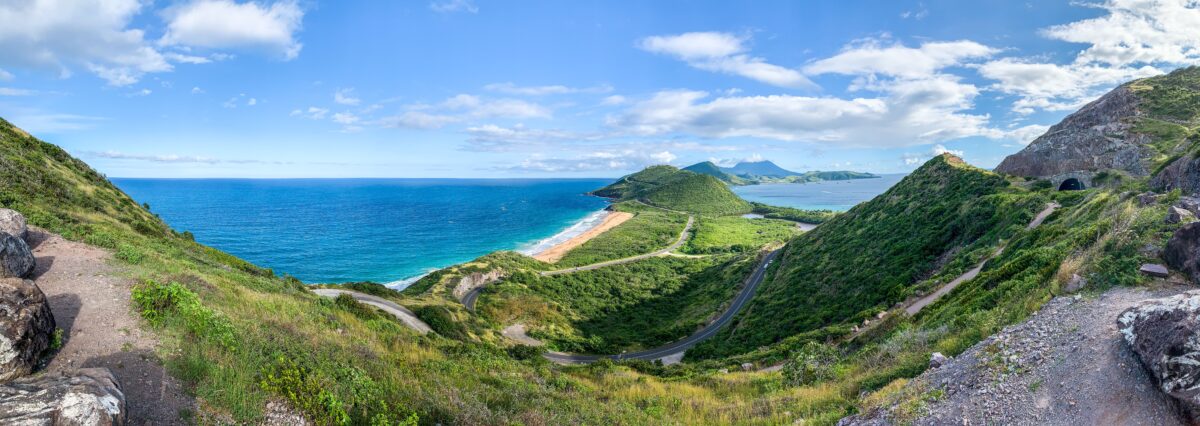
St. Kitts and Nevis is a two-island Caribbean country where a compact land area, volcanic terrain and separate island identities make planning refreshingly straightforward. St. Kitts is the larger, busier island and home to the capital, Basseterre, while Nevis sits about 3 kilometres to the southeast and has a smaller footprint.
The federation covers about 261 square kilometres, making it the smallest sovereign state in the Western Hemisphere by area. That scale is part of the appeal: you can get a handle on the geography quickly, but each island has its own beaches, mountain slopes, settlements and pace.
Guide freshness note: practical details such as transport schedules, entry rules, festival programming and accommodation availability should be confirmed before booking.
Why St. Kitts and Nevis Should Be on Your Radar
St. Kitts and Nevis sits in the Lesser Antilles, in the eastern Caribbean Sea. Both islands were formed by volcanic activity, and their central mountain ranges shape almost everything around them: settlement patterns, road routes, farming land and the views that keep appearing when you are supposed to be watching the road.
Most development is concentrated on flatter or moderately sloping coastal land. On St. Kitts, Basseterre serves as the capital, the main port for passenger arrivals and a key point of entry for cargo. It is the logical base for anyone who wants city services and easy access to the island’s main transport connections.
Nevis is smaller, at roughly 93.2 square kilometres, while St. Kitts covers roughly 168.4 square kilometres. The short distance between them can make a twin-island trip feel manageable, provided you leave room in your plans for transport timing instead of treating the sea crossing like a city bus.
St. Kitts or Nevis: How the Islands Differ

St. Kitts is the larger island and the more practical choice for people who want to begin in Basseterre, use the principal passenger port or attend an event at Warner Park Stadium. The island is about 23 miles long and around 5 miles wide at its broadest point, according to the St. Kitts and Nevis Bureau of Standards.
Its coastline is commonly associated with black-sand beaches, a visual reminder of the island’s volcanic origins. Inland, the central mountains descend toward the coast, with populated and agricultural areas concentrated where the terrain is less steep.
Nevis is approximately 7 miles across and is known for coral reefs and silver-coloured beaches. Its smaller scale suits people looking for a quieter island component after time on St. Kitts, especially couples and families who prefer slower beach days over a packed sightseeing schedule. Neither island is a substitute for the other, so splitting a trip between both makes sense if your schedule allows it.
Getting Oriented in Basseterre
Basseterre is on St. Kitts and is both the federation’s capital and its largest city. For many arrivals, it is the first useful reference point: the city’s port handles cruise-ship passengers and cargo, and government offices and national institutions are concentrated there.
The city is also the setting for Warner Park Stadium, which hosts the St. Kitts Music Festival. The festival’s 2026 edition ran from June 25 to June 27 at the stadium, illustrating Basseterre’s role as an events hub as well as an administrative centre.
Keep a map saved offline before exploring beyond the capital. The islands are small, but mountainous routes and coastal development can make a short distance take longer than it appears on a screen.
When To Visit St. Kitts and Nevis
The St. Kitts and Nevis Bureau of Standards identifies December through March as the cooler part of the year. For people who prefer less heat and humidity, those months are the clearest starting point for choosing dates.
Event-focused trips need a second check. The St. Kitts Music Festival is held at Warner Park Stadium in Basseterre, but its lineup, ticketing and exact dates can change between editions. Book travel around a confirmed programme, not a calendar assumption.
Outside event dates, choose your timing around the kind of trip you want. St. Kitts works well for an arrival-and-explore itinerary centred on Basseterre, while Nevis is a natural addition for beach time, reef scenery and a more low-key island stay.
How To Plan a Two-Island Stay
Start with a simple division of time: use St. Kitts for Basseterre, the principal port and larger-island logistics, then add Nevis for a contrasting coastal and mountain setting. The islands are only about 3 kilometres apart, but confirm the transport option that fits your dates before locking in lodging.
- Choose St. Kitts first if your itinerary revolves around Basseterre, Warner Park Stadium or the main passenger port.
- Add Nevis deliberately instead of treating it as an automatic day trip. A separate overnight gives you more flexibility if transport times are limited.
- Use coastal locations as your planning anchors. Most urban and agricultural development is near the coast because the central terrain is mountainous.
- Check entry rules for your passport. Visa and immigration requirements are nationality-specific and should be verified with an official government or consular source before departure.
History, Government and Everyday Essentials
The country’s constitutional name is Saint Christopher and Nevis, though St. Kitts and Nevis is the standard form used in travel planning. The federation became independent in 1983 and operates as a parliamentary democracy within the Commonwealth.
English is the official language, and the Eastern Caribbean dollar is the national currency. The Eastern Caribbean Central Bank is headquartered in St. Kitts and maintains the stability of the Eastern Caribbean dollar, which is also used by several neighbouring Eastern Caribbean countries.
For a short trip, the most useful takeaway is simple: plan your money, documents and island transport before arrival. Small destinations reward a little advance organisation, especially when a port connection or event schedule is involved. Families comparing options across the region can also use this guide to the best Caribbean islands for families to weigh up island size, beaches and day-to-day pace.
St. Kitts and Nevis: Quick Answers
How much does St. Kitts and Nevis citizenship by investment cost?
Citizenship-by-investment costs must be confirmed directly with the relevant St. Kitts and Nevis government authority before an application is started. This guide does not quote a minimum investment because programme thresholds, fees, family rules and processing requirements can change.
Is St. Kitts and Nevis safe to visit?
St. Kitts and Nevis requires the same practical care as other Caribbean destinations: protect valuables, use established transport arrangements and check official travel guidance for your nationality before leaving. Conditions and advisories can change, so a current official advisory is more useful than a blanket safety rating.
What is the best time of year to visit St. Kitts and Nevis?
December through March is a strong choice for people seeking the federation’s cooler months. If you are travelling for the St. Kitts Music Festival or another scheduled event, confirm dates and availability before booking flights or rooms.
Do you need a visa to visit St. Kitts and Nevis?
Visa requirements for St. Kitts and Nevis depend on your passport and the purpose and length of your stay. Check the official immigration guidance or the nearest St. Kitts and Nevis diplomatic office before travel, even if you have visited another Caribbean country without a visa.
How do you get between St. Kitts and Nevis?
St. Kitts and Nevis are separated by roughly 3 kilometres, and inter-island transport is an essential part of a two-island itinerary. Confirm the available service, departure point, timetable, baggage rules and weather-related changes for your exact travel dates.
What is the capital of St. Kitts and Nevis?
Basseterre is the capital and largest city of St. Kitts and Nevis. It is on St. Kitts and serves as the country’s principal passenger and cargo port.
Your Next Steps
Build your St. Kitts and Nevis itinerary around the difference between the two islands, not a race to tick off every beach. Start with Basseterre and St. Kitts for logistics, then make space for Nevis if you want the full character of the federation.
Before paying for flights or lodging, verify entry requirements, inter-island transport and event dates. Those three checks will do more for a smooth trip than a heroic last-minute spreadsheet.