
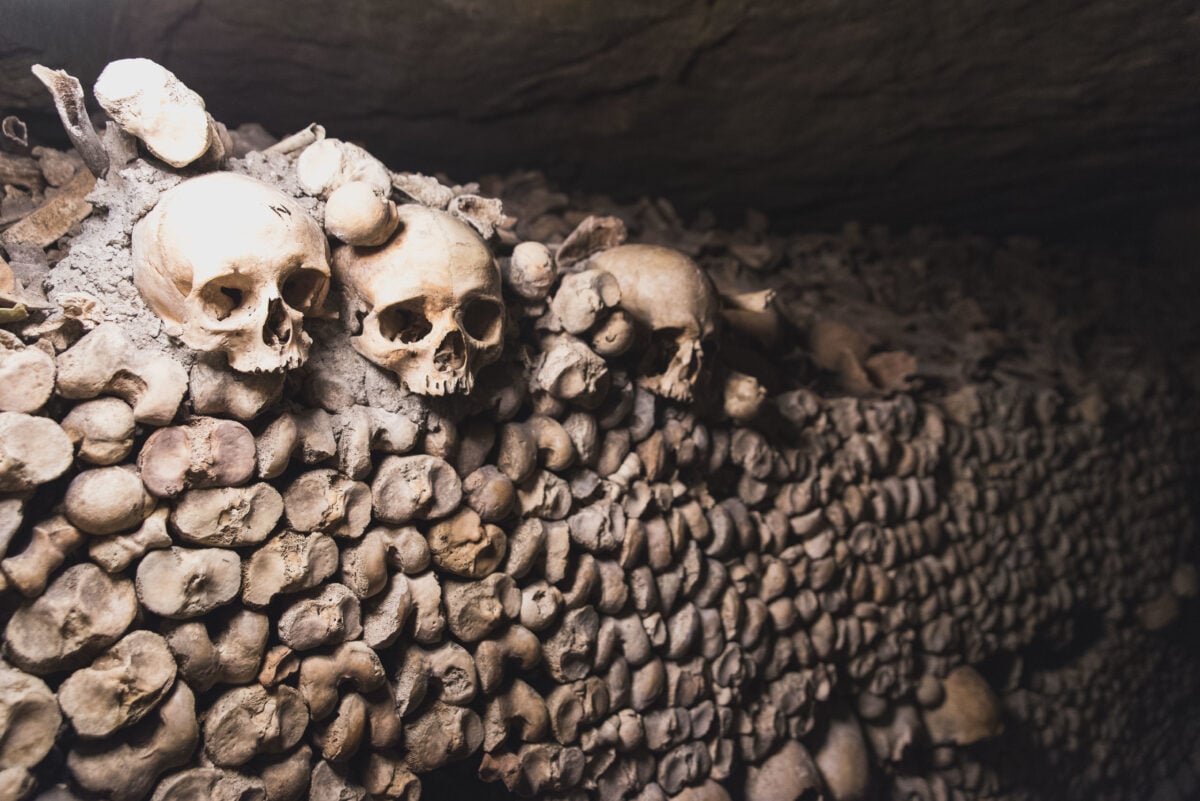
The Paris Catacombs are far larger than most visitors expect. Beneath the streets of Paris sits a tunnel network stretching roughly 200 miles (320 km), with a small public section containing the remains of more than six million people. Most tourists only walk about 1 mile of the tunnels, but the numbers behind the site explain why the Catacombs remain one of the most unusual attractions in France.
The Catacombs were created from former limestone quarries beneath Paris, then converted into mass ossuaries in the late 1700s after the city’s cemeteries became overcrowded. Today, the underground maze reaches across several arrondissements and descends about 20 meters below street level.
If you are planning a Paris trip, it helps to understand the scale before you visit. The experience is colder, darker, and physically larger than many travelers anticipate.
Paris Catacombs Quick Facts
| Statistic | Details |
|---|---|
| Total tunnel network | Roughly 200 miles (320 km) |
| Public route length | About 1 mile (1.5 km) |
| Estimated remains underground | More than 6 million people |
| Depth below street level | Approximately 20 meters |
| Average temperature | 14C (57F) |
| Public opening | 1809 |
| Stair count | 131 down, 112 up |
How Big Are the Paris Catacombs?
The Catacombs are not a single underground chamber. They are part of a sprawling quarry system running underneath large sections of Paris. The full network extends for around 200 miles, although exact measurements vary because many tunnels remain unmapped or inaccessible.
The public route is tiny compared with the full system. Visitors only access a carefully managed section in the 14th arrondissement near Denfert-Rochereau. That route takes around 45 minutes to an hour to complete.
The difference between the tourist section and the full underground network is massive. If every tunnel were opened continuously, the total system would stretch farther than the driving distance between Paris and Brussels.
The official Paris Catacombs website explains that the tunnels originated from limestone extraction used to build much of the city above ground. As Paris expanded during the Roman era and Middle Ages, quarrying pushed deeper underground, creating the maze still visible today.
Before your trip, it helps to compare the Catacombs with other Paris attractions in terms of scale. The Eiffel Tower rises 330 meters above the city, while the Catacombs descend into a parallel underground world below it.
Why Are There Six Million Bodies in the Catacombs?
The huge number of human remains came from a public health crisis.
By the late 1700s, Paris cemeteries were severely overcrowded. The largest cemetery, Les Innocents, had been used for centuries and was creating sanitation problems for nearby residents. According to the official Paris Catacombs history, heavy rain even caused cemetery walls to collapse, spilling remains into surrounding streets and basements.
Authorities decided to transfer bones into abandoned quarry tunnels beneath the city. The process started in 1786 and continued for years, primarily at night.
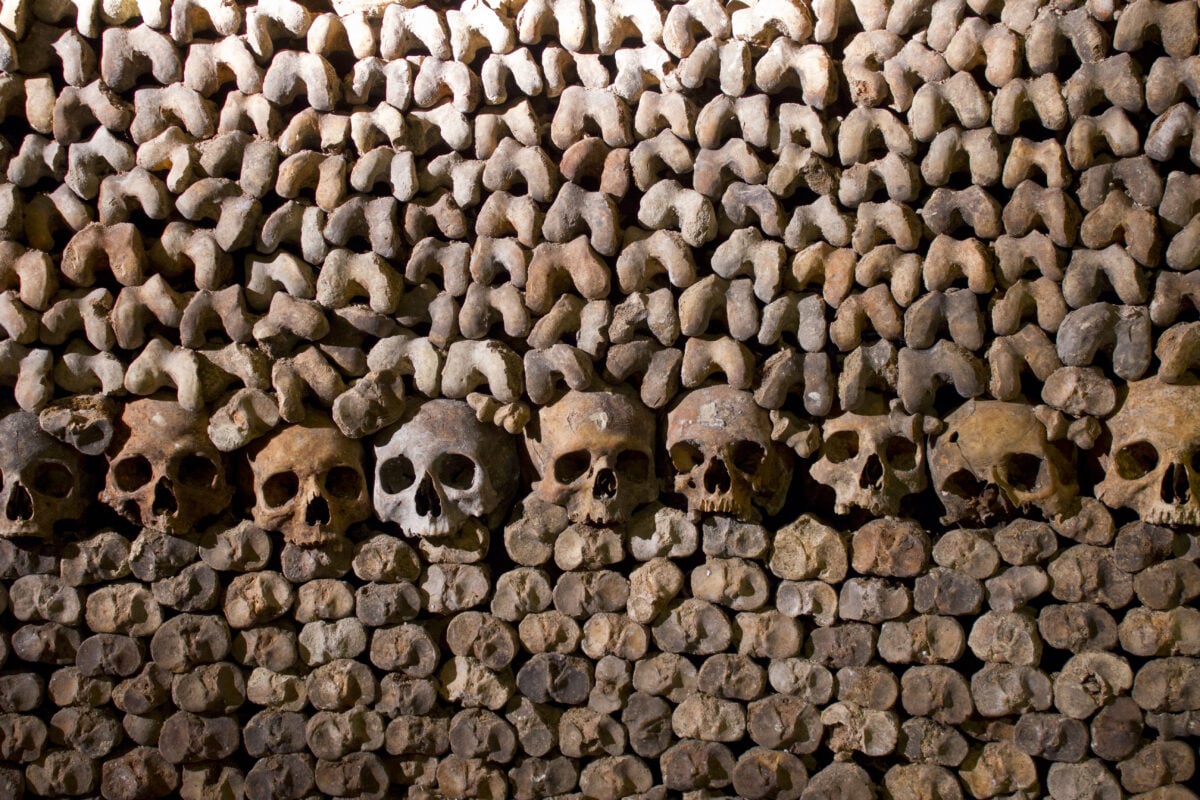
The remains were initially placed underground in large piles, but workers later reorganized them into the carefully stacked walls visitors see today. Many sections feature decorative arrangements using skulls and femurs.
The numbers become more striking when you compare them to Paris’ population during that era. Around the late 1700s, Paris had roughly 600,000 residents. The Catacombs eventually held remains equivalent to many times the living population of the city.
How Much of the Catacombs Can You Actually Visit?
Very little.
The legal tourist path covers only a small fraction of the underground network. Most tunnels remain closed due to safety risks, structural instability, flooding hazards, and navigation concerns.
Unauthorized exploration still happens. Urban explorers known as “cataphiles” illegally enter restricted sections through hidden entrances, sewer connections, or maintenance shafts. French authorities regularly monitor access points because people have become lost underground for days.
The public route is controlled carefully. Visitor numbers are capped daily, and lines can become long during summer and holiday periods. Booking timed tickets in advance through the official Paris Catacombs website is strongly recommended.
If you are comparing major Paris attractions, the Catacombs usually require more physical effort than museums or river cruises. The staircases are narrow, there is no elevator access, and parts of the tunnel feel claustrophobic.
How Deep Underground Are the Paris Catacombs?
The entrance staircase descends approximately 20 meters underground, equivalent to a five or six-story building.
The descent is part of what makes the experience memorable. Noise from the streets disappears quickly, temperatures drop noticeably, and the tunnels become narrower as you move deeper underground.
The temperature remains around 14C year-round because of the depth and stone surroundings. Even during summer heatwaves, the Catacombs stay cold enough that many visitors need a jacket.
How Long Would It Take to Explore the Entire Tunnel Network?
No one fully knows because some sections remain restricted, collapsed, or unmapped.
Using the estimated 200-mile figure, walking the entire accessible network without breaks would likely take several days. Navigation would also be extremely difficult because many tunnels intersect repeatedly with minimal signage.
This complexity is one reason the Catacombs developed a reputation for mystery and urban legends. Stories of missing explorers, secret gatherings, and underground cinemas have circulated for decades.
For travelers interested in unusual European underground sites, Paris is not alone. Naples, Edinburgh, and parts of Prague also have significant underground tunnel systems.
How Many People Visit the Paris Catacombs Each Year?
The Catacombs attract hundreds of thousands of visitors annually, making them one of Paris’ busiest paid attractions despite the limited route size.
The combination of history, architecture, and scale gives the site unusually broad appeal. Some visitors come for historical context, others for dark tourism, photography, or curiosity about the engineering beneath Paris.
Compared with attractions like the Louvre or Eiffel Tower, the Catacombs process far fewer people per hour because of narrow passageways and controlled capacity. This slower flow creates a quieter experience once inside.
What Most Visitors Underestimate About the Catacombs
The scale underground feels psychologically different from reading statistics online.
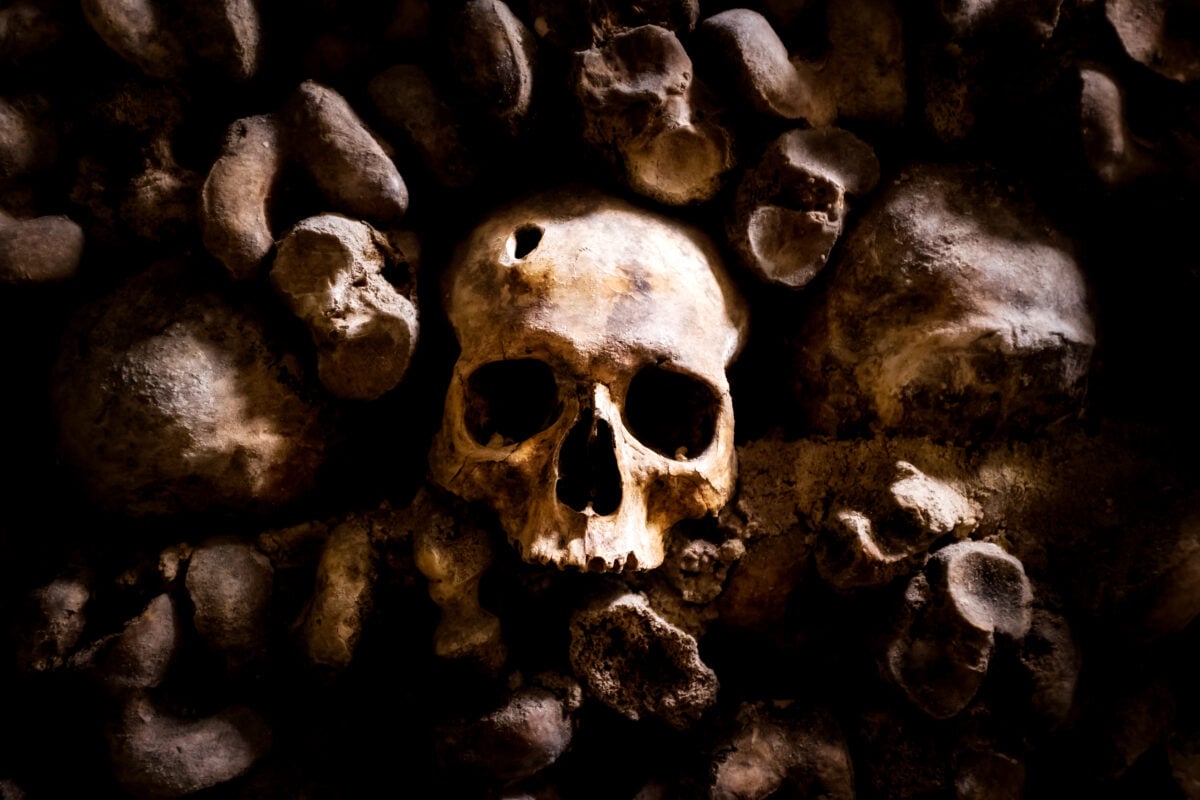
The endless rows of bones create a visual repetition that makes distances feel longer than they are. The tunnels are dimly lit, ceilings vary in height, and there are very few opportunities to stop once the route begins.
Visitors also underestimate how physically enclosed parts of the experience feel. If you dislike tight underground spaces, the Catacombs may feel more intense than expected.
- Bring a light jacket, even in summer.
- Wear shoes with grip because floors can be damp.
- Book timed entry tickets in advance.
- Avoid carrying large luggage or backpacks.
- Expect limited phone signal underground.
The Catacombs are not recommended for travelers with mobility limitations because of the staircases and uneven terrain. The official museum accessibility page provides updated guidance before visiting.
How the Catacombs Compare to Other Underground Attractions
Paris has one of the largest underground ossuaries in the world, but it differs from caves or mining attractions because the tunnels were integrated into city infrastructure.
The Catacombs sit directly below apartments, cafes, roads, and metro lines. In some places, modern Paris operates only meters above centuries-old quarry tunnels.
This overlap between the living city and the underground network is part of what makes the site so unusual. Above ground, Paris is associated with cafes, museums, and boulevards. Below ground, the city becomes quieter, colder, and more industrial.
If you are building a broader France itinerary, combining Paris with destinations like Lyon or the French Riviera creates a strong contrast in atmosphere and pace.

Cornell University Press
Making Space for the Dead: Catacombs, Cemeteries, and the Reimagining of Paris, 1780–1830
1
We earn a commission if you buy through this link, at no extra cost to you.
Is Visiting the Paris Catacombs Worth It?
If you are interested in unusual history, engineering, or large-scale urban infrastructure, the Catacombs are one of Paris’ most distinctive experiences.
The numbers alone explain part of the fascination. A 200-mile underground network containing the remains of six million people is difficult to fully comprehend until you descend into the tunnels yourself.
The visit works best when paired with realistic expectations. You are not exploring the entire underground city. You are seeing a carefully preserved section that hints at the enormous scale hidden beneath Paris.
For trip planning, aim for an early morning entry, allow at least one hour onsite, and combine the Catacombs with nearby Montparnasse or Luxembourg Gardens afterward to avoid crossing the city multiple times in one day.
You can learn more through the official Catacombs museum page, and the Paris tourism board,
