
Every traveller has had the moment. You’re staring at a departure board, chatting to someone in a hostel kitchen or filling in an arrivals card, and you realise your mental map of the world has a few blank patches. Brushing up on world geography before your next trip fixes that, and it’s easier than it sounds: Brazil’s capital has been Brasília since 21 April 1960, yet plenty of people still say Rio.
Below you’ll find the capitals that catch people out, the flags that look like twins, the borders worth knowing and a few painless ways to make it all stick.
Which Capitals Catch Travellers Out?
The most common slip is assuming a country’s biggest or best-known city is its capital. Plenty of them aren’t, and these are the ones that come up again and again.
| Country | Capital | Often mistaken for |
|---|---|---|
| Australia | Canberra | Sydney or Melbourne |
| Turkey | Ankara | Istanbul |
| Canada | Ottawa | Toronto or Montreal |
| Switzerland | Bern | Zurich or Geneva |
| Morocco | Rabat | Casablanca or Marrakech |
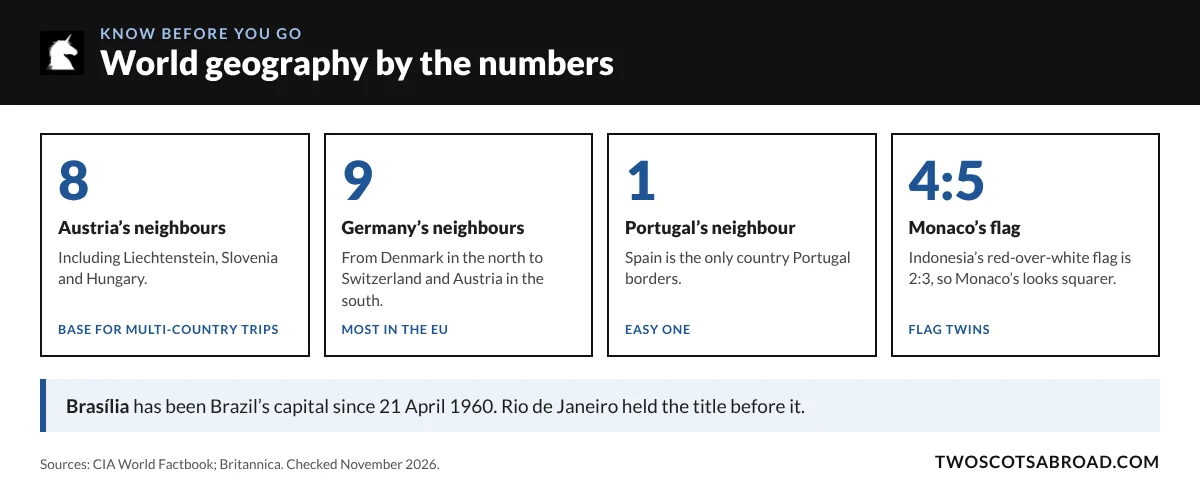
| Brazil | Brasília | Rio de Janeiro |
| New Zealand | Wellington | Auckland |
| Nigeria | Abuja | Lagos |
| Vietnam | Hanoi | Ho Chi Minh City |

A few have a story behind them. Canberra was built as a compromise when Sydney and Melbourne both wanted the title. Brasília was a planned city, built from scratch to move the capital inland from Rio. Bolivia goes one further and splits the job, with Sucre as the constitutional capital and La Paz as the seat of government.
Why does it matter on the road? Most embassies sit in the capital, so if you lose a passport or need a visa for an onward country, that’s often where you’ll be heading (some countries also run consulates in bigger cities, so check before you travel). Locals notice too. Mentioning Rabat to a Moroccan host is a small thing, but it shows you’ve done your homework, especially if you’re planning a trip around somewhere like Tangier and the north of Morocco.
The quickest fix is little and often. A free world capitals quiz from GeoQuizzes gives you ten random countries per round with no sign-up, and you can filter it to Europe, Asia, Africa, the Americas or Oceania depending on where you’re going next.
Which Flags Look Almost Identical?
You see flags everywhere when you travel: at border crossings, on ferries, outside hotels and embassies and on the tail of every plane at a busy airport. Being able to read them is oddly satisfying. It’s also harder than it looks, because some flags are near-twins.
| Flag pair | What they share | How to tell them apart |
|---|---|---|
| Chad and Romania | Vertical blue, yellow and red stripes | Chad’s blue is a darker shade |
| Indonesia and Monaco | Red over white | Monaco’s flag is 4:5 and Indonesia’s is 2:3, so Monaco’s looks squarer |
| Ireland and Côte d’Ivoire | Green, white and orange | The colours run in the opposite order |
| Slovenia and Slovakia | White, blue and red horizontal stripes | Their coats of arms, which sit in different places |
| Australia and New Zealand | Blue with the Union Jack and the Southern Cross | New Zealand’s stars are red. Australia’s are white, with an extra seven-pointed star |
The CIA World Factbook describes the Romanian flag as similar to Chad’s, with Chad’s blue band darker, so don’t feel bad if you’ve never spotted the difference. Britannica’s list of flags that look alike has the Indonesia and Monaco proportions, and a few more pairs to test yourself on.
A flag quiz is the fastest way to get these into your head. Seeing a flag and picking the country from four options ten times in a row teaches more than staring at a poster of all of them, because you have to actually recall the answer. On GeoQuizzes the wrong options are drawn from the same region, which is exactly where the look-alikes trip you up.
Which Countries Border Each Other?
A trip gets much easier to plan once you know who borders whom. A few that surprise people:
- Austria has eight neighbours, including Liechtenstein, Slovenia and Hungary, which makes it a brilliant base for multi-country trips.
- Germany has nine, from Denmark in the north to Switzerland and Austria in the south.
- Spain and France share a border, with tiny Andorra sitting on it high in the Pyrenees.
- Portugal borders only one country: Spain.
- Brazil borders every South American country except Chile and Ecuador.
Knowing the neighbours helps you spot cheap overland connections, combine countries on one trip and make sense of the food, languages and history you come across. It also settles the classic argument about whether it’s quicker to fly or take the train. If you’re mapping out a route across several borders, our trip planning guide and free spreadsheet helps you lay out the legs in order.
How Do You Make Geography Stick?
Here’s the honest truth: nobody learns geography by reading lists like the ones above. You learn it by being asked and getting it wrong a few times. Psychologists call this the testing effect, and in a 2006 study at Washington University in St. Louis, students who were tested on material remembered more a week later than students who spent the same time restudying it.
Travel is full of dead time that’s perfect for a quick round:
- Airport gates and train platforms. A ten-question round fits neatly into the wait before boarding.
- Long-haul flights. Quiz your travel partner on the capitals of the countries you’re flying over. The moving map makes it easy.
- Family trips. Let the kids pick a region and keep score across the whole holiday.
- Pub quiz prep. Geography rounds turn up at plenty of quiz nights, and capitals are some of the easiest points going.
Start with the region you’re about to visit. Heading to the Balkans? Learn the capitals and flags before you go, and you won’t mix up Podgorica (Montenegro) with Pristina (Kosovo) when you’re working out bus routes to Mostar in Bosnia and Herzegovina. Off to Southeast Asia? Make sure you know Vientiane from Phnom Penh.
Check Your Region Before You Fly
Pick your destination below to see the capitals, big-city traps and flags to learn, plus a practice plan that fits the time you have left.
 Pre-Trip Geography Check
Pick where you are heading and how long you have before you fly. You get the capitals to learn, the big-city traps, the flags most likely to catch you out and a short practice plan.
Capitals to know
Big-city traps
Flags to watch
Your practice plan
A Quick Pre-Trip Geography Checklist
- Learn the capital of every country you’re visiting, plus any you’ll pass through.
- Learn their flags, especially if a near-twin is nearby.
- Look at the map and name each country’s neighbours.
- Check where your embassy or consulate is in each country, just in case.
- Pick up a couple of fun facts to share with the people you meet.
Frequently Asked Questions About World Geography for Travellers
Why Isn’t the Biggest City Always the Capital?
Capitals are often chosen for political reasons, such as a compromise between rival cities or a move inland to develop a region. Canberra and Brasília were both planned and built for the job.
Which Flags Are the Hardest to Tell Apart?
Chad and Romania are the closest match, since only the shade of blue differs. Indonesia and Monaco are next, told apart mainly by their proportions.
How Long Does It Take to Learn All the World’s Capitals?
It depends on how often you practise. Short, regular rounds tend to work better than cramming, because testing yourself repeatedly helps the answers stick. Start with the regions you travel to and build out from there.
Geography Makes the Trip
Geography won’t pack your bag or find you a cheap flight. It does turn a list of destinations into a picture of the world, and that’s half the joy of travelling.