
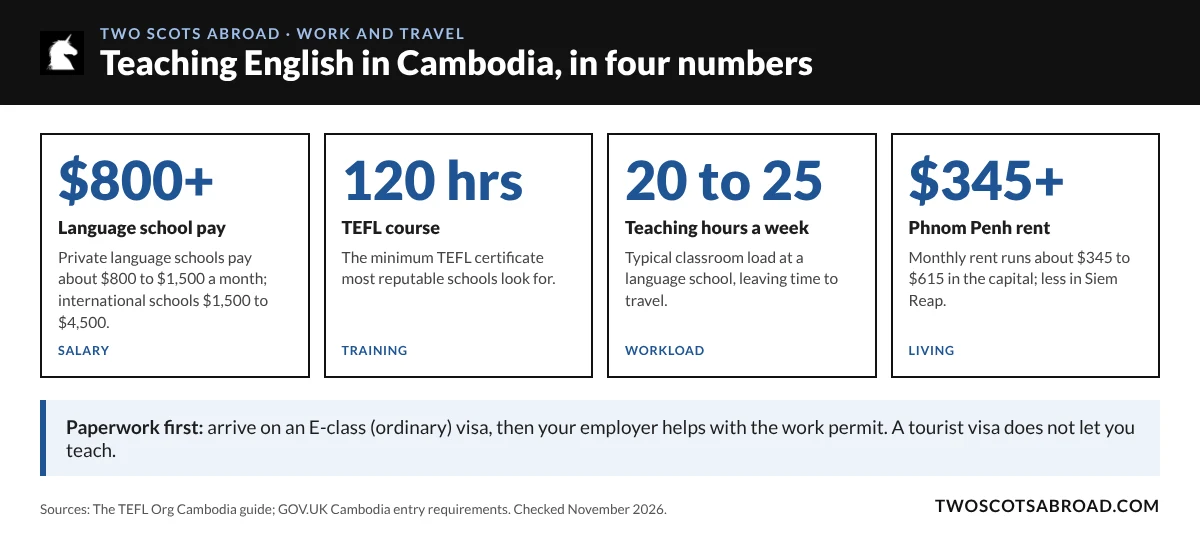
If you’re thinking about teaching English in Cambodia, the first thing to know is that you can’t simply turn up on a tourist visa and start work. GOV.UK says foreign teachers need a business visa and a work permit, and that Cambodia strictly enforces the rules.
Below, we cover what schools ask for, the visa and work permit steps, the main types of teaching job and what they pay, and how to choose between Phnom Penh, Siem Reap and the quieter riverside towns.

Why Teach English in Cambodia?
Demand for English teachers is steady, contracts usually run for a year, and private language schools hire all year round. The TEFL Org, a course provider whose guide to teaching English in Cambodia sets out pay, visas and living costs, also points out that you don’t legally need a degree to teach there.
For travellers, the appeal is the balance. A typical language school timetable is 20 to 25 classroom hours a week, rent is modest by UK standards, and the temples of Angkor, the Mekong and the south coast are all within a weekend’s reach. People tend to go for a mix of reasons:
- Making a difference in students’ lives
- Experiencing a different culture from the inside
- Finding steady work with a one-year contract
- Growing personally and professionally in front of a classroom
- Exploring a beautiful, affordable country
- Building friendships with locals and other teachers

How Teaching Makes a Difference for Students
- Better job prospects: English is a route into tourism, business and international organisations, which tend to pay more than many local jobs.
- Rural education gaps: village and community-run schools often have fewer teachers and resources than city schools, so volunteers and paid teachers there can reach children who’d otherwise miss out.
- Higher education: strong English helps students compete for international scholarships and study abroad places.
What Are the Requirements to Teach English in Cambodia?
Cambodia is one of the more open countries in Southeast Asia for new teachers, but reputable schools still set a bar. Here’s what to have in place before you apply.
1. Qualifications
- Bachelor’s degree: not a legal requirement for every teaching post, but many schools prefer one, and university lecturer roles expect a bachelor’s or master’s.
- Associate’s degree: may help, depending on the employer.
- High school diploma: can be enough for some entry-level roles.
- TEFL certificate: TEFL stands for Teaching English as a Foreign Language. It’s an internationally recognised credential for teaching English abroad or online, and a 120-hour course is the usual minimum that reputable schools look for.
- Teaching licence: a recognised teaching qualification from your home country is usually expected by accredited international schools.
2. English Language Skills
You don’t have to be a native speaker. Fluent speakers from other countries find work too, although native-level English can lift your salary. Schools want teachers who can:
- Speak English fluently, with clear grammar and pronunciation
- Explain vocabulary and grammar in simple steps
- Communicate well with beginners and mixed-level groups
- Stand in front of a class with confidence
3. Teaching Experience
Experience helps but isn’t essential. Plenty of schools hire first-time teachers who’ve completed a TEFL course, and time spent working with children, adults or beginner learners in any setting strengthens an application.
4. Documents Schools Ask For
- A criminal record check from your home country
- Professional references
- Copies of your degree, diplomas and TEFL certificate
- An up-to-date CV
- A sample lesson plan or a short demo lesson
Visas and Work Permits for Teachers
This is the part to get right. A tourist visa (T-class) doesn’t allow work, so teachers enter on an ordinary visa, often still called a business visa, and then sort a work permit with their employer. The steps look like this:
| Step | What it is | Good to know |
|---|---|---|
| 1. Ordinary (E-class) visa | 30-day entry visa for work, business or study | The e-visa costs US$35 at the time of writing; you can also get it on arrival, paid in US dollars |
| 2. Work permit and employment card | Issued by the Ministry of Labour and Vocational Training | Your employer applies; a medical check is part of the process |
| 3. EB visa extension | Converts your E-class visa into a longer stay, usually 6 or 12 months | The 12-month EB extension needs your work permit and employer paperwork |
| 4. Renewals | Work permit and EB extension renewed each year | Budget for the fees, which vary and change, so ask your school what it covers |
Your passport needs at least six months’ validity on arrival, and again when you extend your stay. If you fly into Phnom Penh, Siem Reap or Sihanoukville, you’ll also need to submit the free e-Arrival Card within seven days before you land. Rules change, so check GOV.UK and confirm the process with your school before you book flights.
While you’re sorting paperwork, check that your travel insurance covers longer stays abroad. Our comparison of True Traveller and World Nomads is a useful place to start.
What Types of Teaching Jobs Are There, and What Do They Pay?
Where you teach shapes your hours, your pay and who’s in your classroom. Pay figures below come from The TEFL Org’s Cambodia guide, checked in November 2026.
| Job type | Typical pay | Hours and students | Usually needs |
|---|---|---|---|
| Private language school | US$800 to $1,500 a month | 20 to 25 classroom hours a week; evening and weekend classes for children and young adults | TEFL certificate; degree preferred |
| Accredited international school | US$1,500 to $4,500 a month | Daytime timetable, smaller classes, full school calendar | Teaching licence and experience |
| Public or community school | Varies, often lower | Daytime classes, larger groups | Varies by school or NGO |
| University | Not published | Fewer contact hours, more preparation | Bachelor’s or master’s plus experience |
| Private tutoring | US$10 to $25 an hour | Flexible, often evenings and weekends | Your own students and a legal way to work |
International schools pay the most and have the most conventional hours, but they’re the hardest to get into without a formal teaching qualification. Language schools are where most new TEFL teachers start. Try the planner below to see how pay and rent stack up in each city.
 Cambodia Teaching Budget Planner
Pick a city, the kind of job you’re aiming for and how you’d like to live. The planner gives a rough monthly range for pay, costs and what could be left over, using The TEFL Org’s published figures.
Possible leftover each month
The breakdown
Before you count on it
Where Should You Teach in Cambodia?
Decide first if you want to be in the middle of things or somewhere slower, then compare the main options:
- Phnom Penh: the capital has the largest job market, modern amenities, a big expat community and lively nightlife. It’s also the priciest place to rent, at around US$345 to $615 a month.
- Siem Reap: nicknamed “Temple Town”, it has a more relaxed pace, night markets and artisan workshops, with Angkor on the doorstep. There are fewer jobs than in the capital, mostly at language centres and international schools, and pay can be a little lower. Rent runs around US$270 to $410.
- Battambang and Kampot: smaller, scenic riverside towns for a slower, more local life. You still get markets, banks and hospitals without the crowds, but jobs are scarcer and pay tends to be lower.
Weather matters too. The rainy season runs from roughly May to October, and our guide to the best time to visit Southeast Asia to avoid humidity explains what each season feels like.
How to Make the Most of Living in Cambodia
Learn Some Khmer
English is common in tourist areas and international schools, but a few words of Khmer go a long way. Greeting neighbours with “Chom reap suor” (hello) or saying “Or kun” (thank you) at the market shows respect, and locals are usually delighted when foreigners try.
Join In With Holidays and Festivals
Cambodia has a packed calendar of public holidays and festivals. The big three are Khmer New Year in April, Pchum Ben in late September or October, and the Water Festival (Bon Om Touk) in November, with boat races, music and street celebrations. For 2027, the provisional public holiday dates put Khmer New Year on 14 to 16 April. Many schools close for these breaks, which gives you built-in time to travel.
Balance Work and Downtime
- Budget carefully: US dollars are used for most everyday spending alongside the Cambodian riel. The TEFL Org puts average monthly spending at about US$565 before rent, and sharing a flat can save up to $100 a month.
- Explore at weekends: visit the floating villages of Tonle Sap Lake, tour the temples or head to the coast.
- Get involved locally: join a sports or arts club, or volunteer outside the classroom. If you’d like to try volunteering before you commit to a contract, our guide to Workaway and HelpX explains how work exchanges operate.
Teaching English in Cambodia FAQ
Do you need a degree to teach English in Cambodia?
Not by law. Many private schools prefer a degree alongside a TEFL certificate, and universities and international schools expect one.
Can non-native speakers teach English in Cambodia?
Yes. Fluent English and a TEFL certificate are what most schools look for, although native-level English can help with pay.
Can you teach in Cambodia on a tourist visa?
No. Teachers need an ordinary (E-class) visa and a work permit and employment card from the Ministry of Labour. A tourist visa can’t be used for work.
How much do English teachers earn in Cambodia?
Private language schools typically pay about US$800 to $1,500 a month and accredited international schools about $1,500 to $4,500, according to The TEFL Org. Private tutoring pays roughly $10 to $25 an hour.
When do schools hire?
Private language schools hire all year, and contracts usually run for 12 months. International schools tend to recruit ahead of their academic year.
Teaching English in Cambodia lets you build a classroom career while living in one of Southeast Asia’s most welcoming countries. Sort the visa and work permit early, choose a city that fits how you want to live, and the weekends will look after themselves.