
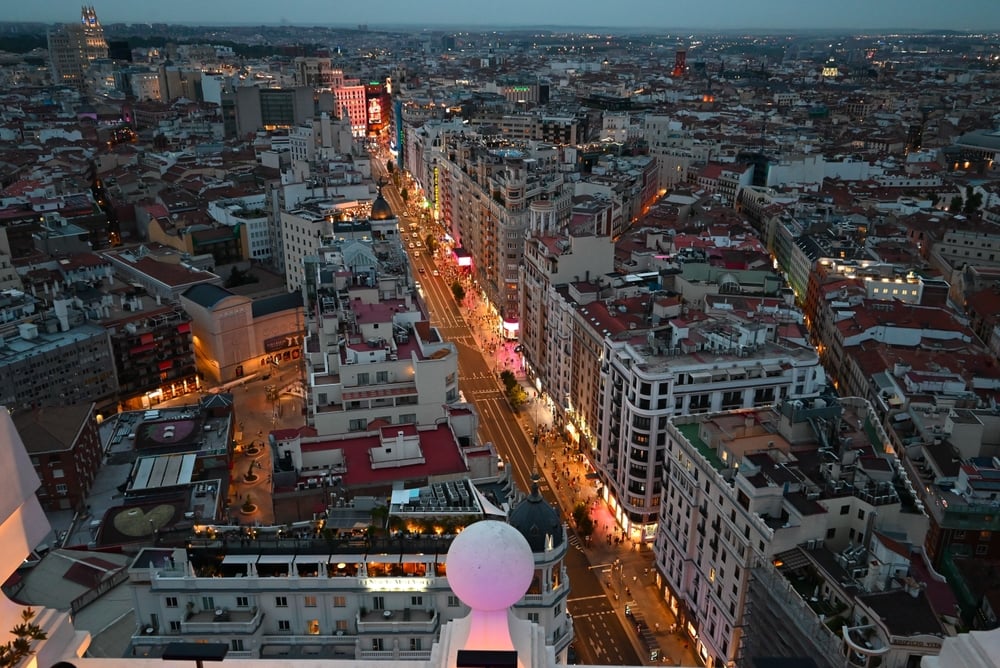
The average hotel room in Spain cost €141.61 a night in September 2026, up 7.4% on a year earlier, according to new figures from Spain’s National Statistics Institute (INE). Rates in the Madrid region jumped 14.1% to €186.65, the biggest rise and the highest average of any Spanish region.
That’s about £119 a night across Spain and £156 in the Madrid region at the European Central Bank exchange rate on 23 October 2026. INE published the figures that same day, and they cover 106 resorts and towns, 36 stretches of coast and islands, and every region of Spain, from Marbella (the priciest resort at €286.57) to Ciudad Real (the cheapest at €59.39).
Booked a Spanish hotel and wondering if you’re paying over the odds? Pick your destination in the tool below, type in what you paid per night, and you’ll see how it compares with the local average, how much rates there have moved in a year and where the place ranks. Prices checked October 2026.
New INE data, September 2026
How pricey is your Spanish holiday spot?
Pick a resort, coast, island or region. Add what you paid per night if you like, and we’ll compare it with the average hotel room rate there and across Spain.
Average room rate means what hotels took per occupied room per night in September 2026, before breakfast extras and similar add-ons.
How it compares
Average room rate per night, September 2026.
Every destination ranked
Most expensive first. Red means room rates rose on September 2025, green means they fell.
Figures are averages across every hotel and hostal category in each place, so a five-star room and a one-star room count together. Provisional data, which INE may revise. Pound figures use the European Central Bank rate on 23 October 2026 (€1 = £0.83728).
Prepared by Two Scots Abroad using data extracted from the INE website: www.ine.es (Hotel Tourism Short-Term Trends, September 2026, provisional, published 23 October 2026). Licensed under CC BY 4.0. Exchange rate: European Central Bank.
Key Findings
- The average hotel room in Spain cost €141.61 a night in September 2026, up 7.4% on September 2025, according to INE.
- The Madrid region had the highest average rate of any region at €186.65 a night, and the biggest rise, up 14.1%.
- Marbella was the most expensive of 106 resorts and towns INE tracks, at €286.57 a night (about £240), up 13.4%.
- Room rates rose in 80 of those 106 resorts and towns, and in 32 of 36 coasts and islands.
- Benidorm averaged €132.50 a night (up 4.5%), Calvià, home to Magaluf and Santa Ponsa, €167.63 (up 10.1%), and Salou €93.01 (up 10.4%).
- Extremadura was the cheapest region at €72.97 a night, about 61% less than the Madrid region.
- Visitors from the UK accounted for 27.2% of all hotel nights booked by foreign visitors in September, more than any other country. That's 7.71 million nights.
How Much Does a Hotel in Spain Cost in 2026?
The average room in a Spanish hotel cost €141.61 a night in September 2026. That's what hotels took per occupied room per night, across every category from one-star hostales to five-star resorts, so treat it as the middle of the market rather than what you'll pay for a sea view.
What the average room rate actually measures
INE calls it the average daily rate (ADR): room revenue divided by rooms sold. It moves when prices change and when the mix of guests changes, so more five-star bookings push it up even if no hotel raised its prices.
INE's separate hotel price index tracks like-for-like rooms. It rose 6.7%, a touch less than the average rate.
Price by hotel category
The gap between star ratings is bigger than the gap between most regions:
- Five-star hotels: €332.75 a night, up 10.9%
- Four-star hotels: €144.31 a night, up 5.7%
- Three-star hotels: €115.56 a night, up 8.2%
- Two-star hotels: €91.96 a night, up 3.7%
- One-star hotels: €93.59 a night, up 10.3%
Good to know: one-star hotels averaged slightly more than two-star ones in September.
Which Spanish Region Has the Most Expensive Hotels?
The Madrid region does, at €186.65 a night, ahead of the Balearic Islands (€176.81) and the Basque Country (€158.57). At the other end, Extremadura (€72.97), Castile and León (€79.01) and Aragon (€80.61) were the cheapest.
| Rank | Region | Average room rate | In pounds | Change on Sept 2025 | Bed occupancy |
|---|---|---|---|---|---|
| 1 | Madrid region | €186.65 | £156 | +14.1% | 62.6% |
| 2 | Balearic Islands | €176.81 | £148 | +9.0% | 82.6% |
| 3 | Basque Country | €158.57 | £133 | +12.1% | 67.2% |
| 4 | Andalusia | €139.74 | £117 | +6.4% | 63.2% |
| 5 | Canary Islands | €136.19 | £114 | +2.8% | 73.2% |
| 6 | Catalonia | €135.27 | £113 | +5.9% | 65.0% |
| 7 | Valencian Community | €120.63 | £101 | +6.7% | 67.9% |
| 8 | Cantabria | €105.71 | £89 | +13.7% | 53.6% |
| 9 | La Rioja | €94.44 | £79 | +6.0% | 51.1% |
| 10 | Melilla | €88.27 | £74 | −4.6% | 51.6% |
| 11 | Asturias | €87.36 | £73 | +3.7% | 53.7% |
| 12 | Murcia | €85.90 | £72 | +11.8% | 53.6% |
| 13 | Navarre | €85.90 | £72 | +8.4% | 56.4% |
| 14 | Ceuta | €85.26 | £71 | +7.3% | 57.0% |
| 15 | Galicia | €82.71 | £69 | +5.4% | 54.9% |
| 16 | Castilla-La Mancha | €82.38 | £69 | +5.2% | 40.9% |
| 17 | Aragon | €80.61 | £67 | +1.5% | 48.3% |
| 18 | Castile and León | €79.01 | £66 | +5.0% | 46.9% |
| 19 | Extremadura | €72.97 | £61 | +5.0% | 42.0% |
| Spain | €141.61 | £119 | +7.4% | 67.0% |
The Madrid region's 14% jump
Room rates in the Madrid region rose 14.1% in a year, the fastest of any region. INE's like-for-like price index for the region rose 10.4%, so it's not just a change in who was booking. The city of Madrid itself averaged €212.96 a night, up 11.6%, which made it the fourth most expensive resort or town in Spain. Our guide to things to do in Madrid has free and cheap ideas to balance that out.
The Balearics are the fullest
The Balearic Islands weren't the most expensive, but they were the busiest. Hotels there filled 82.6% of their beds in September, the highest occupancy of any region, and the Palma-Calvià area hit 85.3%. If you're heading to Mallorca, Menorca or Ibiza in September, book early, because there's very little slack. If you'd rather skip the crush altogether, these European destinations let you escape the summer crowds.
Where prices barely moved
Aragon (up 1.5%), the Canary Islands (up 2.8%) and Asturias (up 3.7%) saw the smallest rises. Melilla, the small Spanish city on the north African coast, was the only region where the average rate fell, down 4.6%.
The Most Expensive Resorts and Towns in Spain
Marbella topped the list at €286.57 a night (about £240), up 13.4% on a year earlier. Estepona, a little further west along the Costa del Sol, was second at €269.30, and San Sebastián third at €260.67 after a 15.0% rise.
The top ten
- Marbella: €286.57
- Estepona: €269.30
- San Sebastián: €260.67
- Madrid: €212.96
- Barcelona: €207.03
- Palma (Mallorca): €185.89
- Málaga: €179.54
- Adeje (Costa Adeje, Tenerife): €170.19
- Sitges: €167.64
- Calvià (Magaluf, Santa Ponsa): €167.63
Málaga's 17.0% rise was the biggest in the top ten, and it's now pricier than Torremolinos (€160.60). Barcelona rose a more modest 5.6%, which might be the first time anyone has called Barcelona hotel prices modest. If you're heading there, our guide to Barcelona in October covers crowds and day trips, and the best viewpoints in Barcelona are mostly free.
The biggest risers and fallers
Rates rose in 80 of the 106 resorts and towns and fell in 26. The biggest jumps were in Arcos de la Frontera (up 39.9%), Ribadeo (up 30.1%) and Torrevieja (up 28.0%, to €98.66). The biggest falls were in Sitges (down 15.3%), Roquetas de Mar (down 9.6%) and Mogán on Gran Canaria (down 9.5%).
Watch out for: big swings in smaller places. One hotel opening or closing can move a small town's average a lot.
What It Costs in Spain's Big Beach Resorts
Here's how Spain's main beach resorts compare, with the pound equivalent and each one's rank out of 106.
| Resort | Rank (of 106) | Average room rate | In pounds | Change on Sept 2025 |
|---|---|---|---|---|
| Marbella | 1 | €286.57 | £240 | +13.4% |
| Málaga | 7 | €179.54 | £150 | +17.0% |
| Torremolinos | 11 | €160.60 | £134 | +9.6% |
| Benalmádena | 23 | €137.15 | £115 | +0.4% |
| Fuengirola | 35 | €117.53 | £98 | +11.6% |
| Nerja | 15 | €152.68 | £128 | +2.8% |
| Palma (Mallorca) | 6 | €185.89 | £156 | +8.4% |
| Calvià (Magaluf, Santa Ponsa) | 10 | €167.63 | £140 | +10.1% |
| Adeje (Costa Adeje) | 8 | €170.19 | £142 | +8.8% |
| Arona (Los Cristianos) | 30 | €129.44 | £108 | +0.5% |
| San Bartolomé de Tirajana (Maspalomas, Playa del Inglés) | 16 | €149.15 | £125 | −1.5% |
| Mogán (Puerto Rico, Puerto de Mogán) | 43 | €101.95 | £85 | −9.5% |
| Tías (Puerto del Carmen) | 24 | €136.34 | £114 | −7.9% |
| Yaiza (Playa Blanca) | 13 | €157.02 | £131 | +3.7% |
| Teguise (Costa Teguise) | 26 | €135.56 | £114 | +8.1% |
| Pájara (Morro Jable, Costa Calma) | 22 | €137.21 | £115 | +10.0% |
| Benidorm | 28 | €132.50 | £111 | +4.5% |
| Alicante | 25 | €136.03 | £114 | +0.8% |
| Torrevieja | 53 | €98.66 | £83 | +28.0% |
| Salou | 62 | €93.01 | £78 | +10.4% |
| Cambrils | 31 | €129.30 | £108 | −0.1% |
| Lloret de Mar | 68 | €88.44 | £74 | +2.3% |
Benidorm is still mid-table
Benidorm averaged €132.50 a night (about £111), up 4.5%, which put it 28th of 106 and a little below the Spain-wide average. It's a good example of why the average matters: the resort has everything from budget hotels to big four-stars. Our guides to things to do in Benidorm and adult-only hotels in Benidorm cover both ends.
Cheaper alternatives on the same coasts
If Marbella's out of budget, look further along the Costa del Sol: Fuengirola averaged €117.53 and Benalmádena €137.15, against €286.57 in Marbella. On the Costa Daurada, Salou averaged €93.01, about €36 less than Cambrils (€129.30) just along the coast. And on the Costa Brava, Lloret de Mar averaged €88.44. Inland, Granada averaged €100.18 against €155.96 in Seville, and our guide to fun things to do in Granada on a budget keeps the rest of the trip cheap too.
The Canary Islands for winter sun
The Canaries are where a lot of Scottish winter-sun trips end up, and their rates are steadier than the mainland's. Tenerife averaged €141.41 (up 4.3%), Lanzarote €144.82 (up 0.9%) and Gran Canaria €131.85, one of only four coasts and islands where rates fell (down 3.4%). Fuerteventura was the exception, up 14.4% to €131.51. Our things to do in Tenerife guide covers the north and south of the island.
Coasts and Islands Ranked
The Basque coast around San Sebastián (Costa Guipuzkoa) was the priciest stretch of coast in Spain at €245.01 a night, up 15.2%. Ibiza and Formentera came second at €218.97 (up 10.2%) and the Costa de Barcelona third at €205.66.
The Costa del Sol and the Balearics
The Costa del Sol averaged €176.94 (up 8.8%), Palma-Calvià €175.91, Menorca €169.61 and Mallorca as a whole €165.90 (up 9.3%). Ibiza is the expensive island by some distance, so if that's where you're going, our where to stay in Ibiza guide and things to do in Ibiza are worth a look before you book.
The mainland's cheaper coasts
The Costa Blanca averaged €130.55, the Costa Brava €107.87, the Costa Daurada €102.44 and the Costa Valencia €95.24. Further north, the Galician coasts all came in under €86, though you'll want a jacket. For a wider look at the south, our guide to towns and cities in Andalucía is a good starting point.
Who's Staying in Spain's Hotels
Spanish hotels recorded 40.16 million nights in September 2026, up 1.7% on a year earlier. Nights booked by foreign visitors rose 3.2%, while nights by people living in Spain fell 1.9%.
UK visitors are the biggest market
Visitors from the UK accounted for 7.71 million hotel nights, or 27.2% of everything booked by foreign visitors. Germany was second at 17.4%, with France (6.9%), the US (4.7%) and the Netherlands (4.6%) behind. That lines up with the record passenger numbers we covered at Scotland's airports, where cheap European trips keep filling seats.
Mallorca is the busiest island
Mallorca recorded about 7.38 million hotel nights in September, more than any other tourist area in Spain. Madrid, Barcelona and Calvià were the individual towns and cities with the most nights, and Llucmajor on Mallorca had the highest occupancy of any town at 90.1%.
How to Get a Better Price on a Spanish Hotel
You can't do much about a 14% rise in the Madrid region, but you can do a lot about what you pay.
Pick the town next door
Staying one town along can save a lot, as Fuengirola and Salou show. If the town you wanted is booked out, check the next one on the same coast before you change the whole trip.
Watch the hidden extras
The average room rate doesn't include tourist taxes, which some Spanish regions charge per person per night on top of the room price. Our explainer on how hotel taxes work covers why they exist, and our guide to hidden hotel resort fees covers the other charges to look for. It's also worth reading why hotel prices change overnight before you book.
Book smart
- Our tips for booking last-minute hotels in Europe cover when waiting pays off.
- If cash flow is the issue, here's how to book flights and hotels without paying all at once.
- Hiring a car? Our guide to saving money on car rental covers deposits and fees.
Before you go, check the latest UK government travel advice for Spain, and make sure your Global Health Insurance Card (GHIC) is in date. It doesn't replace travel insurance, though. The EU's Entry/Exit System also now registers UK travellers at the border. For more ideas, our list of fun things to do in Spain and the official Spain tourism site are good places to start, and yes, you can drink the tap water in most of Spain.
How to Use the Widget
- Choose your destination: resorts and towns, coasts and islands, or regions.
- Optionally, type in what you paid per night and pick euros or pounds.
- Press "Check my destination" to see the average room rate, the change on September 2025, how it compares with Spain as a whole and where it ranks.
- The chart shows your destination against what you paid, the same place a year ago, the Spain average and the most and least expensive places in the same group.
- Switch the ranked list between resorts, coasts and regions, and tap "Show all" for every destination.
- Use "Copy my result" to share it.
The figures are averages across all hotel types, so a big gap usually reflects the star rating rather than a bad deal. Pound figures use the European Central Bank reference rate on 23 October 2026 (€1 = £0.83728).
About the Data
All hotel figures come from INE's Hotel Tourism Short-Term Trends release for September 2026, published on 23 October 2026. It combines the Hotel Occupancy Survey (EOH), the Hotel Price Index (IPH) and the Indicators on the Profitability of the Hotel Sector (IRSH). The figures are provisional and may be revised.
- INE press release: Hotel Tourism Short-Term Trends, September 2026
- INE annex tables (XLSX), including regions, provinces and tourist areas
- INE hotel occupancy survey, price index and profitability indicators: latest data
- INE average daily rate by tourist site
- INE legal notice and reuse conditions
- European Central Bank euro to pound reference rate
Prepared by Two Scots Abroad using data extracted from the INE website: www.ine.es. INE's information is licensed under Creative Commons Attribution 4.0 (CC BY 4.0). INE does not sponsor or endorse this article. For other data-led guides, see our look at Scotland's 17-year age gap and our roundup of the best-value family holiday destinations.
Frequently Asked Questions
How much is a hotel in Spain per night in 2026?
The average hotel room in Spain cost €141.61 a night in September 2026, about £119, according to INE. That's up 7.4% on September 2025. Five-star hotels averaged €332.75 and three-star hotels €115.56, so the star rating makes a big difference to what you'll pay.
What is the most expensive place to stay in Spain?
Marbella, at €286.57 a night on average in September 2026, ahead of Estepona (€269.30) and San Sebastián (€260.67). By region, the Madrid region was the most expensive at €186.65, and the Basque coast around San Sebastián was the priciest stretch of coast at €245.01.
What is the cheapest region of Spain for hotels?
Extremadura, where the average room cost €72.97 a night in September 2026. Castile and León (€79.01), Aragon (€80.61) and Castilla-La Mancha (€82.38) were next. Of the 106 individual resorts and towns INE tracks, the inland city of Ciudad Real was cheapest at €59.39 a night.
How much is a hotel in Benidorm?
Hotels in Benidorm averaged €132.50 a night in September 2026, about £111, up 4.5% on a year earlier. That put Benidorm 28th of the 106 resorts and towns INE tracks, and slightly below the Spain-wide average of €141.61. Calvià, home to Magaluf, averaged €167.63.
Are hotel prices in Spain going up?
Yes. The average room rate rose 7.4% between September 2025 and September 2026, and INE's like-for-like hotel price index rose 6.7%. Rates rose in 80 of the 106 resorts and towns INE tracks, and in every region except Melilla, where they fell 4.6%.
Is Mallorca or Tenerife cheaper for hotels?
Tenerife, by about €25 a night on September's figures. Hotels on Tenerife averaged €141.41 a night, against €165.90 across Mallorca. Within each island it varies a lot: Calvià on Mallorca averaged €167.63 and Adeje on Tenerife €170.19, while Arona (Los Cristianos) averaged €129.44.
How many UK tourists stay in Spanish hotels?
UK visitors accounted for 7.71 million hotel nights in Spain in September 2026, 27.2% of all nights booked by foreign visitors. That made the UK Spain's biggest foreign hotel market, ahead of Germany at 17.4%. There were almost 1.47 million UK hotel guests that month.
Where does this data come from?
Spain's National Statistics Institute (INE), which publishes hotel occupancy, prices and profitability figures every month. These September 2026 figures were published on 23 October 2026 and are provisional. The pound conversions use the European Central Bank reference rate for the same day.