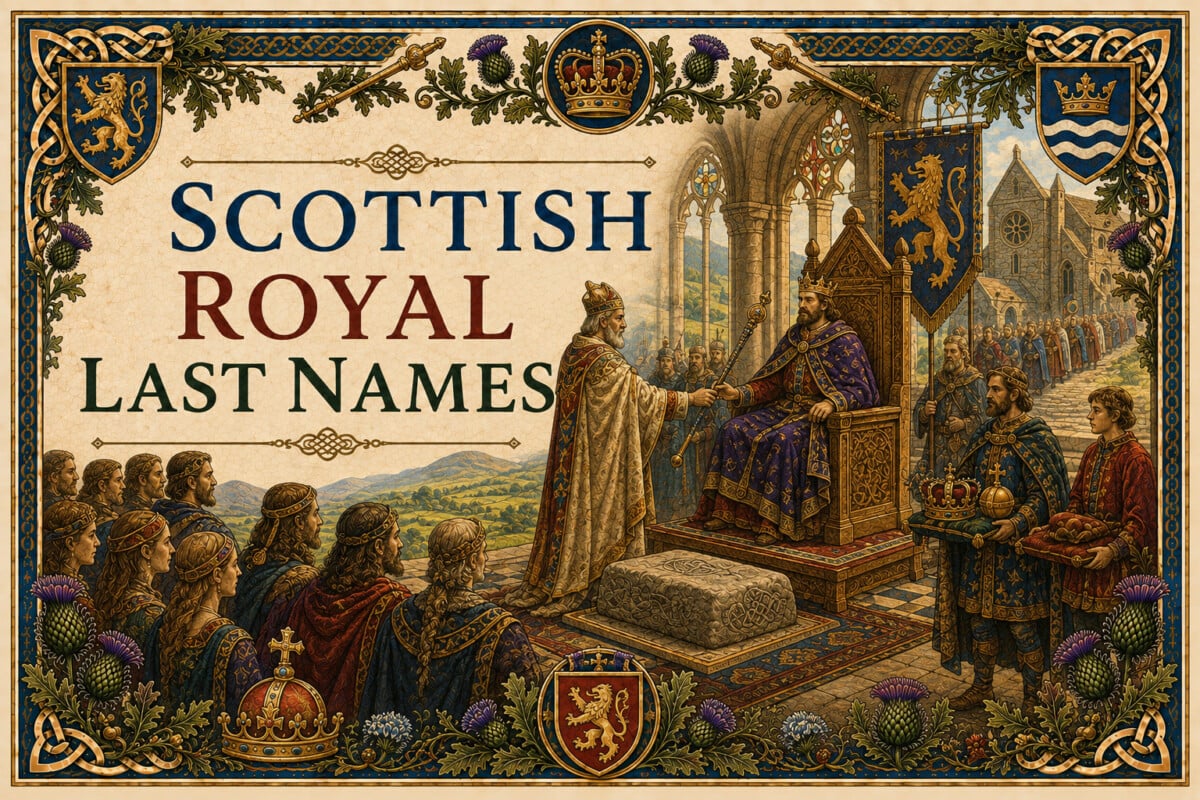
Scottish royal last names include Stewart or Stuart, Bruce, Balliol and Douglas, although only some belonged to families that produced reigning monarchs. These surnames grew out of offices, estates, kinship lines and political alliances in medieval Scotland.
A royal connection is not the same thing as a modern family-tree guarantee. Many people share these surnames through separate branches, clan affiliations, tenants, migration and later spelling changes, so a name alone cannot prove descent from a king or queen.
Still, Scottish royal last names offer a remarkably good route into the country’s history. They lead to battles, abbeys, Highland estates and a few dynasties whose succession problems would make a family WhatsApp group look positively calm.
If you are interested in specific last or first names of the Scottish origin, try our interactive tool below:
Scottish Names Beginning With
Choose which type of Scottish name you would like to explore.
How Scottish Last Names Developed
Scotland’s surnames reflect the languages and communities that shaped the kingdom: Gaelic speakers, Picts, Norse settlers, Anglo-Scots communities and Norman incomers. A surname might identify a father, an occupation, a home territory or a powerful kindred.
Mac and Mc mean “son of” in Gaelic, so names such as MacDonald and MacGregor began as patronymics. Lowland names often used the suffix -son, producing surnames such as Anderson and Wilson. Neither pattern automatically signals nobility. They were practical ways of distinguishing one person from another.
Many elite families used territorial names. Douglas is linked to the Douglas Water area of South Lanarkshire, while Murray is associated with Moray, often rendered in medieval Latin as de Moravia. Norman-style landholding encouraged this habit, and a family’s estate could become its permanent public identity. You can also explore Scottish last names beginning with D for more names with deep Lowland and territorial roots.
Occupational surnames also entered the royal story. Stewart began as a title for an official responsible for a great household. That job title eventually became the name of Scotland’s most enduring royal dynasty.
The House of Stewart and Stuart
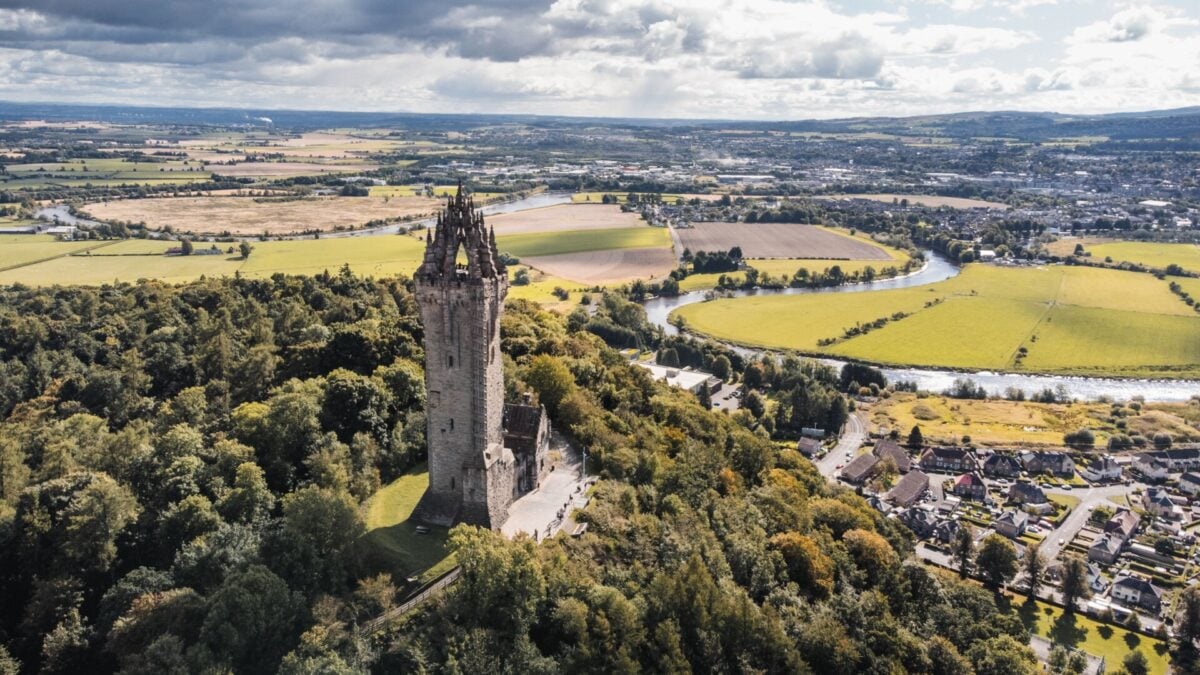
Stewart is Scotland’s clearest royal surname. The name came from the hereditary office of High Steward of Scotland, not from an original place-name or Gaelic patronymic. Walter the Steward married Marjorie Bruce, daughter of King Robert I, tying the family directly to the Bruce royal line.
Robert II, who reigned from 1371 to 1390, took Stewart as his surname and became the first king of the House of Stewart. The dynasty ruled Scotland from 1371 until 1603. Its monarchs included James IV, James V, Mary, Queen of Scots, and James VI.
The Stuart spelling became especially familiar through Mary, Queen of Scots. It is a French-influenced form associated with the years she spent in France, but Stewart and Stuart are closely related spellings in the same broad family tradition. For a wider look beyond the royal branch, see Scottish last names beginning with S.
James VI of Scotland also became James I of England in 1603, uniting the crowns of Scotland and England in one monarch. The Stuart line later ruled across the kingdoms that became Great Britain, making the surname central to British as well as Scottish royal history.
The Bruce Name and the Scottish Crown
Bruce is inseparable from Robert the Bruce, the king who led Scotland during the Wars of Independence. The family had Norman roots, and its surname likely came through an ancestral connection with Brix in Normandy before the Bruces established themselves among Scotland’s leading landholders.
Robert I, known as Robert the Bruce, was crowned king in 1306. His victory at the Battle of Bannockburn in 1314 became a defining event in Scottish memory. The battlefield lies near Stirling, and the Bruce name remains strongly associated with the struggle for Scottish independence.
The Bruce family produced two Scottish kings: Robert I and his son David II. The direct royal line did not last long after David II’s death in 1371, but it passed the crown to Robert II through Robert I’s daughter Marjorie and Walter the Steward.
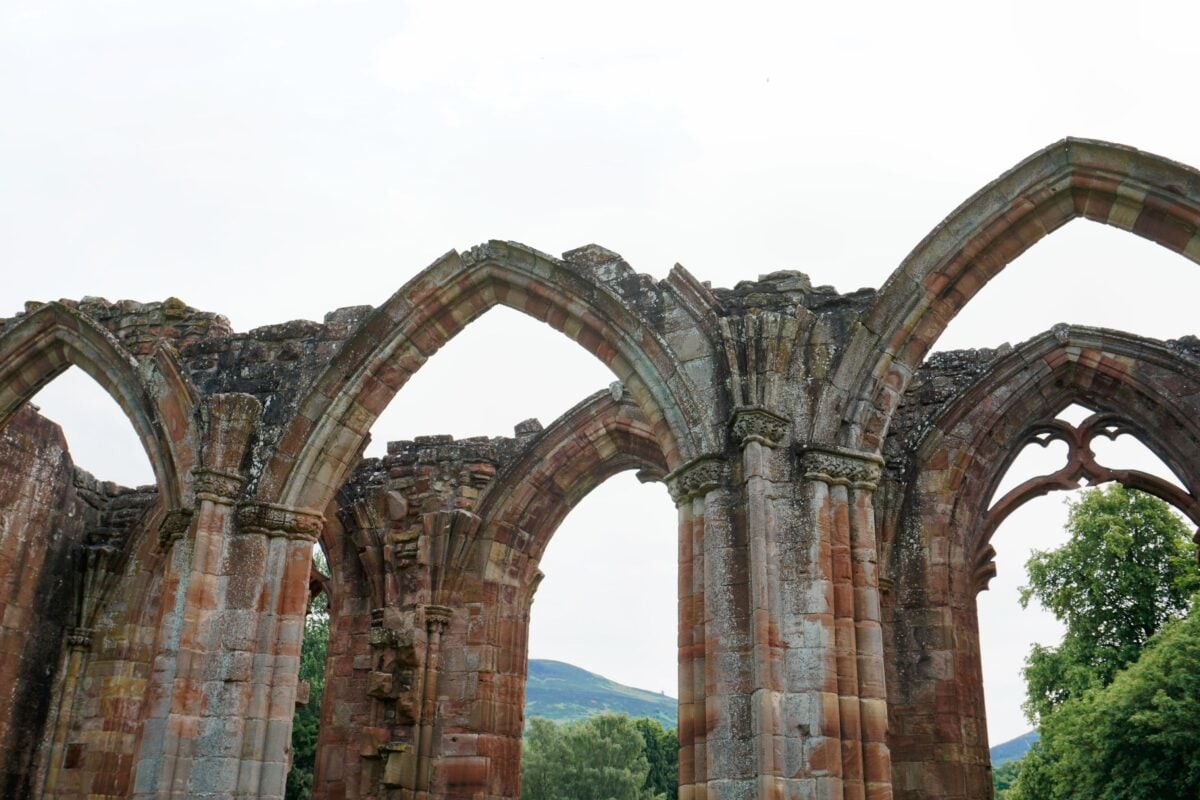
For a place-based connection, Melrose Abbey in the Scottish Borders is traditionally associated with Robert the Bruce’s heart. A plaque in the abbey grounds marks the supposed burial place, making it one of the most tangible stops for anyone following the Bruce story beyond the battlefield at Bannockburn. The name also appears among Scottish last names beginning with B, where spelling and family-history variations can be useful to compare.
The Balliol Family: A Brief but Important Dynasty
The Balliol name belongs to one of Scotland’s most contested royal chapters. John Balliol became king in 1292 after a succession dispute known as the Great Cause, when several claimants argued for the crown following the death of Margaret, Maid of Norway.
John Balliol’s reign lasted from 1292 to 1296 and unfolded under intense pressure from Edward I of England. His political weakness earned him the later nickname “Toom Tabard,” often translated as “empty coat,” though the label reflects hostile medieval and later portrayals as much as it explains the man.
The Balliols were a powerful Anglo-Scottish noble family with lands on both sides of the border. Their royal connection was real but short-lived, and the surname’s importance lies largely in the constitutional crisis that preceded the Wars of Independence.
Modern Balliols should not be casually described as descendants of King John. Medieval inheritance was complicated, surnames passed through many lines, and documented genealogy requires records that connect one generation to the next.
Douglas: Royal Neighbours, Rivals and Allies
Douglas is often grouped with Scottish royal last names because the family stood close to the crown for centuries. The House of Douglas did not establish a reigning Scottish dynasty, but its lords and earls were among the kingdom’s most influential political and military figures.
The surname is territorial, linked to the Douglas Water in South Lanarkshire. In the later Middle Ages, branches known as the Black Douglases and Red Douglases held vast estates and regularly shaped royal government, succession disputes and military campaigns.
The Douglases were powerful enough to be a problem for kings. That was a recurring feature of Scottish medieval politics, where a great magnate could be an indispensable ally one year and a threat to royal authority the next. The family’s prominence makes Douglas a royal-adjacent name, not proof of royal descent.
Castle Campbell in Clackmannanshire offers one useful reminder of the wider noble world in which the Douglases operated. Formerly called the Castle of Glooms, it became associated with the powerful Earls of Argyll and has links to both John Knox and Mary, Queen of Scots. Scottish royal history is rarely just the story of the monarchs.
Other Surnames Often Linked With Scottish Royal History
- Canmore: A modern label for the medieval royal house descended from Malcolm III. It is useful in historical writing, though it was not a hereditary surname used by the dynasty in the modern sense.
- Dunkeld: Another historical house name used for the royal line associated with Duncan I, Malcolm III and their successors. Like Canmore, it is more a dynastic label than an everyday medieval surname.
- MacAlpin: Associated in tradition with Kenneth MacAlpin, often linked with the formation of the kingdom of Alba. Early medieval naming practices were not fixed in the way later surnames were.
- Hamilton: A major noble surname with strong connections to the Stewart and Stuart royal succession, particularly through marriage and inheritance. It is not itself the name of a Scottish reigning dynasty.
- Campbell: One of Scotland’s largest Highland clan names. The Campbells became major landowners in Argyll, and the Dukes of Argyll remain associated with Inveraray Castle on Loch Fyne. Browse Scottish last names beginning with C for other names shaped by clan, occupation and place.
What a Royal Scottish Surname Can and Cannot Tell You
A surname can point you toward a historical tradition, but it cannot settle a genealogy. Stewart may indicate ancestry from one of many unrelated or distantly connected Stewart lines. Bruce, Douglas and Campbell have also spread widely through Scotland and the wider diaspora.
Start with family documents, civil registration, census records, parish registers and wills before attempting to attach a line to a medieval family. A documented chain of records matters more than an appealing surname. This is especially true for names connected to famous clans or kings, where family lore can travel much faster than evidence.
For readers building a home reference shelf, a Scottish genealogy guide or surname reference book can help decode old county names, parish boundaries and spelling variants before searching archives.

The Family Tree Scottish Genealogy Guide: How to Trace Your Ancestors in Scotland
Scottish Royal Last Names FAQ
What is the most famous Scottish royal surname?
Stewart, also spelled Stuart, is the most famous Scottish royal surname because the Stewart dynasty ruled Scotland from 1371 to 1603. James VI later inherited the English throne as James I in 1603.
Was Robert the Bruce’s surname really Bruce?
Yes. Robert I was a member of the Bruce family, a powerful noble house of Norman origin that became established in Scotland. The surname is closely tied to his reign and the Battle of Bannockburn in 1314.
Were the Douglases Scottish royalty?
The Douglases were not a reigning royal dynasty of Scotland. They were one of the country’s most powerful noble families and had extensive influence over monarchs, land and military affairs.
Does having the surname Stewart mean you are related to Mary, Queen of Scots?
No. Stewart is a widespread surname with many family branches. A proven relationship to Mary, Queen of Scots requires documented genealogical evidence, not a shared last name.
Why do some Scottish royal names have different spellings?
Spelling was not standardized in medieval Scotland, and names changed across Gaelic, Scots, Latin, English and French records. Stewart and Stuart are the best-known example of closely related royal surname spellings.
Final Word on Scotland’s Royal Surnames
Scottish royal last names are best read as historical signposts. Stewart points to a dynasty that ruled for more than two centuries in Scotland; Bruce recalls a king and the struggle for independence; Balliol evokes a disputed crown; and Douglas shows how noble families could stand almost shoulder to shoulder with kings.
Use the names as an invitation to investigate, then let records do the hard work. Scotland’s history has plenty of grandeur already. It does not need a dubious royal cousin added to it.