
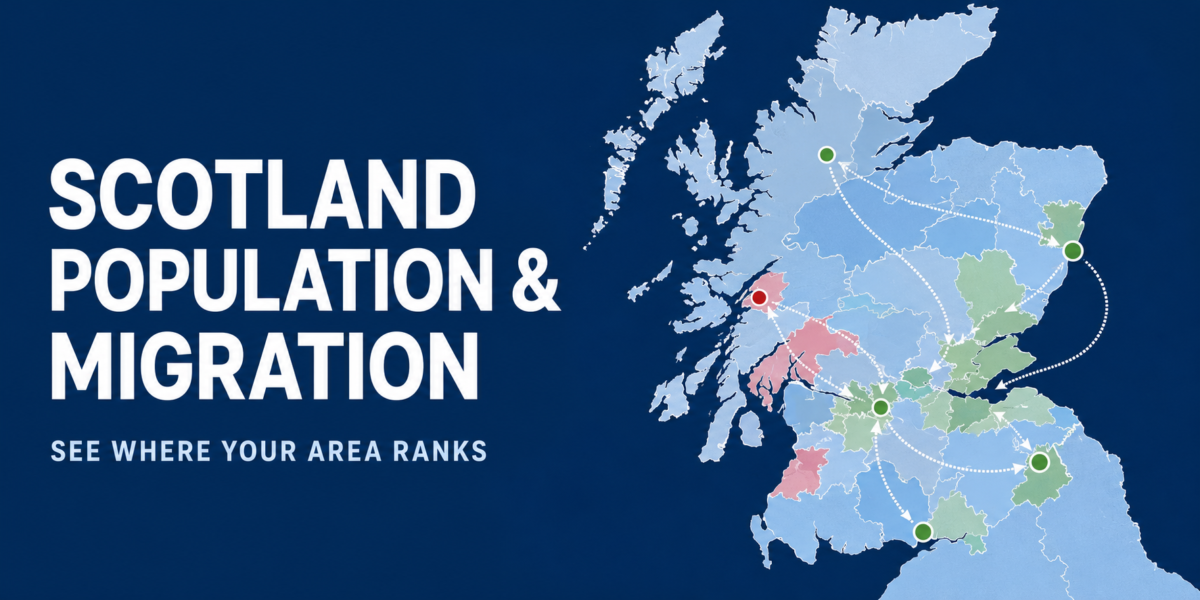
Scotland’s population may be at a record high, but growth is far from evenly distributed. Some council areas are attracting new residents while others are losing population as deaths outnumber births and younger people move elsewhere.
Use the interactive Scotland Population and Migration Explorer below to compare all 32 council areas. You can see the latest population estimates, annual change, net migration, age profile and official projections for the coming years.
The figures are based on the latest data published by National Records of Scotland
Explore population, migration, age and projected growth across Scotland’s 32 council areas.
Shetland is shown in an inset position to keep the map compact.
What Scotland’s Latest Population Figures Show
Scotland’s population reached an estimated 5,545,500 people on 30 June 2025, the highest level recorded. Growth during the latest year was tiny, however, with the national population increasing by only 2,200 people, or less than 0.1%.
That is a marked slowdown from recent years. According to National Records of Scotland’s mid-2025 population estimates, the average annual increase over the previous two decades was around 23,000 people.
The national total also conceals substantial local differences. Population increased in 12 council areas during the latest year and decreased in the remaining 20. Looking only at the Scotland-wide figure is a bit like checking the average weather and assuming it is dry everywhere. The local result can be very different.
- East Lothian recorded the fastest percentage growth at 1.1%, adding 1,280 people.
- Glasgow City recorded the largest numerical increase, adding 4,010 people.
- Midlothian grew by 0.7%, an increase of 670 people.
- West Lothian grew by 0.6%, adding 1,080 people.
- Clackmannanshire recorded the steepest percentage decline at 0.7%.
- Aberdeen City experienced the largest numerical fall, losing an estimated 1,140 residents.
Which Parts of Scotland Are Growing Fastest?
The strongest percentage growth was concentrated in East Lothian, Midlothian and West Lothian, all within reach of Edinburgh. These areas offer access to the capital while providing more residential space than many central neighbourhoods.
New housing, family movement and internal migration can all shape these figures. A council area does not need to attract thousands of people from overseas to grow. Residents moving a relatively short distance from a city into a neighbouring authority can shift the local totals surprisingly quickly.
Glasgow followed a different pattern. The city gained 7,140 people through international migration after overseas departures were accounted for, helping it record Scotland’s largest overall population increase. At the same time, Glasgow lost residents to other Scottish council areas, showing how several movements can pull the same population figure in opposite directions.
Anyone considering relocating can compare the figures with our practical guide to moving to Scotland from England, which covers housing, healthcare, costs and the parts of the process that tend to catch people out.
Why Are Some Scottish Council Areas Losing Population?
A falling population does not automatically mean everyone is packing a van and heading south. In much of Scotland, the larger pressure comes from natural change, which is the number of births minus the number of deaths.
Deaths exceeded births in 30 of Scotland’s 32 council areas during the year to mid-2025. Glasgow City recorded 54 more births than deaths, while Midlothian recorded 16 more. Every other council area had negative natural change.
This helps explain why a place can gain residents through migration and still record an overall population decline. Aberdeenshire, for example, had positive net migration, but deaths exceeded births by a larger amount. Its estimated population consequently fell slightly.
Several rural, island and former industrial areas face a combination of older populations, fewer births and younger adults moving elsewhere for education or employment. These patterns usually develop over years. A single annual fall is useful evidence, but the longer trend gives a better view of where an area is heading.
How Migration Is Changing Scotland’s Population
Net migration was positive in 25 of Scotland’s 32 council areas during the latest year. Net migration measures the number of people arriving minus those leaving, so a positive figure indicates that more people moved into an area than moved away.
Scotland gained 17,900 people through migration in the year to June 2025. That total included movement between Scotland and the rest of the UK as well as international migration. Moves between Scottish council areas change local populations but cancel each other out when Scotland is measured as a whole.
The pattern varies sharply by location. Large cities attract students, workers and international arrivals, while neighbouring council areas often gain people moving out of those cities. Rural regions can also attract people from elsewhere in the UK, particularly those seeking more space or approaching retirement.
Glasgow recorded the highest council-level net migration gain at 3,910 people. South Lanarkshire followed with 2,060, while East Lothian gained 1,520. Aberdeen City, Dundee City and Edinburgh all recorded net migration losses during the same period.
People exploring the country can use our Scotland road trip planner to see how these council areas fit together geographically. Distances that look minor on a map can involve ferries, single-track roads or enough sheep-related delays to ruin an overly ambitious schedule.
Scotland’s Population Is Getting Older
Scotland is growing older as well as growing more slowly. People aged 65 and over accounted for 21% of the population in mid-2025, up from 16.3% in 2005. Children aged 15 and under represented 15.8%, down from 18.2% twenty years earlier.
Over those two decades, the number of people aged 65 and over increased by 332,400, or 39.9%. The number of children fell by 54,000, while the working-age population grew by 156,900.
The oldest population profiles are generally found in rural and coastal authorities. Dumfries and Galloway had 28.7% of residents aged 65 or over, followed by Argyll and Bute at 28.4%, Na h-Eileanan Siar at 28.1%, and the Scottish Borders and South Ayrshire at 28%.
Glasgow, Edinburgh, Aberdeen and Dundee have younger profiles, with higher proportions of people aged 16 to 64. Universities, employment and international migration all contribute to the difference.
How Urban and Rural Scotland Compare
Scotland’s four largest cities contain a high share of working-age adults, but city growth is rarely straightforward. Glasgow gained population during the latest year, while Edinburgh, Aberdeen and Dundee recorded small declines.
Edinburgh attracted people from overseas and the rest of the UK but lost more residents to other parts of Scotland. Housing costs, family moves and the appeal of neighbouring areas can all contribute to that flow. Midlothian, East Lothian and West Lothian each recorded population growth during the same period.
Rural authorities cover far larger areas, so even modest population changes can affect schools, healthcare, transport and local services. Highland has more than 237,000 residents spread across an enormous land area, while some island authorities have fewer people than a single urban neighbourhood.
If the numbers have sparked a trip north, our guide to where to stay in the Scottish Highlands explains the most practical bases for exploring Inverness, Fort William, Skye and the surrounding region.
Which Scottish Council Areas Could Grow by 2032?
Scotland’s population is projected to increase by 4.4% between 2022 and 2032. National Records of Scotland projects growth in 23 of the 32 council areas, although the figures are scenarios based on demographic assumptions and should not be read as guaranteed forecasts.
The strongest projected growth is concentrated around Edinburgh and Glasgow. Midlothian is projected to grow by 14.7%, followed by East Lothian at 12.4% and Glasgow City at 10.9%.
Nine council areas are projected to decline over the same decade. The largest projected decreases are in Inverclyde at 5.4%, West Dunbartonshire at 4.6%, and Na h-Eileanan Siar at 3.6%.
| Council Area | Projected Change, 2022–2032 |
|---|---|
| Midlothian | +14.7% |
| East Lothian | +12.4% |
| Glasgow City | +10.9% |
| Na h-Eileanan Siar | -3.6% |
| West Dunbartonshire | -4.6% |
| Inverclyde | -5.4% |
Migration is projected to remain the main source of growth. NRS expects deaths to outnumber births in most council areas, with Edinburgh and Midlothian the only exceptions under the principal projection.
The projections also point toward continued ageing. Every council area is projected to have more people of pensionable age by 2032, while Midlothian is the only authority projected to record an increase in the number of children.
Full assumptions, alternative scenarios and council-level tables are available in the NRS 2022-based subnational population projections.
How to Use the Scotland Population Explorer
Select a measurement from the menu to change the map and council rankings. You can compare areas by population, annual change, net migration, median age, density or projected growth.
Choose two council areas using the comparison menus or select an area directly from the map. The panels beneath the map show population history, age structure, migration and the components behind the latest annual change.
Positive net migration does not always produce population growth because births, deaths and smaller administrative changes are also included in the annual estimate. Check the “What drove the latest change?” section when a result looks slightly odd. Scottish population maths has a habit of refusing to fit neatly into one headline.
What the Population Terms Mean
Population estimate The estimated number of people usually living in an area on 30 June of the stated year. Annual population change The difference between one mid-year population estimate and the next. Net migration The number of people moving into an area minus the number moving out. Internal migration Movement between council areas within Scotland. Natural change The number of births minus the number of deaths during the year. Population density The estimated number of residents per square kilometre. Population projection A future population scenario based on assumptions about births, deaths and migration. It is not a prediction or target.
About the Data and Methodology
The explorer uses the latest mid-year population estimates published by National Records of Scotland. These figures estimate the population on 30 June 2025 and include council-level age, migration, birth and death data.
Future figures come from the 2022-based subnational population projections. The estimates and projections use different base years, so the latest estimate should be used when checking the current population.
Council boundaries are based on May 2024 Office for National Statistics boundary data. Figures may be rounded, so individual components may occasionally differ slightly from a displayed total.
Official release dates can change during the year. Our searchable Scottish Government statistics calendar tracks forthcoming population, tourism, housing, health and economic publications.
Data last updated: July 2026.
Scotland Population FAQ
What Is the Population of Scotland in 2025?
Scotland’s estimated population was 5,545,500 on 30 June 2025. This was the highest population recorded for Scotland, although the annual increase was less than 0.1%.
Is Scotland’s Population Increasing or Decreasing?
Scotland’s population increased by approximately 2,200 people between mid-2024 and mid-2025. Twelve council areas grew while 20 recorded a decline.
Which Part of Scotland Is Growing Fastest?
East Lothian had the fastest annual percentage growth, increasing by 1.1%. Glasgow City added the largest number of residents, with an increase of 4,010.
Which Scottish Council Area Has the Largest Population?
Glasgow City is Scotland’s largest council area by population, with an estimated 654,330 residents. Edinburgh is second with 531,370, followed by Fife with 373,990.
Which Scottish Council Area Has the Smallest Population?
Orkney Islands had Scotland’s smallest council population in mid-2025, with an estimated 21,920 residents. Shetland Islands and Na h-Eileanan Siar were the next smallest.
Why Is Scotland’s Population Growing?
Migration is the main source of Scotland’s population growth. Deaths have exceeded births nationally in every year since the year ending mid-2015.
Are More People Moving to or Leaving Scotland?
More people moved to Scotland than left during the year to June 2025. The country recorded net migration of approximately 17,900 people.
Is Scotland’s Population Getting Older?
Yes. People aged 65 and over represented 21% of Scotland’s population in mid-2025, compared with 16.3% in 2005.
Are Population Projections Accurate?
Population projections are scenarios based on assumptions about future births, deaths and migration. They are useful for planning but should not be treated as guaranteed forecasts.
