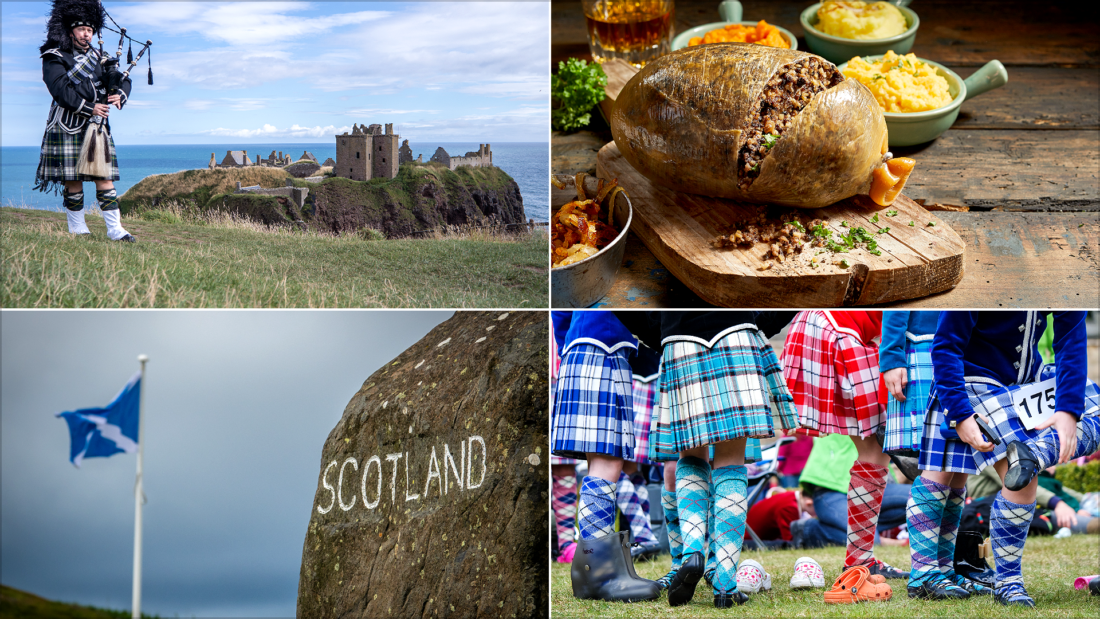
Scotland is most commonly associated with kilts, bagpipes, Scotch whisky, haggis, Highland landscapes, and castles. Beyond those headline items, the country has a deep roster of national symbols, inventions, folklore, and traditions that shape its identity worldwide, from the unicorn as national animal to Alexander Graham Bell’s telephone.
There’s a reason people keep coming back, and honestly, search interest in Scotland travel has been climbing steadily, peaking over the winter months when flights and accommodation are surprisingly affordable.
Quick Answer
Things strongly associated with Scotland include the Saltire flag, the thistle, kilts, tartan, bagpipes, Scotch whisky, haggis, the Loch Ness Monster, Highland Games, golf, shortbread, and the unicorn as national animal. Scotland also gave the world the telephone, television, and penicillin. If you’re curious about the full rundown, check out what Scotland has invented over the centuries.
National Symbols of Scotland
Scotland’s national symbols span flags, animals, plants, and mottos, most rooted in folklore and tradition rather than formal legislation. Even the country’s best-known nickname has a story behind it, and we explain why it’s called Bonnie Scotland separately.
- The Saltire (St. Andrew’s Cross): Scotland’s national flag, widely considered the oldest national flag still in use. The Saltire also forms part of the Union Flag design.
- The Lion Rampant: The heraldic banner of the Royal Arms of Scotland, frequently seen at sporting events. Technically a royal banner, its use by the public at events like Euro 2020 has sparked the #FreeTheLion debate.
- The thistle: Scotland’s floral emblem, linked to a legend about its role in warning Scots of an enemy attack at the Battle of Largs. It appeared on Scottish coins by the 1470s and became the national emblem by the 13th century.
- The unicorn: Scotland’s national animal, appearing on the royal coat of arms since the 12th century. A National Unicorn Museum is being established in Forres, Moray.
- The Scots Pine: Scotland’s national tree.
- The Scottish Terrier: Scotland’s national dog.
- “Flower of Scotland”: Widely treated as the national anthem and played at football and rugby matches involving Scotland’s national teams.
- National motto – “Nemo me impune lacessit”: Latin for “No one provokes me with impunity.” The motto also belongs to the Order of the Thistle, Scotland’s order of knighthood.
- The Stone of Destiny (Stone of Scone): A sandstone slab symbolizing Scottish monarchy. Every British monarch since 1296 has been crowned on or above it.
- Saint Andrew: Patron saint of Scotland, celebrated on St. Andrew’s Day (30 November), which has been an official bank holiday since the St. Andrew’s Day Bank Holiday (Scotland) Act 2007.
- The Great Seal of Scotland: Used by the First Minister to authorize official documents.
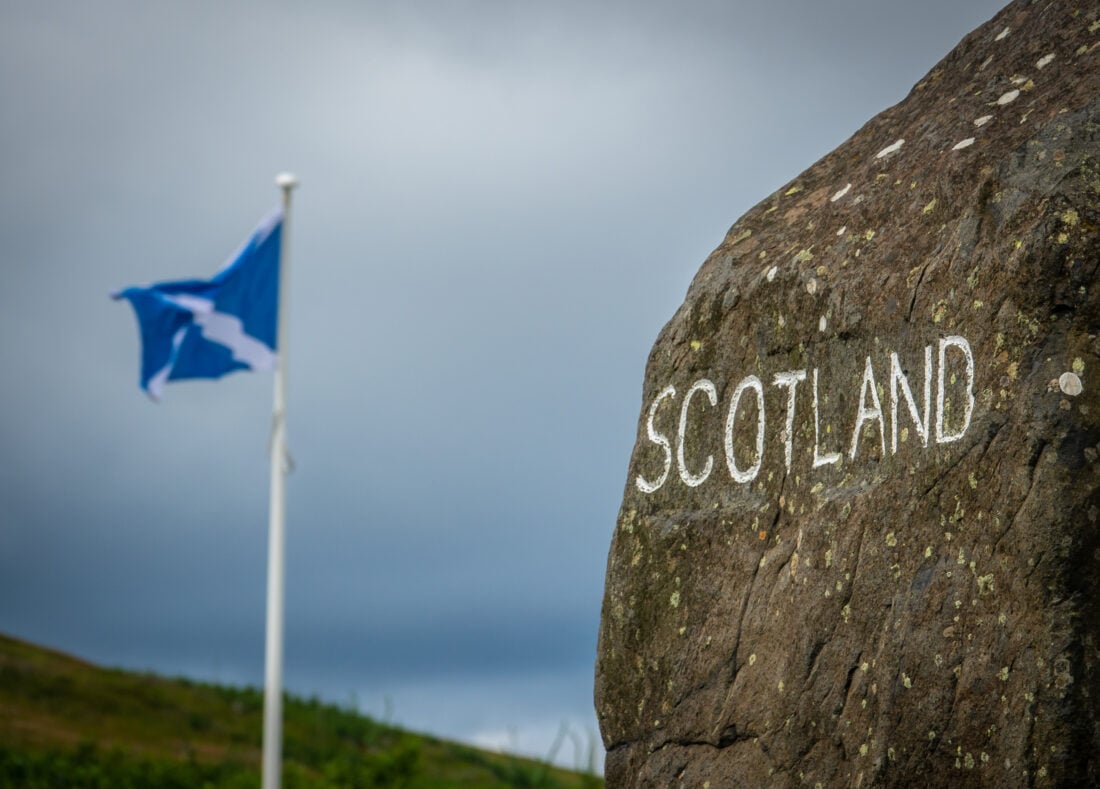
The Saltire (St. Andrew’s Cross)
Scottish Food and Drink
What is Scotland’s national dish?
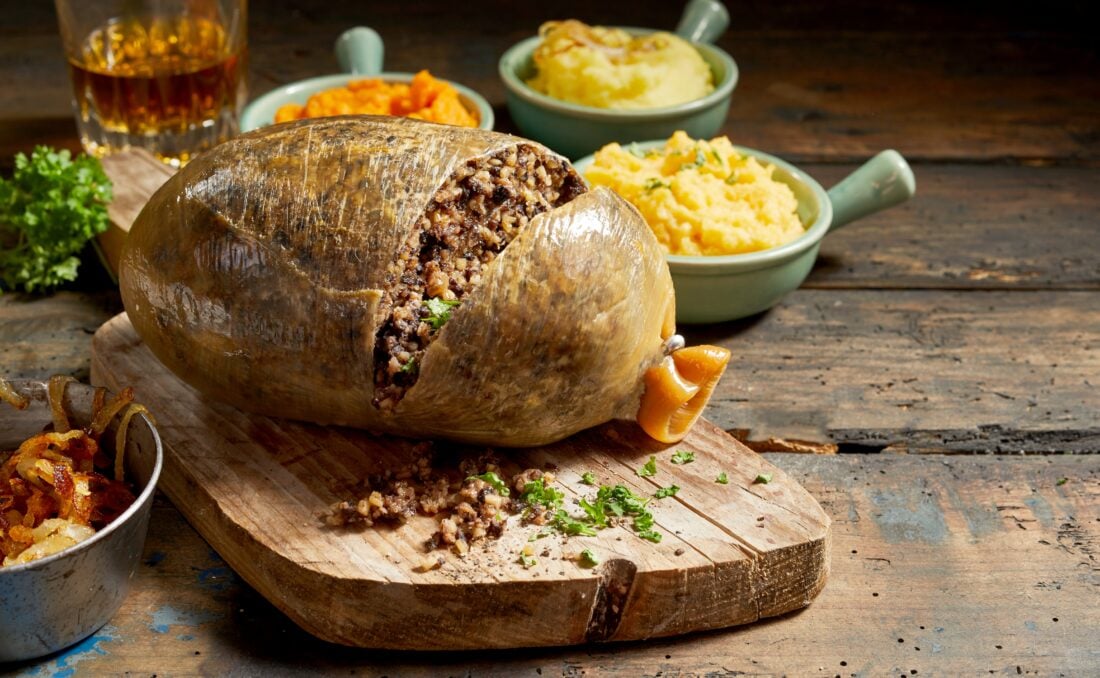
Haggis is Scotland’s national dish. It is made from sheep heart, liver, and lungs mixed with oatmeal and spices, traditionally cooked in a sheep’s stomach. It is typically served with neeps (turnip) and tatties (potatoes), particularly on Burns Night and St. Andrew’s Day. Haggis was banned in the United States for 50 years under USDA regulations; the ban was lifted in 2021.
What is Scotland’s national drink?
Scotch whisky is Scotland’s national drink. Production dates to the 11th century. Authentic Scotch whisky is made only in Scotland and must be aged in oak casks for a minimum of three years. Scotland has over 130 active distilleries, many offering tours and tastings.
During World War II, a cargo ship called SS Politician ran aground off Eriskay carrying 264,000 bottles of whisky. Locals hid bottles in haystacks, under floorboards, and even in coffins, a story that became Scottish legend.
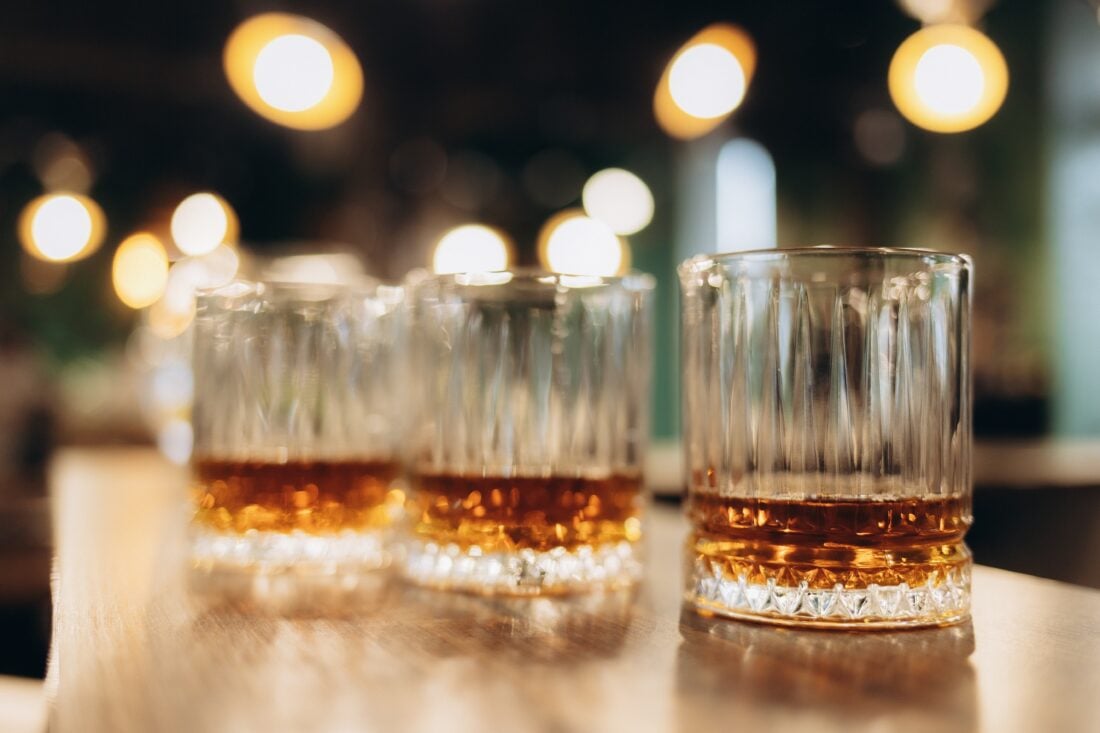
Scotch Whisky
Other iconic Scottish foods and drinks
- Scottish shortbread: A rich, buttery biscuit with origins in leftover bannock dough, popularized by Mary Queen of Scots and later Queen Victoria. Often packaged in red plaid tartan tins.
- Irn-Bru: A Scottish soft drink that has historically outsold Coca-Cola in Scotland.
- Scotch pie: A staple of Scottish football culture, with butchers closely guarding their individual recipes.
- Black Bun: A dense fruitcake eaten traditionally at Hogmanay (Scottish New Year).
- Dunlop cheese: Invented by Barbara Gilmour, one of Scotland’s notable food innovations.
Kilts, Tartan, and Scottish Fashion
Kilts and tartan are central to Scottish identity, with textile origins dating to the 3rd and 4th centuries. The modern kilt as recognized today was invented in 1727 by Thomas Rawlinson, an English Quaker. Following the Battle of Culloden, the British Government banned kilts and tartan in 1746; the ban was lifted in 1782. Tartan patterns are now regulated by the Scottish Register of Tartans, established in 2008.
Harris Tweed, woven in the Outer Hebrides, is another globally recognized Scottish fabric, known for warmth and durability.
Scottish wool more broadly is a valued commodity, with knitted sweaters and scarves among the most common Scotland-associated products.
Bagpipes, Music, and Dance
Bagpipes are the instrument most immediately associated with Scotland, particularly the Great Highland Bagpipes. Their exact geographic origin is debated, with roots traced to ancient Egypt and Rome, but their association with Scotland became firmly established in the 18th century. Bagpipes have deep ties to Scottish military history and are frequently paired with fiddles and folk songs.
Highland dancing is Scotland’s national dance. Ceilidh dancing is a participatory tradition featuring dances like the Gay Gordons and Strip the Willow, where swapping partners is standard.
The Royal Edinburgh Military Tattoo takes place annually at Edinburgh Castle, which sits on a dormant volcano, featuring international military bands, pipes, drums, stunt motorbikes, and fireworks.
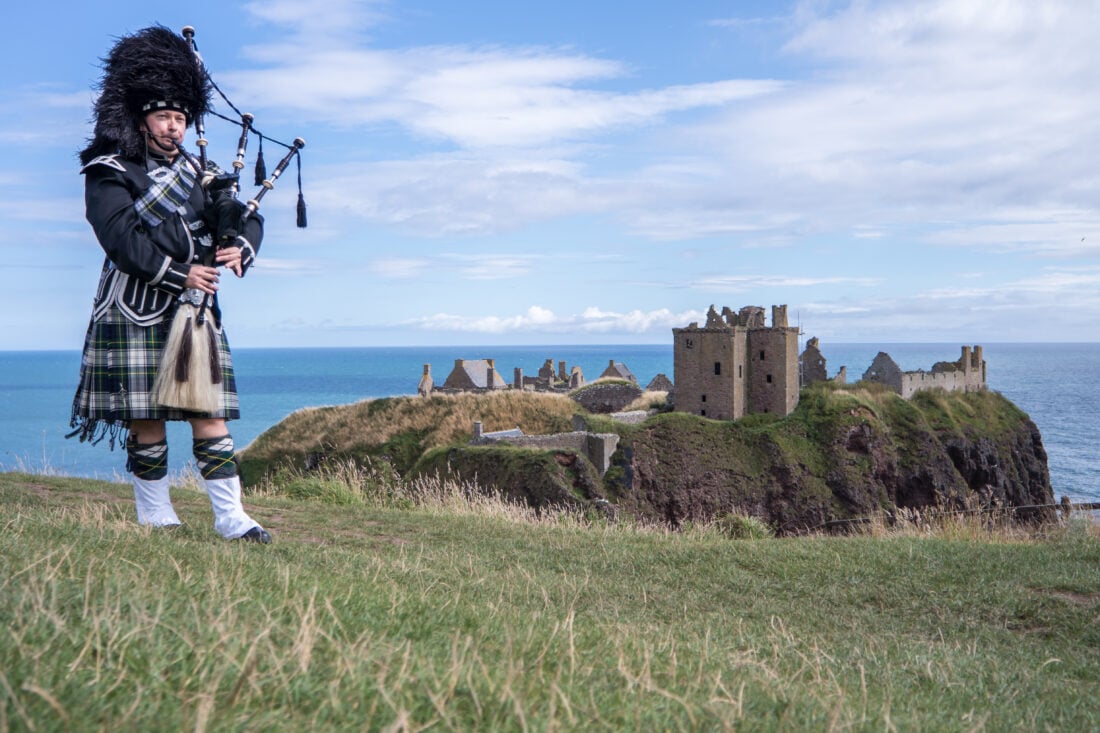
Bagpipes
Landscapes and Geography
The Scottish Highlands are described as Western Europe’s last true wilderness. The region is known for road trips, cycling, hiking, and dramatic scenery that honestly hits different in person. Travellers consistently single out Glencoe, Loch Lochy, and the Fairy Pools on Skye as genuinely transformative, the kind of places that make you rethink your entire trip itinerary. Scotland has over 30,000 freshwater lochs, with Loch Ness the most internationally famous.
Ben Nevis is Scotland’s highest mountain. The country also contains two national parks and 282 Munros. Scotland is home to Europe’s first Dark Sky Town. The weather is, predictably, the one universal grumble, with rain showing up whether you packed for it or not (currently sitting at 79°F with broken clouds, as of April 2026, which is honestly unusually warm).
Scottish beaches, including Luskentyre on Harris, have white Caribbean-style sand, with considerably colder water temperatures. If you’re planning to explore the coastline, our west coast Scotland guide covers what to see and practical tips for getting around.
The Old Man of Hoy is a sea stack on Orkney, formed in 1817 and popular with climbers.
Castles and History
Scotland historically had over 3,000 castles. Notable examples include Stirling Castle, Bothwell Castle, and Crookston Castle near Glasgow. Edinburgh Castle is a historic icon associated with numerous conflicts and reports more paranormal incidents than the entire Tower of London. Ghost tours in Scotland sell out faster than whisky tastings.
Mary King’s Close in Edinburgh was sealed during the Black Death and rediscovered in the 1990s; it is now a tourist attraction.
Key historical documents include the Declaration of Arbroath (1320), Scotland’s declaration of independence.
From 1563 to 1736, Scotland executed approximately 2,500 people during the witch hunts. In 2022, Scotland issued official apologies and full pardons.
Scottish Folklore and Mythology
- The Loch Ness Monster (Nessie): The legend traces back to sightings reportedly dating to 565 AD. The famous photograph that sparked modern interest was taken in 1934 and later confirmed as a hoax, but Nessie remains a major tourism draw.
- Kelpies: Legendary water horses from Scottish folklore said to lure riders onto their backs before dragging them underwater. The Kelpies sculptures in Falkirk commemorate this myth.
- The Fairy Flag of Dunvegan: A legendary artifact said to have saved the MacLeod Clan of Skye three times.
- Sawney Bean: An alleged cannibal clan leader whose story historians still debate as either historical fact or political fabrication.
Scottish Inventions and Innovations
Scotland has a remarkable record of invention. Verified Scottish innovations include:
- The telephone – Alexander Graham Bell
- Television – John Logie Baird demonstrated the world’s first live working television system in 1926
- Penicillin – Alexander Fleming
- The Falkirk Wheel – the only rotating boat lift in the world, connecting two canals
- The Glasgow Tower – holds a Guinness World Record as the tallest fully rotating freestanding structure
- “The Wealth of Nations” – Adam Smith wrote the foundational text of modern capitalism while in Kirkcaldy, Scotland
VisitScotland records at least 101 Scottish inventions in total.
Golf in Scotland
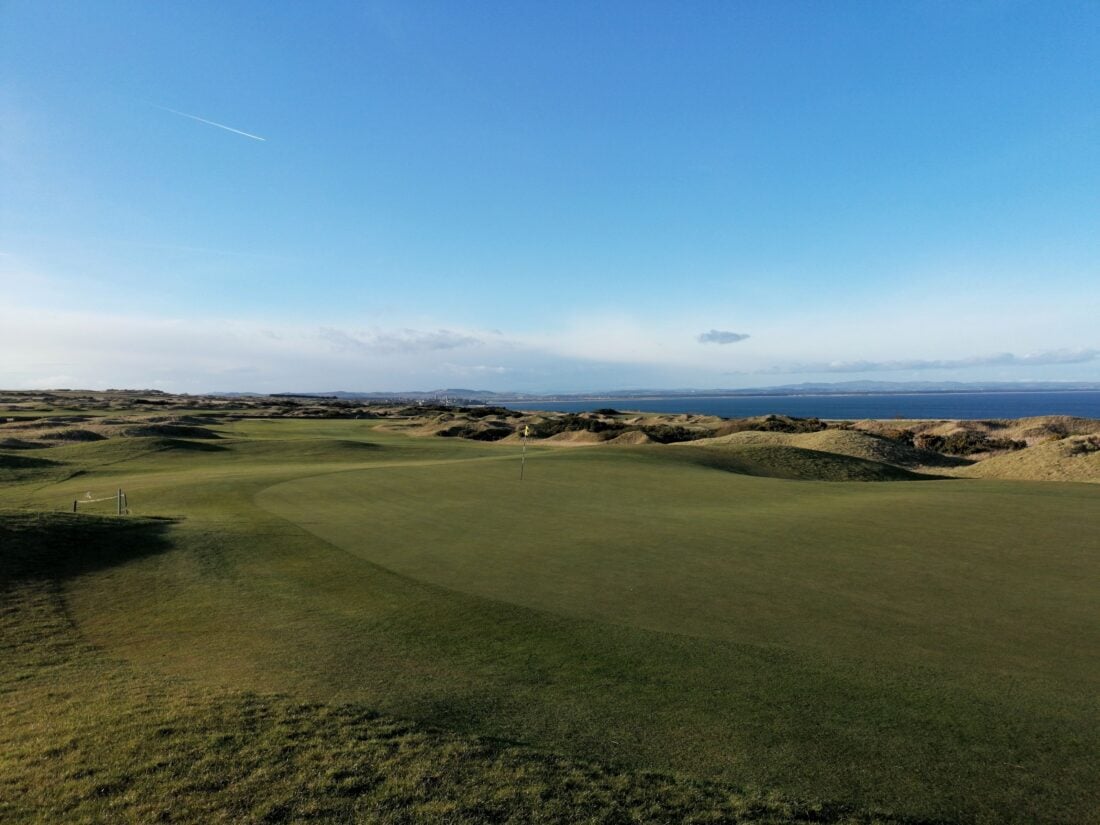
Golf originated in Scotland in the 1400s, played along the east coast near royal properties. King James IV officially endorsed the sport in 1502. St Andrews built the first 18-hole golf course in 1764, setting the global standard. Scotland attempted to ban golf in 1457, 1471, and 1491 to keep men focused on archery practice, none of the bans stuck. If you’re visiting St Andrews, you can join one of the Guided Walks of the Old Course running through spring 2026, which take you right through the historic clubhouse grounds.
Highland Games and Traditions
The Highland Games originated in the 11th century and feature events like the caber toss and hammer throw. Up Helly Aa is a fire festival held each January in Shetland, celebrating Viking heritage with the burning of a longship.
Burns Night is an annual celebration of Scotland’s national poet Robert Burns.
Hogmanay (Scottish New Year) is marked by traditions including the eating of Black Bun.
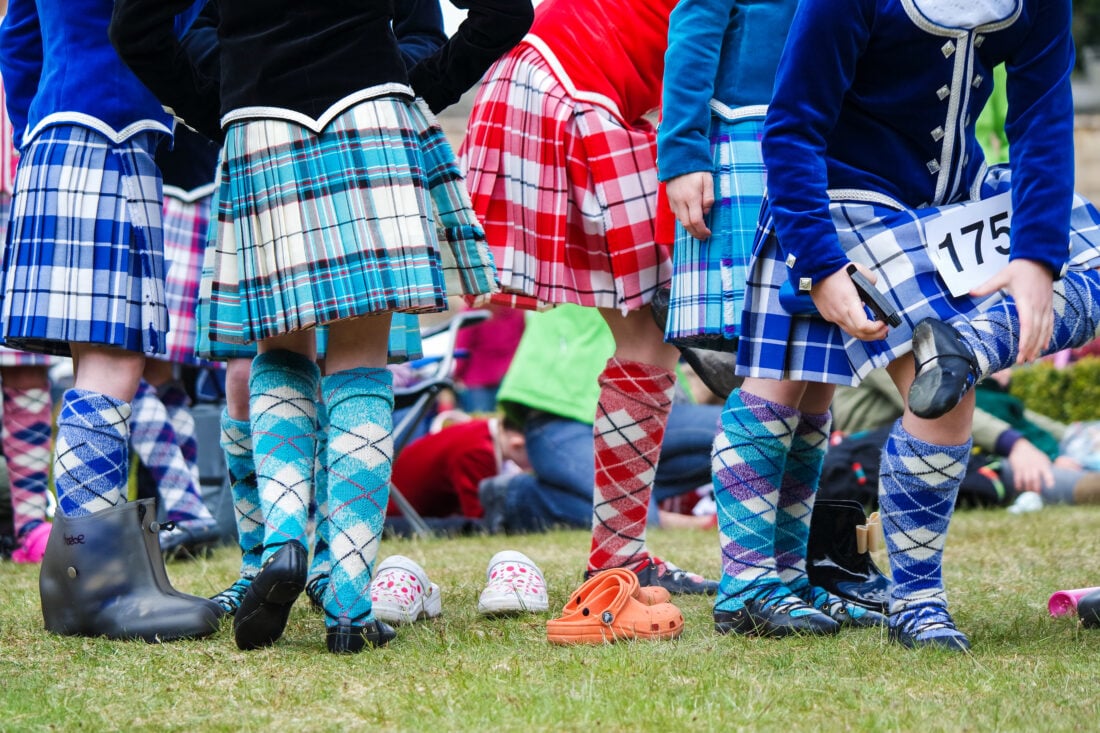
Highland Games
Scottish Language and Culture
Scottish Gaelic (Gàidhlig) is spoken by around 70,000 Scots. The language has shaped place names, music, and arts across Scotland and features in popular culture including the TV series Outlander. Turns out, the show has had a massive impact on tourism too, with Outlander filming locations across Scotland pulling in visitors from all over the world.
The Edinburgh Fringe is the largest arts marketplace on Earth, launching unknown performers to international recognition.
J.K. Rowling began writing Harry Potter in Edinburgh, with local sites including Greyfriars Kirkyard and George Heriot’s School influencing the books. Edinburgh has become a significant Harry Potter tourism destination as a result.
The University of Edinburgh, founded in 1582, is one of the world’s leading research institutions.
Frequently Asked Questions
What is the national animal of Scotland?
The unicorn is Scotland’s national animal. It has appeared on the royal coat of arms since the 12th century.
What food is most associated with Scotland?
Haggis is Scotland’s national dish, sheep offal mixed with oatmeal and spices, traditionally served with neeps and tatties. Scotch whisky, shortbread, Irn-Bru, and Scotch pie are also strongly associated with Scottish food culture.
What are Scotland’s national symbols?
Scotland’s main national symbols include the Saltire flag, the Lion Rampant, the thistle (floral emblem), the unicorn (national animal), the Scots Pine (national tree), the Scottish Terrier (national dog), and the motto “Nemo me impune lacessit.”
Did Scotland invent golf?
Yes. Golf originated in Scotland in the 1400s along the east coast. St Andrews established the first 18-hole golf course in 1764, and the sport’s rules were first formally set in 1744.
