This Bolivia travel guide covers the big three stops most travellers string together: La Paz, the Uyuni salt flats and Copacabana on Lake Titicaca. Add in Death Road, a handful of high-altitude days and a currency that changed in 2026, and there’s a bit to plan. The good news? It’s one of the most rewarding countries we’ve visited.
Bolivia at a glance (checked October 2026):
- Visa: UK and US passport holders can visit visa-free for up to 90 days. The US visa requirement was dropped on 1 December 2025.
- Currency: the boliviano (Bs). It stopped being pegged at 6.96 to the US dollar on 29 June 2026 and now floats, so check the rate before you go.
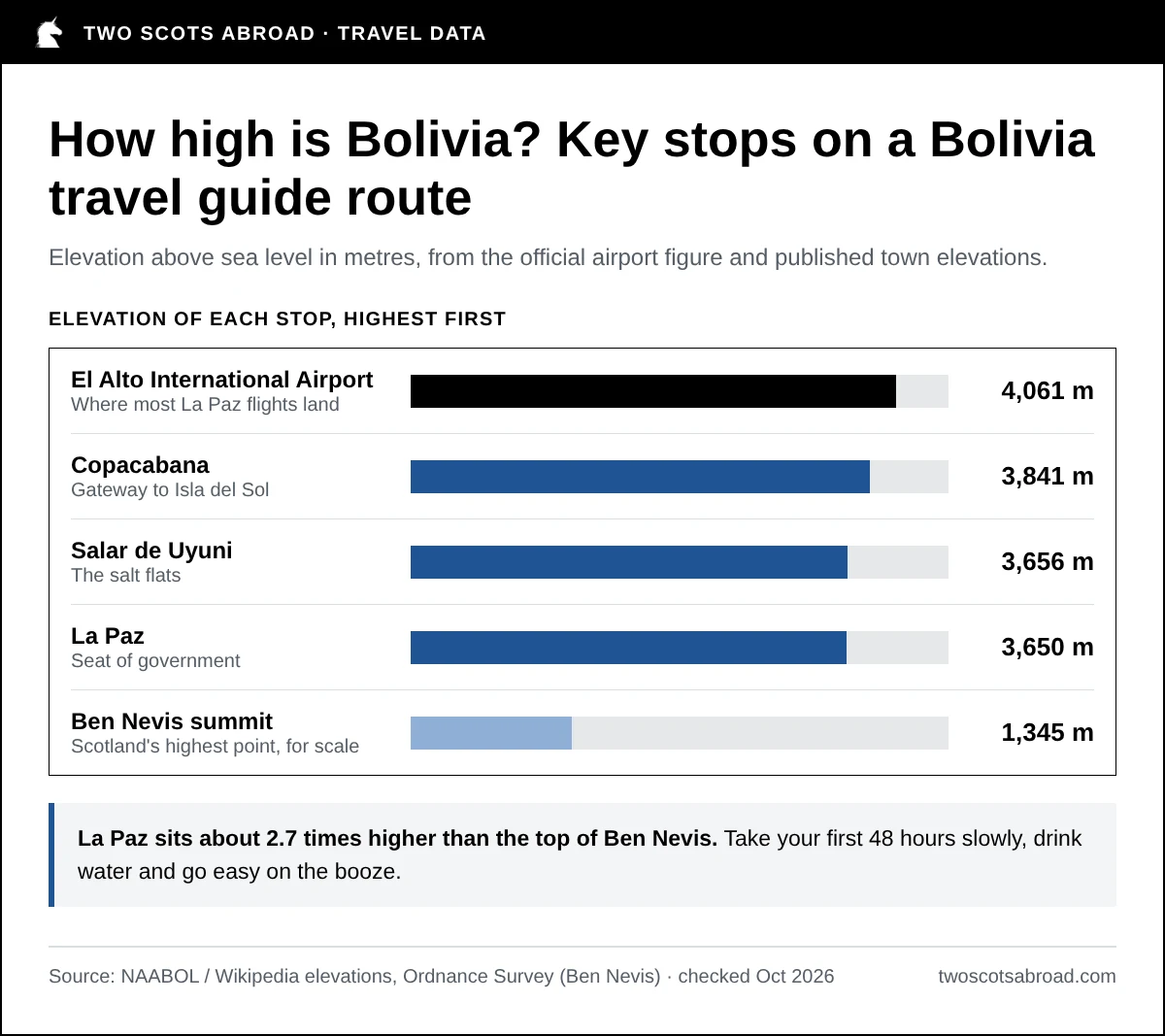
- Altitude: La Paz sits at about 3,650 m, Uyuni’s salt flat at about 3,656 m and Copacabana at about 3,841 m.
- Capital: Sucre is the constitutional capital, but La Paz is the seat of government.
- Biggest risk to your plans: road blockades, which can close routes (even to airports) at short notice.
La Paz
What to do in Bolivia’s capital
Strictly speaking, La Paz is Bolivia’s seat of government, while Sucre is the constitutional capital.
Where to sleep in La Paz, in peace 😉
Cycle Death Road – yes, the one on Top Gear!
Most flights land at El Alto International Airport, which sits at 4,061 m, higher than the city itself. Don’t plan a big day straight off the plane. Death Road (the North Yungas Road) drops around 3,500 m over its 64 km, from the cold high pass down into the warm Yungas, so pack layers.

Uyuni / Salt Flats
Salar de Uyuni, aka Bolivia’s Salt Flats, remains one of the highlights of our 17-month career break to travel around the Americas and Europe.
Salar de Uyuni is the world’s largest salt flat, and as there is no horizon there are plenty of opportunities to take silly photos of dinosaurs chasing you!
It’s honestly the most fun you can have with wellies on! Stick around until sunset to snap the day slip away in blues, yellows, oranges, and reds.
For scale, it covers around 10,582 km² at roughly 3,656 m above sea level. It’s driest from April to November; rain arrives in the southern summer (January is the wettest month), and that thin layer of water is what creates the famous mirror effect. Curious how it stacks up against the rest? Here’s our guide to the world’s largest salt flats.

Copacabana
A stopover in Copacabana may come first or last on your Bolivian itinerary, depending on if you are entering or leaving Bolivia.
This stop, which is the gateway to the stunning Isla del Sol, is on the way to Peru (or on the way to Bolivia from Peru). You can even spend a night on the island!
Two things before you hop on the boat. There are no ATMs on Isla del Sol, so take enough small notes for the village entry tickets, food and a bed. And access to the north of the island has been restricted on and off in recent years, so ask in Copacabana which parts are open before you plan a full north to south hike.
Travel from Peru to Bolivia or vice versa with Bolivia Hop. Here’s our review.
Want more of the lake? On the Peruvian side we stayed with a family on Taquile, which you can read about in our Lake Titicaca homestay review.

Altitude in Bolivia
Every stop above sits more than twice as high as the top of Ben Nevis. GOV.UK flags altitude sickness as a risk in La Paz and on the Salar de Uyuni, so take your first 48 hours slowly, drink plenty of water and read the TravelHealthPro altitude illness factsheet before you go.
Bolivia Entry Requirements
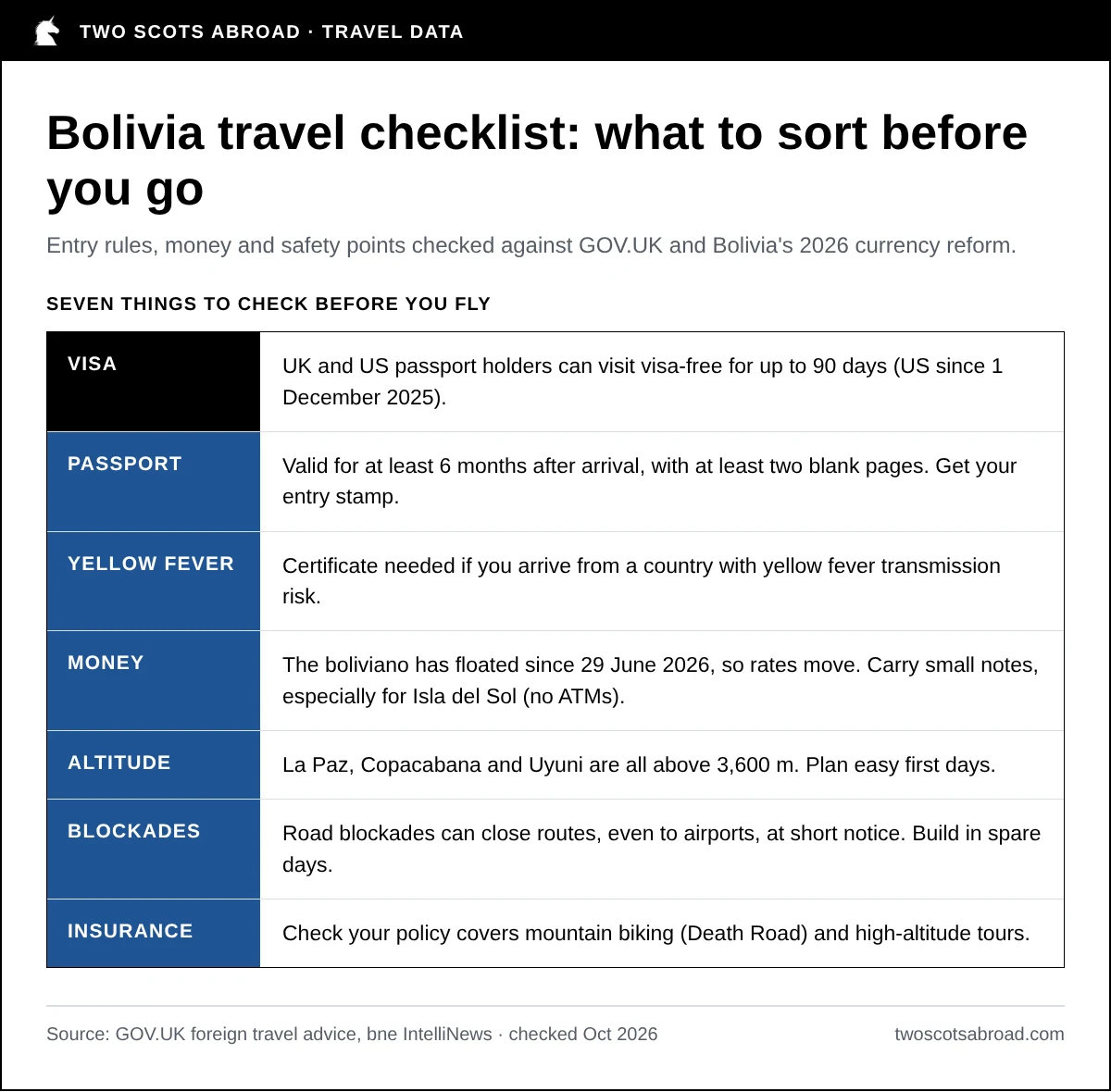
British citizens don’t need a visa for a tourist trip and can stay up to 90 days in any one year, according to the GOV.UK entry requirements for Bolivia. Border officials sometimes stamp 30 days, but that still covers the full 90.
Your passport should be valid for at least 6 months after you arrive and have two blank pages. Make sure you get an entry stamp (you’ll be fined on the way out without one), and carry a yellow fever certificate if you’re arriving from a country with yellow fever risk.
US travellers, good news: Bolivia scrapped its tourist visa for Americans on 1 December 2025, so a valid passport now gets you up to 90 days. Other nationalities should check with the Bolivian embassy before booking.
How Much Does Bolivia Cost?
For help planning your own daily budget for Bolivia see this post
Bolivian boliviano is the currency used in Bolivia, for the best rates, check out this link. ATMs are widely available in La Paz and Sucre. Less so in the town of Uyuni but there is at least one. Credit cards are often accepted in the bigger cities.
Heads up: prices in pounds or dollars are harder to pin down than they used to be. Bolivia ended its 15-year peg of 6.96 Bs to the dollar on 29 June 2026, and the new market-based rate started at 9.73 Bs. It has kept moving since, and cash, card and ATM rates don’t always match. Compare the total you pay after fees, and if a card machine offers to charge you in pounds, say no.
Tipping in Bolivia is not essential but appreciated.

Is Bolivia Safe to Visit?
Yes, for most trips, but it pays to be flexible. The GOV.UK safety advice for Bolivia warns that protests and road blockades can start with little notice and disrupt transport, including roads to airports, and that fuel shortages have hit some areas. Never try to cross a blockade, and leave a spare day before any flight home.
In the cities, use radio taxis or established companies rather than flagging one down, and don’t get into a taxi that already has passengers. There are no official minimum standards for salt flat tour operators, so go with a reputable company and check the jeeps and the driver.
Doing Death Road? Check the bikes, make sure your guide carries a first aid kit, and confirm your insurance covers mountain biking. Our comparison of backpacker travel insurance is a good place to start.
Best Time to Visit Bolivia
For dry roads, clear skies and easier tours, aim for roughly April to November, when rain on the Altiplano is low (nights at altitude are properly cold, mind). Come in the wet season around January if you’re chasing the Uyuni mirror, but expect some tours and roads to be affected by rain.
Useful Travel Guides
Bolivia’s hop on / off bus service for backpackers, ran by two canny Irish lads and local tour guides!
Learn Spanish before you go.
Heading on to Peru? Here’s our Peru itinerary with routes and transport.
Bolivia Travel FAQs
Do I need a visa for Bolivia?
Not if you hold a UK or US passport. Both can visit Bolivia visa-free for up to 90 days; the US requirement was removed on 1 December 2025.
What is the capital of Bolivia?
Sucre is Bolivia’s constitutional capital, while La Paz is the seat of government, home to the presidential palace and the national legislature.
Can you use US dollars in Bolivia?
Bolivianos are what you need for day to day spending. Since the peg ended on 29 June 2026 the exchange rate moves daily, so compare cash, card and ATM costs and carry small boliviano notes for places like Isla del Sol.
How high is La Paz?
La Paz is about 3,650 m above sea level, and its El Alto airport is 4,061 m, making it the world’s highest international airport. That’s roughly 2.7 times the height of Ben Nevis.
How many days do you need in Bolivia?
We’d plan on at least 10 days to cover La Paz, Death Road, a salt flats tour from Uyuni and Copacabana with Isla del Sol at a sensible pace for the altitude, plus a spare day in case of blockades.
