
This article has links to products and services we love, which we may make commission from.
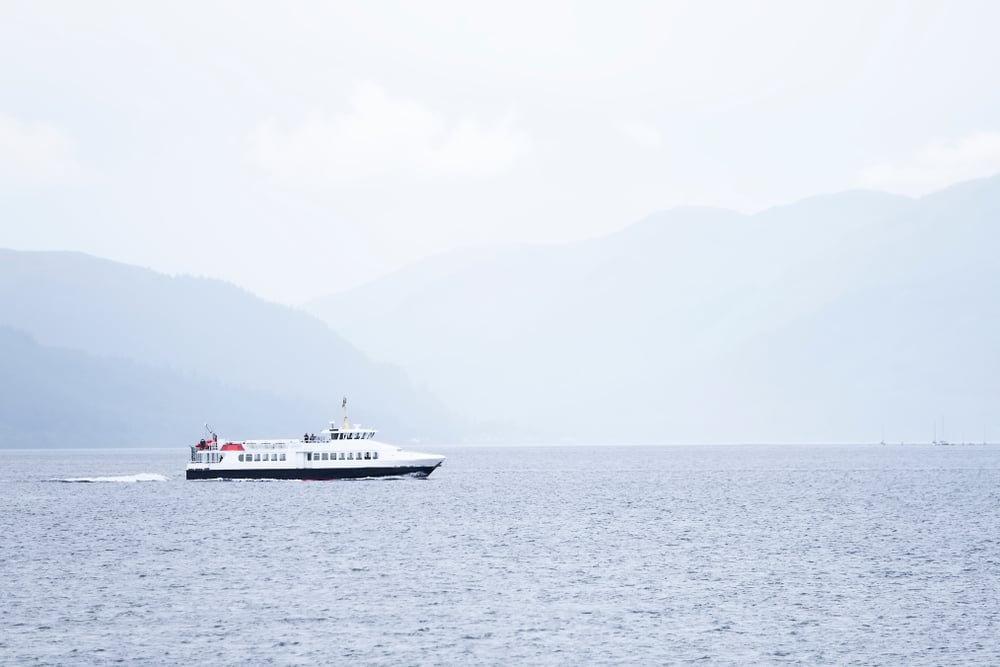
I once stood on a ferry deck somewhere off the west coast, rain horizontal, a soggy cheese toastie in hand, thinking: this is absolutely worth it. That was the Mull crossing. I was right, for once.
Scotland has close to 800 islands. Fewer than 100 are inhabited. Deciding which ones to actually visit can feel genuinely overwhelming, especially if you’ve spent three weeks building a spreadsheet of options like I definitely did not do (I did). This guide cuts through the noise and covers the best Scottish islands to visit based on what each one actually does well. Interest in Scottish island travel has been climbing steadily, with searches peaking in the early months of the year, so if you’re planning a spring trip you’re in good company.
Quick Answer: Which Scottish Islands Should You Visit?
| Island | Best For | How to Get There |
|---|---|---|
| Isle of Skye | Scenery, photography, hiking | Bridge from mainland |
| Orkney | Prehistoric history, WWII sites | Ferry from John O’Groats; flights |
| Islay | Whisky, wildlife | Ferry or flight |
| Mull + Iona | Coastal scenery, religious history | Ferry from Oban (50 min) |
| Harris (Outer Hebrides) | Beaches, Harris Tweed | Ferry from Skye or via Stornoway |
| Arran | Everything, honestly | Ferry, accessible by public transport |
| Staffa | Puffins, Fingal’s Cave | Boat from Mull |
| Isle of Bute | History, architecture | Ferry, Firth of Clyde |
Ferry services to the western islands are mostly run by Caledonian MacBrayne (CalMac). For Orkney and Shetland, NorthLink Ferries handles the northern routes. Book ahead, especially in summer.
Isle of Skye: Stunning, Busy, and Still Worth It
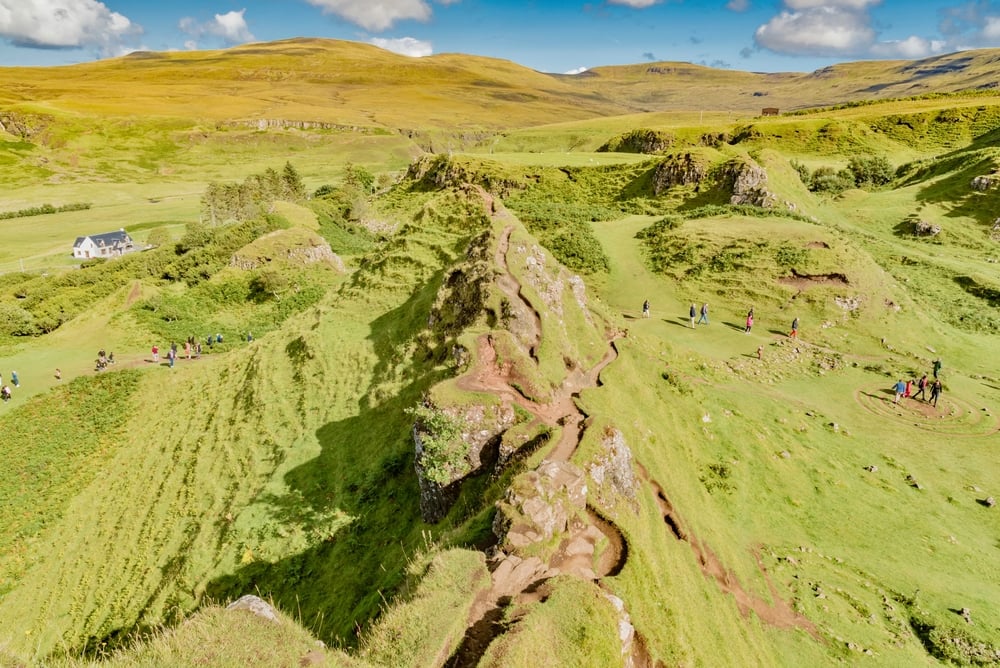
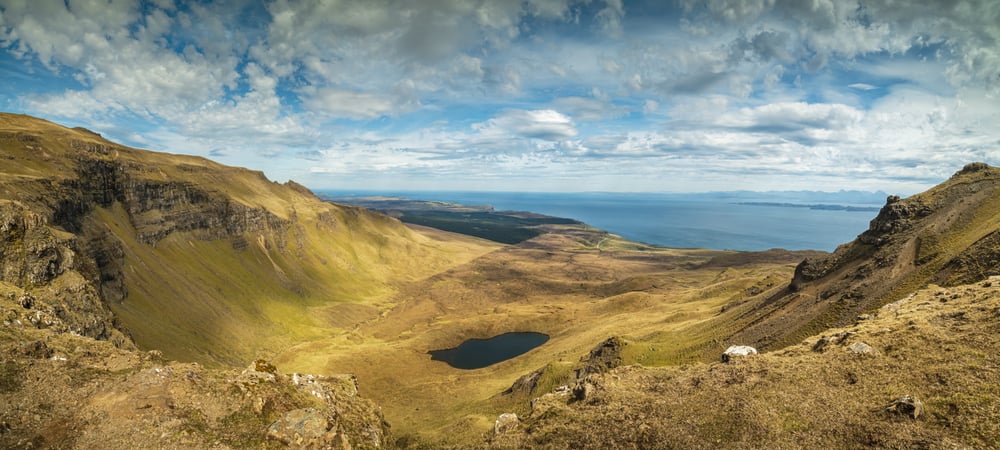
Skye is Scotland’s most visited island, and it earns that status even if the car parks don’t. The Cuillin mountains, the Quiraing, the Old Man of Storr, Neist Point Lighthouse … the landscapes here are genuinely dramatic in a way that photographs cannot fully prepare you for.
Portree is the main town and a reasonable base. The Trotternish Peninsula is the scenic drive you want, with coastal cliffs dropping into the sea and the volcanic rock formation nicknamed Kilt Rock (the lava columns look like kilt pleats, which is either charming or a stretch depending on your mood). The Sligachan Bridge and surrounding Cuillin views are worth the stop.
Skye has also appeared in a handful of films including Stardust, Transformers: The Last Knight, and Snow White and the Huntsman, which explains why certain viewpoints now resemble a photography queue.
The downsides are real: you need a car, it gets congested in summer, and it costs more than you’d expect. Visit in spring or autumn if you can. The bridge makes it accessible from the mainland, which is convenient and also partly why it’s so busy. If you’re combining Skye with time on the mainland, our guide to where to stay in the Scottish Highlands covers nearby bases.
Orkney: Older Than the Pyramids and Oddly Relaxed About It
Orkney is the one that surprises people most, myself included. I expected a remote, bleak outpost. What I got was an archipelago of over 70 islands (around 20 inhabited) with some of the best-preserved prehistoric sites in northern Europe, decent coffee, and no traffic lights.
Skara Brae is a Neolithic village uncovered by a storm in 1850 and still standing. Maeshowe is a 5,000-year-old burial mound with a winter solstice alignment, and you need to book a 30-minute tour in advance. The Ring of Brodgar and Stones of Stenness round out a prehistoric landscape that genuinely makes you reconsider the scale of human history.
Orkney also has significant WWII history. Scapa Flow was a major wartime harbour, and the Churchill Barriers were built to protect it from submarines. Near the first barrier, Italian POWs constructed the Italian Chapel, which is one of those things you see and immediately want to tell someone about.
St. Magnus Cathedral in Kirkwall is worth an hour of your time. Kirkwall itself is the main base for visitors and easy to navigate by car or bike. The ferry lands at Stromness. Orkney Ferries connects 13 island destinations within the archipelago.
The cultural feel here is more Nordic than Celtic, which makes sense given the history. It’s distinct from anywhere else in Scotland.
Islay: Nine Distilleries on One Island, Which Is Either Impressive or a Problem

Islay (pronounced eye-la, not iz-lay, and I said it wrong for an embarrassingly long time) is the southernmost of the Inner Hebrides and holds the title Queen of the Hebrides. It has around 3,000 inhabitants and nine working distilleries producing some of the world’s most distinctive peaty whisky. Ardbeg, Laphroaig, Bowmore, Bunnahabhain: if those names mean anything to you, Islay is your island. Whisky is, honestly, one of the highlights of Scottish food and drink culture and Islay is where you experience it at its most concentrated.
Beyond whisky, Islay has golden eagles, grey seals, and evidence of prehistoric settlers going back around 10,000 BC, documented at the Museum of Islay Life. You get there by ferry or flight, and renting a car on the island is strongly recommended. From Islay, you can also reach Jura and Colonsay.
Mull, Iona, and Staffa: Three Islands, One Trip
This combination is the classic west coast run and it works well. Mull is a 50-minute ferry from Oban and gives you access to Iona, Staffa, the Treshnish Isles, and the Isle of Ulva.
Mull itself has wildlife, coastal scenery, silver-sand beaches, lochs, rivers, and waterfalls. Duart Castle and Calgary Bay are highlights. It’s often recommended for people who aren’t specifically after whisky (that’s Islay’s territory) but want a full outdoor island experience.
Iona is tiny, roughly three miles long with about 150 residents, and no visitor cars are allowed. Iona Abbey marks where Christianity first arrived in Scotland. The landscape is stark and the atmosphere is quiet in a way that feels deliberate rather than empty.
Staffa is where you go for Fingal’s Cave, the basalt rock formation that inspired Mendelssohn’s Hebrides Overture. It’s also a puffin colony, which is reason enough. Most people visit Staffa on a boat trip from Mull rather than staying.
West Coast Tours runs daily excursions covering Mull, Iona, and Staffa. Taking an early ferry to Iona helps with the crowds.
Harris (Outer Hebrides): Scotland’s Best Beaches, Full Stop
The Outer Hebrides is a 130-mile archipelago of around 220 islands, 15 of them inhabited. Harris is the part most people have seen in photographs without realising it: white sand, turquoise water, the kind of beach you’d associate with somewhere considerably warmer.
One writer who’s visited beaches across California, New Zealand, Brazil, and the Caribbean said Harris’s best beaches are as good as any of them. That’s a claim. Having been there, I don’t think it’s wrong. If you’re the type who collects stunning island destinations, Harris absolutely belongs on your list.
Harris is also where Harris Tweed is made, if you’re into textiles. The Callanish Standing Stones on the neighbouring Isle of Lewis are over 5,000 years old and genuinely impressive at scale. The wider Outer Hebrides includes North Uist (more water than land), South Uist (home to the Bronze Age-Iron Age Cladh Hallan Roundhouse), and Berneray with its rocky bays and white beaches.
Getting to Harris takes effort, ferry from Skye or arriving via Stornoway on Lewis. That’s part of why it still feels like somewhere rather than a day trip destination.
Isle of Arran: Scotland in Miniature (and That’s Not a Slight)
Arran gets called Scotland in miniature a lot, and it’s accurate. You get mountain peaks, beaches, coastline, forests, culture, and local produce all on one island. It’s accessible by public transport from the mainland, which makes it unusual among the bigger islands.
Activities include hill walking, golf, biking, and paragliding. The Machrie Moor Standing Stones add a prehistoric dimension. Arran is particularly good for self-driving or campervan trips, and the tourist infrastructure is stronger here than on most Scottish islands, which is either a plus or a minus depending on what you’re after.
Isle of Bute: The One People Overlook
Bute sits in the Firth of Clyde and has a medieval castle, a restored set of Victorian toilets that have become a minor attraction, and Mount Stuart, a neo-Gothic mansion with a Marble Hall and formal gardens. The port town of Rothesay is the focal point. It’s not as dramatic as Skye or as historically loaded as Orkney, but it’s an easy and underrated day or weekend trip. If you’re basing yourself in Glasgow, it’s a quick hop. Our Glasgow travel guide has more on using the city as a launch pad for west coast trips.
Practical Tips for Visiting the Scottish Islands
- Book ferries early. CalMac routes fill up fast in summer, especially if you’re taking a car. Check in online and keep your confirmation number handy.
- Visit off-peak. Spring and autumn give you better prices, fewer crowds, and the same landscapes. Search interest peaks in January through March, so planning early is smart.
- Focus on one island or group per trip. Trying to cover too much means you cover nothing properly.
- Bring layers and waterproofs. This is not optional. Scottish island weather is variable in a way that means all four seasons in one afternoon.
- Drive carefully on single-track roads. Passing places exist for a reason. Use them.
- Spend locally. Book tours with local operators, buy food from local shops. The island economies depend on it more than you’d think.
- For Iona: no visitor cars allowed. Go early to avoid the crowds.
- For Orkney inter-island travel: Orkney Ferries connects 13 destinations. Flights connect Kirkwall with several outer islands including North Ronaldsay and Papa Westray.
- For Outer Hebrides: inter-island flights run between Benbecula and Stornoway.
Which Scottish Island Should You Actually Choose?
If you want scenery and don’t mind sharing it: Skye. If history is your thing: Orkney, no question. Whisky: Islay. Beaches that will genuinely surprise you: Harris. A manageable first Scottish island trip: Arran. A three-island run that punches above its weight: Mull, Iona, and Staffa out of Oban.
The honest answer is that most of them are worth it. Scotland has close to 800 islands and fewer than 100 are inhabited, which means the ones people do visit have usually earned the attention. Past-me would have tried to visit six islands in a week and come back exhausted having seen none of them properly. Don’t do that.